
Wear a speedsuit or fitted crop-and-tights for sprints and hurdles, a featherweight singlet with split shorts or half-tights for 800m and up, and a roomier cut with event-specific footwear for jumps and throws. Every event group solves a different physical problem — drag, heat, or range of motion — and the kit follows.
Walk the call room at any major championship and you can guess an athlete’s event before you see their bib: second-skin speedsuits on the sprinters, singlets that barely register on a scale for the distance field, kit built for rotation on the throwers. This guide breaks down what to wear for each discipline, what the fabric technology does, and how the pros approach race-day kit — so whether you are racing this season or building a collection of athlete-issue pieces, you know exactly what belongs to each event.
Key facts · Verified · updated August 2026
- Sprints & hurdles
- The problem is drag — speedsuit or crop-and-tights
- 800m and up
- The problem is heat — featherweight singlet
- Field events
- The problem is range of motion — roomier cut
- AeroSwift
- Introduced March 2016; Vapor kits wind-tunnel-tested for Rio
- The honest number
- Nike never published a drag-reduction % — distrust quotes
- Race-vest weight
- 40–70 g at the true race tier
- Weather
- The warm-up layer is part of the kit
- Same map, two uses
- Racing this season or collecting by event — kit belongs to its discipline
Sprints (100m–400m and hurdles): tight kit, minimal drag
Sprint events are decided by hundredths of a second, so sprint kit has one obsession: eliminating anything that flaps, drags, or weighs. The traditional answer is the speedsuit — a one-piece or two-piece compression-fit kit that sits flush against the body — or a tight crop-and-shorts combination cut from the same stretch fabric.
The engineering behind modern sprint kit is serious. Nike introduced AeroSwift in March 2016 as its lightweight speed-apparel technology, built around a simple principle: eliminating excess material to keep weight to a minimum. The 2016 Vapor track and field kits combined a four-way stretch knit made with recycled polyester, breathable engineered mesh, and small “AeroBlade” elements positioned through hundreds of hours of wind-tunnel testing — which Nike described as delivering the greatest drag reduction of any of its track and field kits to that date. Federation teams including the USA, Brazil, Germany and China wore those kits at the Rio Games.
Nike has never published a percentage figure for that drag reduction, so treat any number you see quoted as invented. What is verifiable is the design logic: tight, seamless-feeling construction, stretch knit that moves with maximal hip and shoulder drive, and ventilation engineered directly into the fabric rather than added afterward.
Typical sprint race kit: speedsuit or fitted crop top with bun huggers/short tights, and sprint spikes — which use a stiff, full-length plate that pushes you onto your toes, around seven to ten pin positions, and little to no heel cushioning.
Middle and long distance (800m and up): the singlet rules
From 800m to 10,000m, aerodynamics matters less and heat management matters far more. A distance race is a prolonged thermal event, and the classic answer — a racing singlet with split shorts or half-tights — has survived decades of innovation because it works.
The fabric science is worth understanding. Elite racing singlets are typically around 85–90% polyester (often recycled) blended with roughly 10–14% elastane. According to the American Chemical Society, polyester is hydrophobic — its moisture regain is about 0.4%, meaning sweat is not absorbed into the fiber itself. Instead, capillary action through the fabric’s micropores pulls moisture to the surface, where it evaporates and cools you. Cotton does the opposite: it absorbs sweat and holds it against your skin, which is why no serious racer wears cotton on the start line.
Ventilation in top-tier kit is built into the knit itself. AeroSwift-era construction uses single knit where breathability is needed, double knit where structure is needed, and true holes constructed directly in the fabric — engineered knit ventilation rather than cut-outs. Body-mapping is now industry-wide: Nike’s Dri-FIT ADV tier uses sweat and heat-zone data from its Sports Research Lab to engineer material zone by zone, adidas builds perforated panels into its adizero racing singlets, and ASICS body-maps ventilation on its METARUN singlet. adidas splits its own system into AEROREADY, its core sweat-wicking fabric technology, and HEAT.RDY, a hot-conditions tier combining lightweight fabrics with enhanced airflow.
And the weight? Genuine race vests come in at roughly 40 to 70 grams for current elite models. If a “racing singlet” feels like a training tee, it probably is one.
Typical distance race kit: lightweight singlet with split shorts (maximum stride freedom) or half-tights (compression and no ride-up), plus distance spikes — the most flexible plate on the track, the most midsole cushioning, and around four to six pins. Middle-distance spikes sit between the two, with a semi-aggressive half- to three-quarter-length plate.
Field events: mobility over aerodynamics
Field athletes are not fighting air resistance for 10 seconds or managing heat for 30 minutes — they are producing a handful of maximal efforts with long recoveries in between. Kit priorities shift accordingly.
Jumps (long, triple, high, pole vault)
Jumpers need total freedom through the hips and shoulders at takeoff, so most compete in the same singlet-and-shorts or crop-and-brief kit as runners, fitted closely enough that nothing interferes with rotation or landing. Footwear is event-specific: high jump shoes, for example, carry spikes in both the heel and forefoot to grip through the curved approach and the plant, on a stiff plate.
Throws (shot, discus, hammer, javelin)
Throwers prioritize range of motion above everything — a discus turn or javelin crossover demands unrestricted movement through the shoulders, torso and hips, so throws kit tends to be cut more generously than sprint kit while still using the same wicking fabrics. Because throwers spend long competitions mostly waiting between attempts, staying warm between rounds matters as much as the kit underneath. Footwear diverges completely: rotational throws use smooth-soled shoes with no spikes at all, while javelin throwers wear heavier boot-style shoes with ankle support and spikes at heel and toe.
Event-by-event kit table
| Event group | Typical competition kit | Footwear |
|---|---|---|
| Sprints & hurdles (100–400m) | Speedsuit, or fitted crop + short tights | Sprint spikes: stiff full-length plate, ~7–10 pins |
| Middle distance (800–3,000m) | Singlet + split shorts or half-tights | Mid-distance spikes: half–¾ plate, ~6–8 pins |
| Long distance (3,000m+) | Ultra-light singlet + split shorts | Distance spikes: flexible plate, most cushioning, ~4–6 pins |
| Jumps | Singlet/crop + shorts or briefs, close fit | Event-specific; high jump shoes spike heel and forefoot |
| Rotational throws | Roomier singlet/tee + shorts, full range of motion | Smooth-soled throwing shoes, no spikes |
| Javelin | Fitted kit with free shoulder movement | Boot-style shoes, ankle support, heel + toe spikes |
Three problems, three wardrobes
Every event group is solving a different physical problem — read the problem and the kit chooses itself.
Data table — three problems, three wardrobes
| Event group | The problem | The kit |
|---|---|---|
| Sprints & hurdles | Drag | Speedsuit, or crop-and-tights in the same stretch knit |
| 800m and up | Heat | Featherweight singlet with split shorts or half-tights |
| Field events | Range of motion | Roomier cut, event-specific footwear |
The drag–heat–mobility framing per this guide’s sources, including Nike’s AeroSwift/Vapor material on wind-tunnel-tested sprint kit. Nike has never published a drag-reduction percentage.
Weather adaptations: the warm-up layer is part of the kit
Race kit is deliberately minimal, so it offers almost no protection before the gun. That is what the rest of the system is for.
- Cold or wet meets: a full national-team-style tracksuit over race kit until the last possible moment. This is exactly the role federation tracksuits were built for — warm-up, podium, and everything between efforts. Browse our international teams collection to see how federations kit their athletes for it.
- Hot championships: lighter warm-up layers, and race kit built for heat — this is where technologies in the HEAT.RDY mold, designed around airflow and faster evaporation, earn their place.
- Field event athletes: layers go back on between attempts. A jumper or thrower may put a tracksuit on and take it off six times in one competition.
One more equipment note worth knowing before any meet: World Athletics now caps sole thickness at 20mm for all track and field events, and most facilities restrict spike pins to 6mm pyramids — always check the host track’s rules before race day.
What the pros actually wear
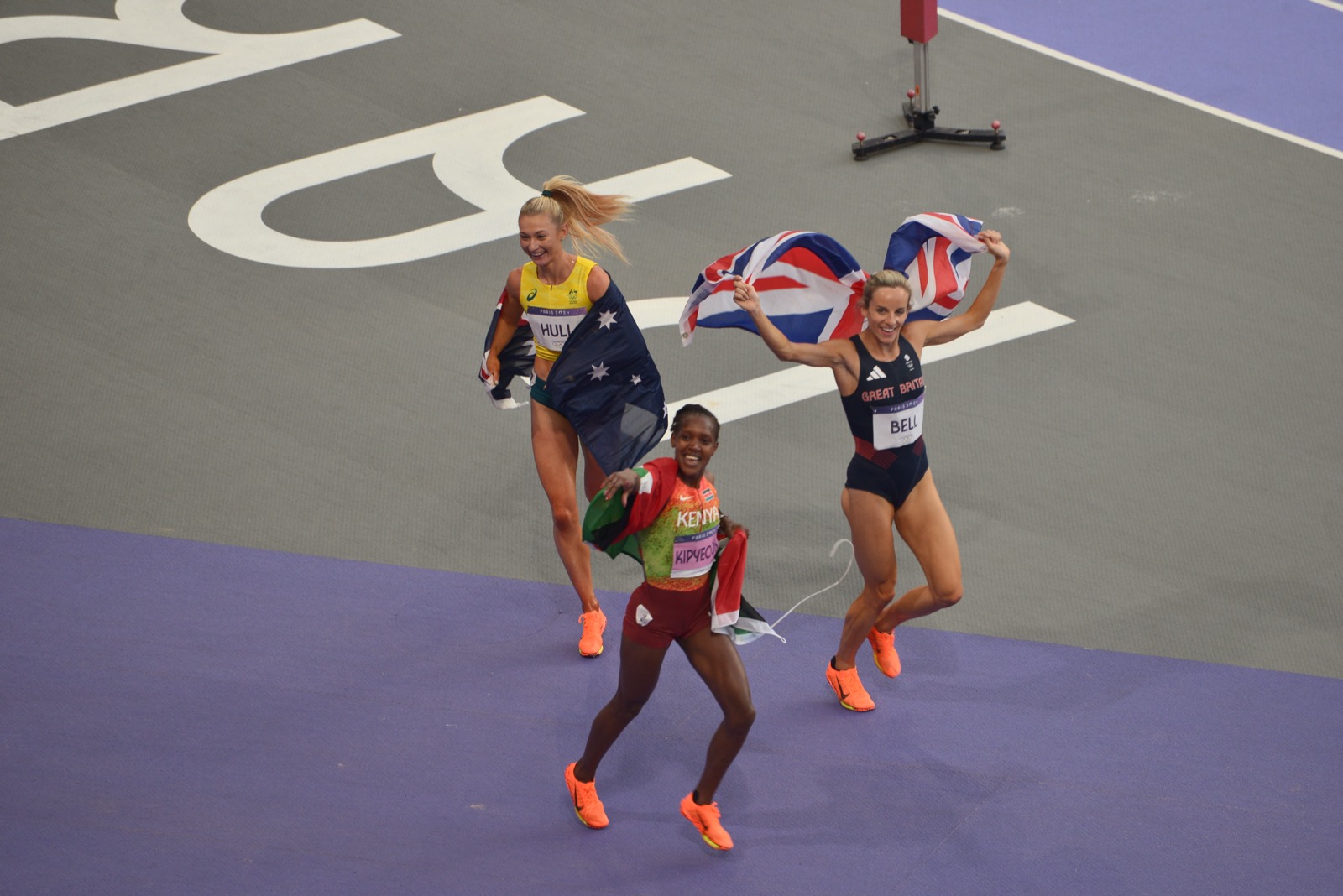
Watch a televised final and the pattern above plays out almost without exception: speedsuits and crop kits in the sprint lanes, featherweight singlets in the distance field, generous cuts and smooth-soled shoes in the throwing circle. The athlete-issue versions of these kits — the Nike Pro Elite tier worn by sponsored professionals and Team USA athletes — are issued to contracted athletes rather than offered in Nike’s retail range, which is why they circulate through the secondary market and command collector attention. If that side of the sport interests you, our vintage national team tracksuits buyer’s guide covers what to look for, and our track and field gift guide maps pieces to the athletes and collectors in your life.
Do I need a speedsuit to sprint, or is a singlet fine?
A singlet and tight shorts are race-legal and what many sprinters wear. Speedsuits follow the elite logic of minimizing loose material, but at most levels, fit and comfort at full extension matter more than marginal aero gains.
Split shorts or half-tights for distance races?
Both are standard. Split shorts maximize stride freedom and airflow; half-tights stay put and add light compression. It is a personal preference — many athletes train in one and race in whichever feels faster.
Why do racing singlets feel so much thinner than training shirts?
Because they are. Current elite race vests weigh roughly 40–70 grams and use high-polyester stretch knits with ventilation built directly into the fabric. Training tops trade some of that lightness for durability.
How should track spikes fit?
Snug and glove-like — tighter than your trainers. Most athletes go a half to a full size down from their trainer size, with sprint spikes fitted tightest and distance spikes allowing slight wiggle room. Wear thin socks.
What should I wear over race kit at a cold meet?
A full tracksuit, kept on until as close to the start as the schedule allows, and put back on immediately after (and between field-event attempts). It is the most-used piece of kit an athlete owns.
Whatever your event, the right kit is the one built for its specific job. Explore our full range of authentic pro and federation track and field kit — singlets, speedsuits, half-tights and national team tracksuits — in the Elite Athletics Clothes catalog.