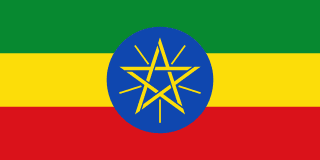
Forged in highland terrain above 2,000 metres and a culture where running is a way of life, Ethiopia stands as one of the greatest distance-running nations in the history of athletics.
Ethiopia is one of history’s greatest distance-running nations, with more than 20 Olympic athletics gold medals since Abebe Bikila’s barefoot marathon victory in Rome in 1960. Shaped by highland training above 2,000 metres, it produced legends such as Haile Gebrselassie, Kenenisa Bekele, Tirunesh Dibaba and Derartu Tulu, dominating the 5,000m, 10,000m and marathon for decades.
Ethiopia’s relationship with distance running is older than its medals. The highland plateaus sit above 2,000 metres, and for centuries communities there covered long distances on foot for trade, communication and herding. Add a diet built on injera and plant foods, and the altitude did the rest: a population conditioned for endurance long before anyone thought to time it.
The same official Pro Elite competition apparel worn at the Olympics and World Championships is available at Elite Athletics Clothes.
Running in Ethiopia was practical before it was competitive. The plateaus sit above 2,000 metres above sea level, and communities across the highlands covered long distances on foot for trade, communication and pastoral work. Endurance was a daily requirement, not a sport.
That environment, together with a diet built on injera and plant foods, produced a population with unusual cardiovascular conditioning. The raw material for champions was part of everyday highland life; the sport simply hadn’t arrived yet.
Organised athletics began to take formal shape in the mid-20th century, largely catalysed by Emperor Haile Selassie I, who saw sport as a vehicle for national pride and international recognition. The Ethiopian Athletics Federation was established to oversee national competitions, and the country began sending athletes abroad. But it was not until the 1960 Rome Olympics that Ethiopia truly announced itself to the world, in the most dramatic fashion imaginable.
No story of Ethiopian athletics begins anywhere other than with Abebe Bikila, the imperial guard soldier who became a global icon on the cobblestoned roads of Rome on 10 September 1960. Running barefoot along the Appian Way under the floodlights of the eternal city, Bikila crossed the marathon finish line in a world-record 2:15:16, becoming the first Black African to win an Olympic gold medal. Four years later, at the 1964 Tokyo Olympics, he became the first man to defend the Olympic marathon title, this time in shoes, breaking his own world record with 2:12:11 just six weeks after an appendectomy.
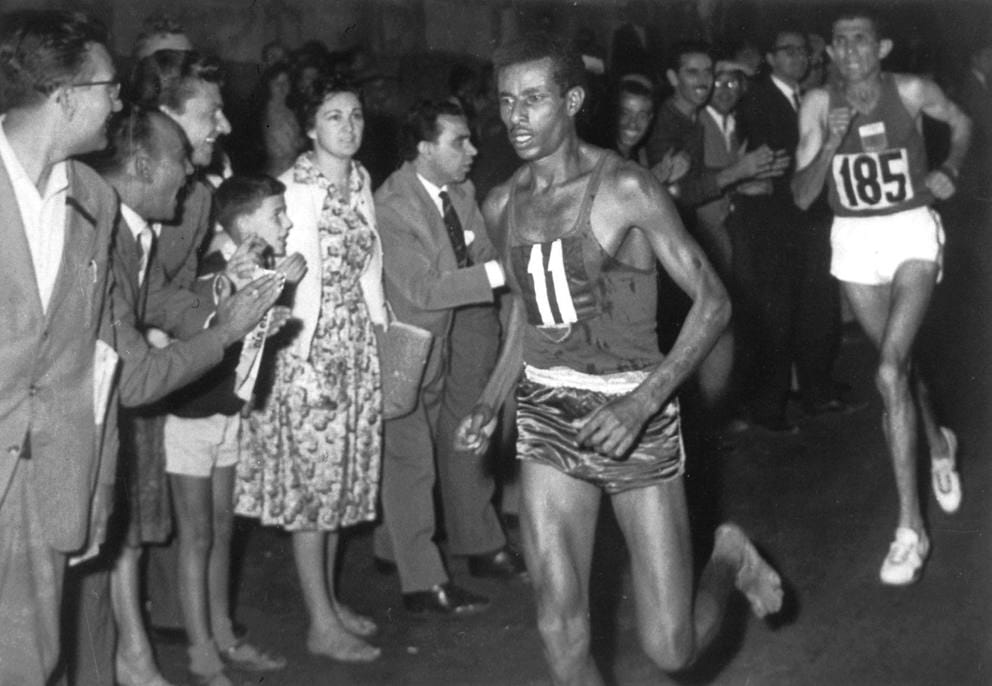
Bikila changed more than the record books. He proved an African athlete could beat the world, twice, and Ethiopia’s athletics identity dates from Rome 1960.
Then came Miruts Yifter, “Yifter the Shifter”, named for his brutal late-race acceleration. He took bronze in the 10,000m at Munich 1972, then won both the 5,000m and 10,000m at the 1980 Moscow Olympics at 33 or older. Two golds in one Games settled Ethiopia’s distance-running reputation.
Ethiopia’s roll of honour reads like a history of distance running itself. From a barefoot marathon pioneer to record-breaking track machines and the finest female distance runners the sport has seen, these are the champions who defined the nation.
The imperial guard soldier who won marathon gold barefoot in Rome 1960 in a world-record 2:15:16, the first Black African Olympic champion, then defended in Tokyo 1964 with 2:12:11 weeks after an appendectomy.
“Yifter the Shifter”, famed for a devastating finishing kick. After 10,000m bronze at Munich 1972, he claimed a stunning 5,000m and 10,000m double gold at the 1980 Moscow Olympics at age 33 or older.
Born 1973 in Asella, he set 27 world records, won four consecutive World 10,000m titles (1993-1999) and two Olympic 10,000m golds (1996, 2000), and ran his 2:03:59 Berlin Marathon world record in 2008.
Born 1982 in Bekoji, a triple Olympic champion whose 5,000m and 10,000m world records (12:37.35 and 26:17.53) stood for some 15 years until 2020, alongside six senior World Cross Country golds. He later ran 2:01:41 to win the 2019 Berlin Marathon.
Born 1985 in Bekoji, widely regarded as the greatest female distance runner in history. A three-time Olympic gold medallist and five-time world champion, she set a 10,000m world record of 29:54.66 at the 2008 Beijing Olympics.
At Barcelona 1992 she became the first Black African woman to win Olympic gold, in the 10,000m, sharing a famous victory lap with Elana Meyer. She won again at Sydney 2000 and took the 2009 New York City Marathon.
Since Abebe Bikila’s gold in 1960, Ethiopia has won more than 20 Olympic athletics titles across several generations. No single star accounts for that total; it took a production line.
Olympic gold medals per Games, 1956–2024 · total 24, all in athletics. Dashed columns mark the boycotted Games of 1976, 1984 and 1988. The twin peaks are Sydney 2000 and Beijing 2008. Source: Wikipedia Olympic medal table.
| Games | Golds |
|---|---|
| Melbourne 1956 | 0 |
| Rome 1960 | 1 |
| Tokyo 1964 | 1 |
| Mexico City 1968 | 1 |
| Munich 1972 | 0 |
| Montreal 1976 | boycotted |
| Moscow 1980 | 2 |
| Los Angeles 1984 | boycotted |
| Seoul 1988 | boycotted |
| Barcelona 1992 | 1 |
| Atlanta 1996 | 2 |
| Sydney 2000 | 4 |
| Athens 2004 | 2 |
| Beijing 2008 | 4 |
| London 2012 | 3 |
| Rio 2016 | 1 |
| Tokyo 2020 | 1 |
| Paris 2024 | 1 |
| Total | 24 |
| Games | Champion | Detail |
|---|---|---|
| Atlanta 1996 | Haile Gebrselassie | Outkicks Paul Tergat by six metres |
| Sydney 2000 | Haile Gebrselassie | Retains the title on the final stride, again ahead of Tergat |
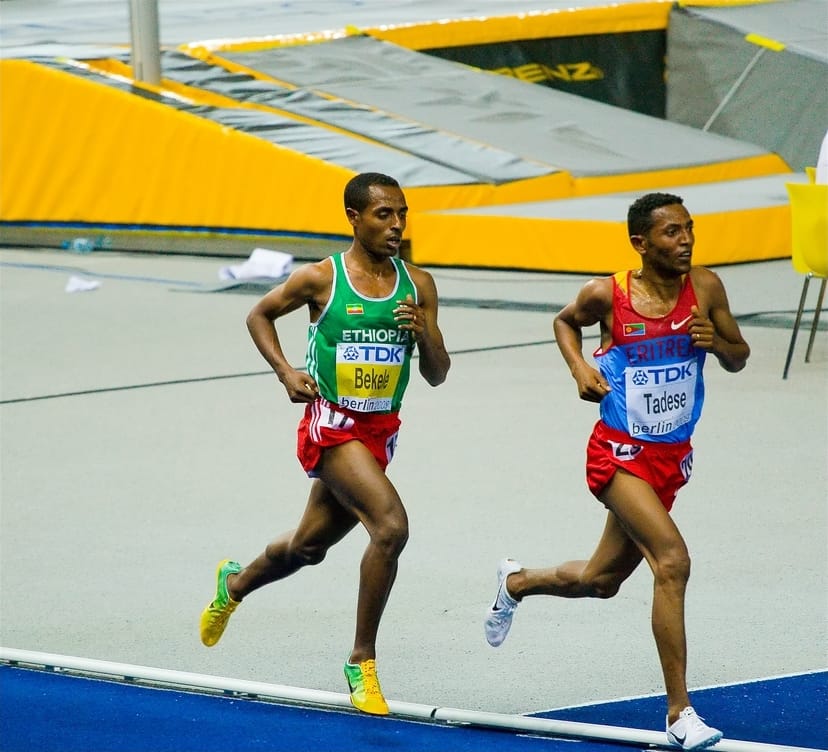
| Athens 2004 | Kenenisa Bekele | Wins with a 53-second last lap, Olympic record |
| Beijing 2008 | Kenenisa Bekele | Retains the title and adds the 5,000m gold |
Four consecutive Olympic 10,000m titles for one nation, shared by two men. Source: Olympics.com, World Athletics.
Abebe Bikila wins marathon gold barefoot in a world-record 2:15:16, becoming the first Black African to win an Olympic gold medal.
Bikila defends his marathon title in shoes with a world-record 2:12:11, the first man to win back-to-back Olympic marathon golds.
Miruts Yifter wins both the 5,000m and 10,000m titles, two golds in a single Games.
Derartu Tulu wins 10,000m gold, becoming the first Black African woman to win an Olympic gold medal.
Haile Gebrselassie captures the first of his two Olympic 10,000m gold medals.
Gebrselassie retains his 10,000m title, while Derartu Tulu wins a second 10,000m Olympic gold.
Kenenisa Bekele wins 5,000m and 10,000m gold; Tirunesh Dibaba takes both women’s titles and sets a 10,000m world record of 29:54.66.
Almaz Ayana shatters the women’s 10,000m world record with a staggering 29:17.45.
At the World Athletics Championships, Ethiopia has been equally dominant since the event began in 1983, accumulating dozens of gold medals. Athletes such as Kenenisa Bekele, with multiple golds in the 5,000m and 10,000m, Haile Gebrselassie with four world titles, Tirunesh Dibaba with five, and Meseret Defar with multiple titles have led the charge, with Ethiopia regularly finishing among the top three nations in the total medal table.
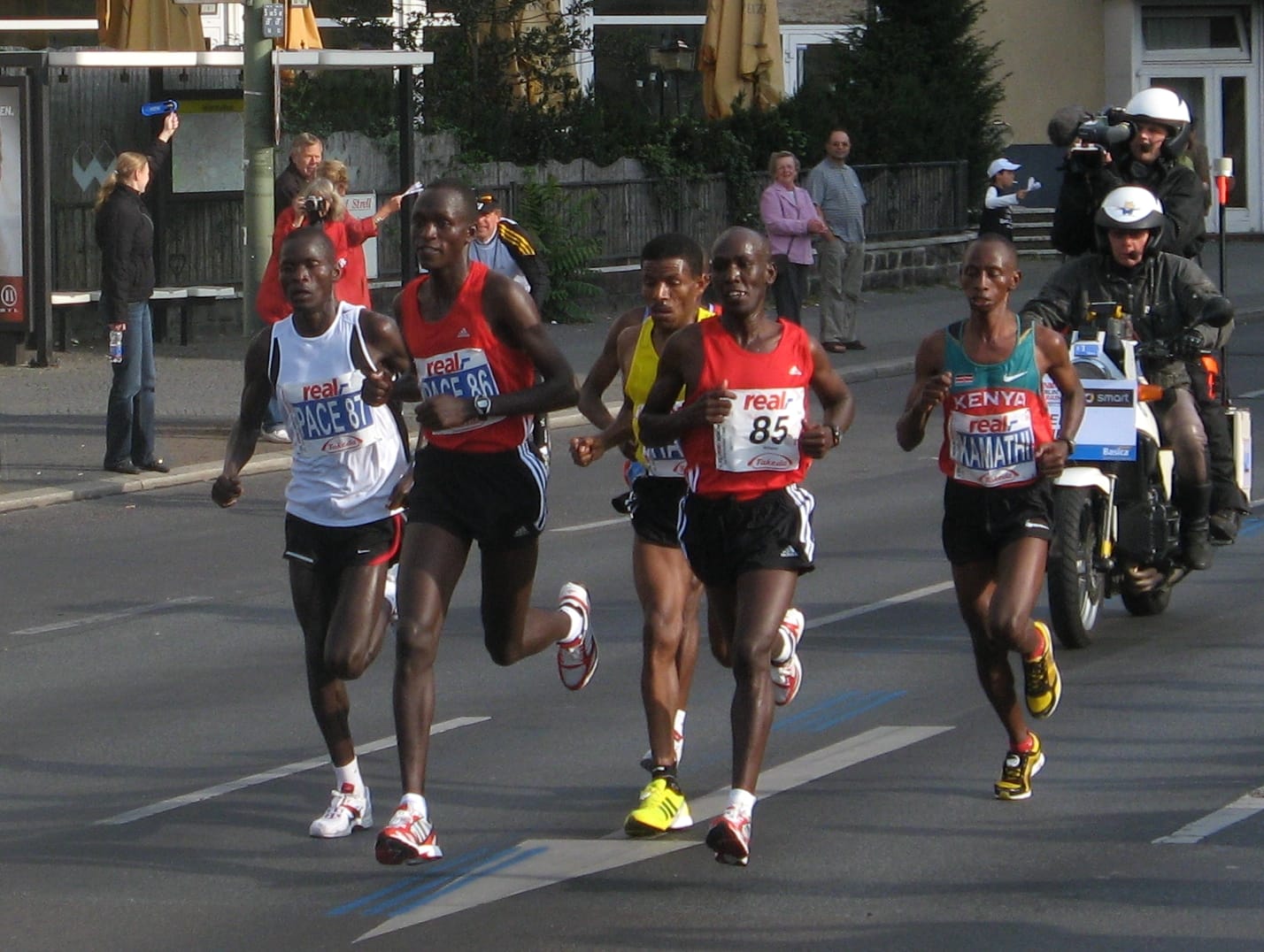
Its most dominant discipline may be cross country. Ethiopia has been the most successful nation in World Cross Country Championship history, with dozens of individual and team titles across senior, junior and under-20 categories. Cross country is where the highland talent pool gets sorted; the best of it moves on to track and road.
Understanding Ethiopia’s dominance requires looking beyond genetics and medals to the cultural, geographic and social ecosystem that produces champions at a rate no other nation can match. Its central highlands, particularly the regions of Arsi, Oromia and Amhara, sit at altitudes between 2,000 and 3,000 metres, naturally increasing red blood cell count and oxygen-carrying capacity. Towns like Bekoji, Addis Ababa, Sululta and Adama have become world-famous running centres.
Community and mentorship do the rest. Young athletes grow up surrounded by champions, and coaches such as Sentayehu Eshetu have developed generations of talent in informal but effective training groups. Prize money and contracts add the economic pull; national pride adds the push.
Ethiopian athletes compete in the national green, yellow, white and red, colours any athletics fan can pick out at the front of a race.
Ethiopia’s running culture thrives on mentorship and community rather than formal coaching academies. In Bekoji alone, the small highland town has produced Haile Gebrselassie, Kenenisa Bekele, Tirunesh Dibaba, Derartu Tulu and dozens of other world-class runners, with coaches passing down knowledge and technique through direct mentorship.
The Ethiopian Athletics Federation continues to invest in identifying and developing young talent, maintaining strong links between domestic competitions and the international circuit. The country participates actively in the Diamond League, World Marathon Majors and all major championships, and remains a dominant force in the World Athletics Cross Country Championships.
For many young Ethiopians, running offers a path to economic security. The prize money at major international marathons and the financial rewards of athletics contracts motivate thousands to dedicate themselves to the sport, feeding a pipeline that consistently replaces retiring champions with new waves of talent.
Ethiopian athletics in the mid-2020s is still a superpower, but no longer an unchallenged one. Kenya pushes hardest across every distance discipline, and Uganda, Morocco and others now produce genuine contenders. Ethiopia’s answer is depth: new names keep arriving in the 1,500m, 5,000m, 10,000m, marathon and steeplechase as fast as champions retire.
The pressure showed at the 2025 World Championships in Tokyo, where Ethiopia went without a gold medal for the first time since 1991 — two silvers (Tigist Assefa in the marathon, Yomif Kejelcha in the 10,000m) and two bronzes were the whole haul. The reply came seven months later: at the 2026 London Marathon, Kejelcha ran 1:59:41 on his debut, the first Ethiopian under two hours and the second man in history to break the barrier in a record-eligible race.
At the Paris 2024 Olympics, Ethiopian athletes competed in the official Adidas Ethiopia Pro Elite 2024 OLY Sleeveless Speedsuit, a technically advanced 84% recycled polyamide and 16% spandex competition suit in the national colours of green, yellow, white and red. Ethiopian runners are sponsored by major brands, compete in top European clubs and attract global media attention year-round.
The match-worn Adidas Ethiopia Pro Elite 2024 OLY Sleeveless Speedsuit from Paris 2024 is no longer in stock at Elite Athletics Clothes — athlete-issued Ethiopia kit is produced in small numbers, and once a piece is gone it rarely returns. The Ethiopia rail below carries what is in stock now.
Ethiopia’s pipeline of talent shows no sign of slowing. Athletes in the junior and under-20 age groups continue to dominate World Cross Country Championships, signalling that the next wave of Olympic and World Championship gold medallists is already in training on the Ethiopian highlands.
The traditional heartlands of Ethiopian distance running continue to feed the pipeline, with junior and under-20 athletes dominating World Cross Country Championships.
New training programmes in Addis Ababa and the Rift Valley are broadening the geographic base of Ethiopian athletics beyond its historic highland centres.
The federation is investing in women’s middle distance, looking for successors to Genzebe Dibaba over 800m and 1,500m.
Track runners moving up to the road keep the marathon tradition alive, with podium results at the Abbott World Marathon Majors.
| Event | Mark | Athlete · Venue |
|---|---|---|
| First Olympic gold | 1960 | Abebe Bikila · Rome Marathon |
| Men’s Marathon (Olympic WR) | 2:12:11 | Abebe Bikila · Tokyo 1964 |
| Men’s 5,000m world record (2004–20) | 12:37.35 | Kenenisa Bekele · 2004 |
| Men’s 10,000m world record (2005–20) | 26:17.53 | Kenenisa Bekele · 2005 |
| Women’s 10,000m world record (2016–21) | 29:17.45 | Almaz Ayana · Rio 2016 |
| Marathon world record (2008) | 2:03:59 | Haile Gebrselassie · Berlin 2008 |
| Berlin Marathon | 2:01:41 | Kenenisa Bekele · 2019 |
| First Ethiopian sub-2 marathon | 1:59:41 | Yomif Kejelcha · London 2026 |
| World records set | 27 | Haile Gebrselassie |
Every Ethiopia piece at Elite Athletics Clothes is athlete-issued Adidas Pro Elite — the competition kit made for the national team and worn at the Olympic Games and World Championships, not a fan replica. The rail runs from the 2024 OLY generation back to pieces from the era of Tirunesh Dibaba and Meseret Defar, in small numbers that rotate as items sell.
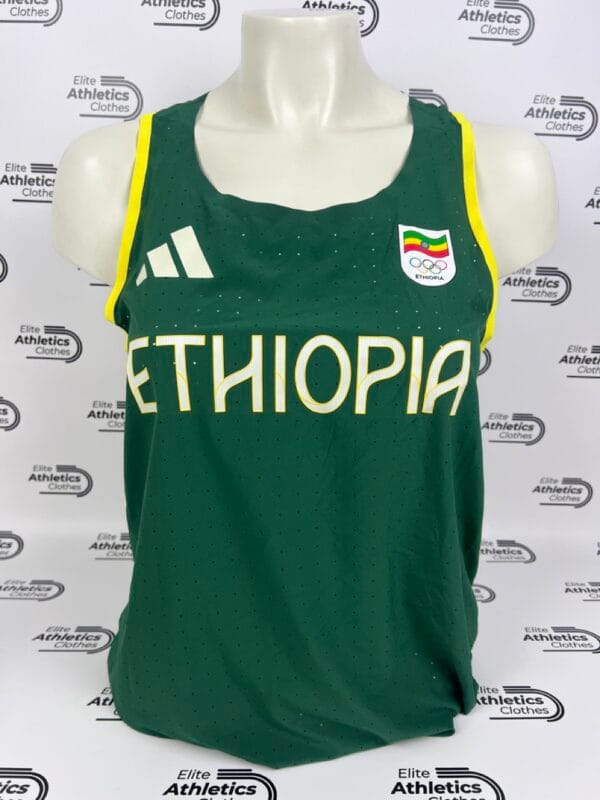 Adidas Ethiopia Pro Elite 2024 OLY Women Distance Singlet140,00 €View Piece →
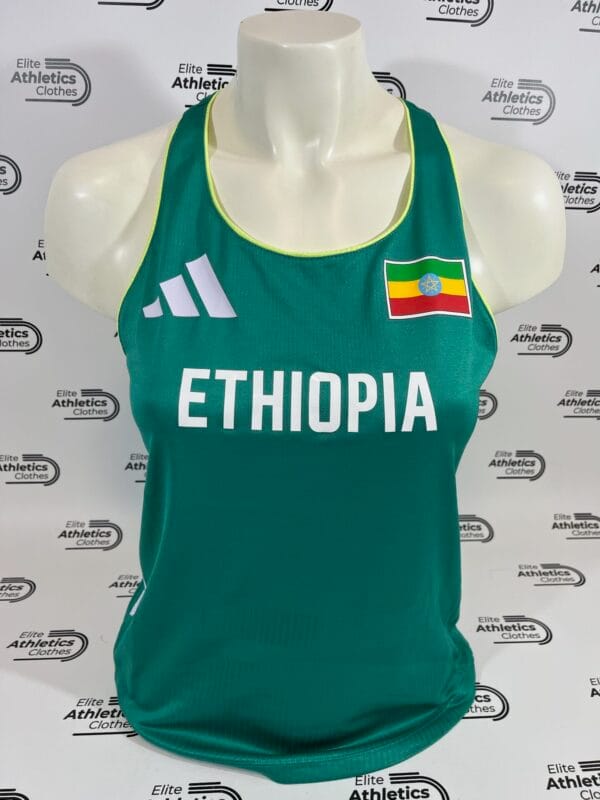 Adidas Ethiopia Pro Elite 2024 Women Distance Singlet
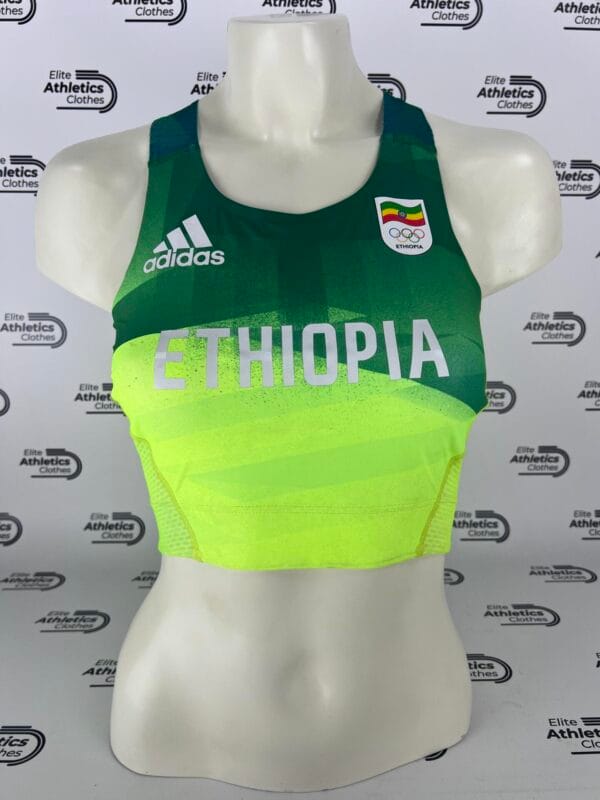 Adidas Ethiopia Olympic Team Pro Elite 2020 Women Crop Top90,00 €View Piece →
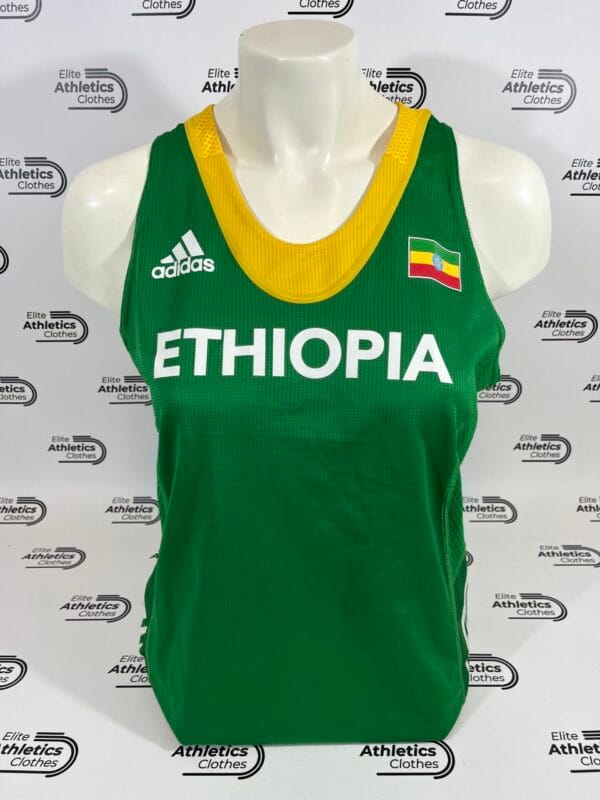 Adidas Ethiopia Pro Elite 2014 Women Distance Singlet
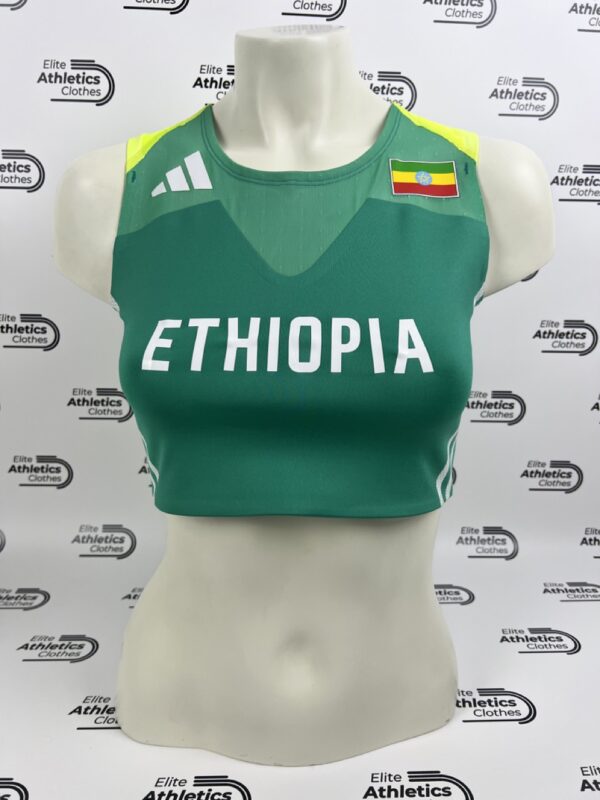 Adidas Ethiopia Pro Elite 2023 Women Crop Top
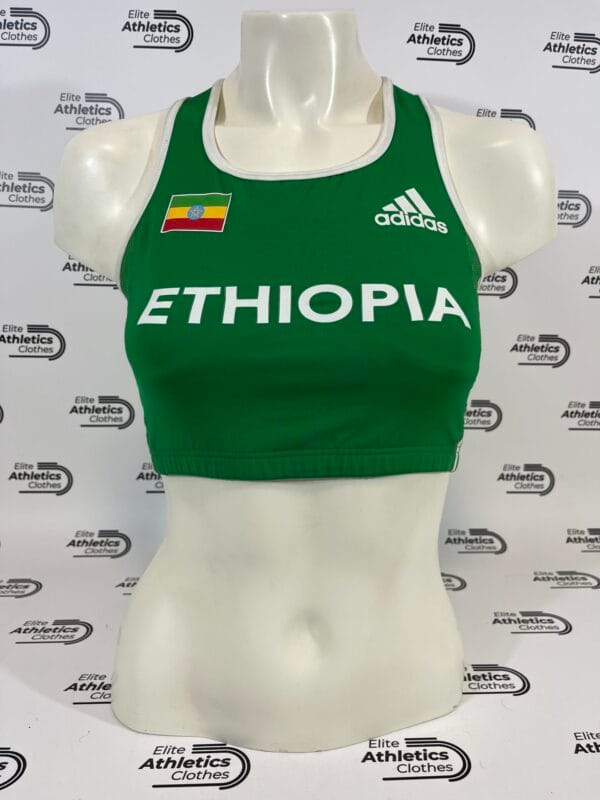 Adidas Ethiopia Pro Elite 2012 Women Crop Top
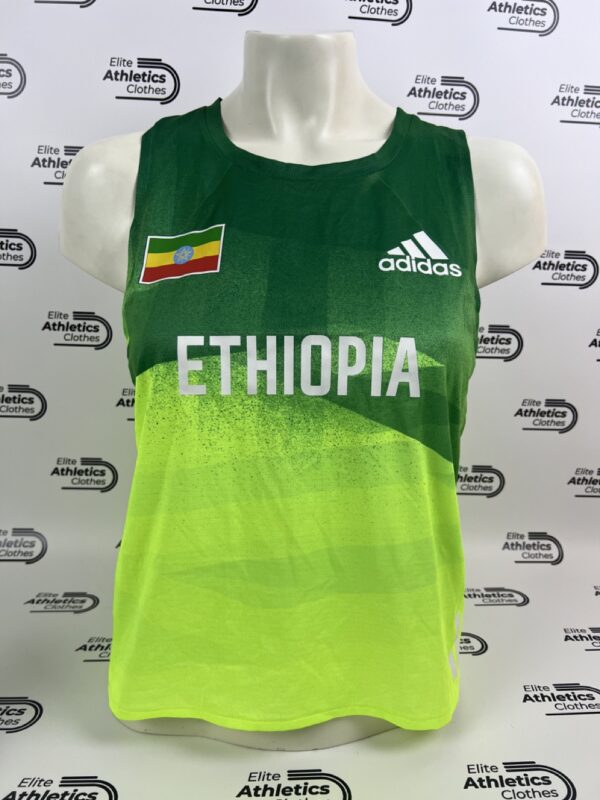 Adidas Ethiopia Pro Elite 2022 Women Distance Singlet
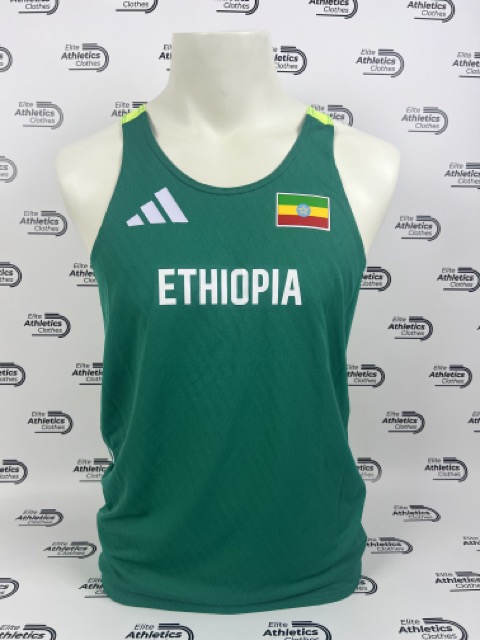 Adidas Ethiopia Pro Elite 2023 Distance Singlet
Most experts point to either Haile Gebrselassie, who set 27 world records and won two Olympic golds, or Kenenisa Bekele, a triple Olympic champion who holds some of distance running’s most enduring records. Among women, Tirunesh Dibaba, with three Olympic golds and five world titles, is widely considered the greatest female distance runner Ethiopia has produced.
Ethiopia first competed at the Olympics in 1956 at the Melbourne Games, but it was the 1960 Rome Olympics where the country made its mark, when Abebe Bikila won the marathon gold barefoot, becoming the first Black African Olympic gold medallist in any sport.
Its success is attributed to high-altitude training environments between 2,000 and 3,000 metres, a long cultural tradition of running as part of daily life, strong community mentorship, economic motivation and a national passion for the sport. Towns like Bekoji have produced a disproportionate number of world-class runners, suggesting environment and community matter as much as physiology.
The team wears Adidas-designed Pro Elite competition apparel in the national colours of green, yellow, white and red. At major championships athletes compete in technically advanced speedsuits and singlets, such as the Adidas Ethiopia Pro Elite 2024 OLY Sleeveless Speedsuit worn at Paris 2024. Authentic versions are available at Elite Athletics Clothes.
Ethiopia has won over 20 Olympic gold medals in athletics since Abebe Bikila’s victory in 1960, making it one of the most successful nations in Olympic athletics history. Its golds span the marathon, 5,000m, 10,000m and cross country across multiple decades, with medal-winning performances at every Summer Olympics since 1960 apart from boycotted editions.
Abebe Bikila (1932-1973) was an Ethiopian long-distance runner who became the first Black African to win Olympic gold, taking the marathon at the 1960 Rome Olympics barefoot. He defended his title at Tokyo 1964, the first man to win back-to-back Olympic marathon golds, and is considered the founding father of modern Ethiopian athletics.
adidas supplies the Ethiopian Athletics Federation’s national kit — a partnership so central that its sponsorship has been reported as roughly half of the federation’s annual income. Authenticated athlete-issued Ethiopia pieces surface at Elite Athletics Clothes when available.
We use cookies to run this store, remember your preferences and measure traffic. Accept or deny non-essential cookies below.