
Choosing track spikes used to be simple: buy whatever fit and screw in the longest pins the shoe would take. Not anymore. Between event-specific plate design, three different pin geometries, facility restrictions and a World Athletics rulebook that changed significantly in November 2024, a wrong choice can now get you turned away at check-in — or cost you a race. This guide covers what actually matters: how spikes differ by event, which pins to run, how they should fit, and exactly what the current rules allow. We sell the kit that goes over the spikes, not the spikes themselves — consider this the expert resource we wish every athlete had before their first call room.
Key facts · Verified · updated July 2026
- Sole thickness (track & field)
- 20 mm flat limit — since 1 Nov 2024
- Pin projection outdoors
- ≤9 mm (High Jump & Javelin: ≤12 mm)
- Pin projection indoors
- ≤6 mm unless the venue permits 9 mm
- Spike positions
- maximum 11 on the sole
- The gauge test
- tip half must pass a 4 mm square gauge
- Road & race walking
- up to 40 mm sole
- Facility reality
- most tracks cap everyone at 6 mm pyramid pins
- Fit rule
- half to a full size down from trainers
Spike Anatomy: One Track, Six Different Shoes
Every spike is a trade-off between power transfer and cushioning, and the balance shifts with race distance and event demands.
Sprint Spikes (100m–400m)
Sprint spikes are the most aggressive shoes on the track. They’re built around a stiff, full-length plate that pushes you onto your toes, with roughly 7–10 pins for maximum traction and essentially zero heel cushioning. The race is short enough that impact absorption doesn’t matter — every gram and every degree of plate flex is spent on power transfer instead.
Middle-Distance Spikes (800m–3,000m)
Middle-distance spikes split the difference: a semi-aggressive plate that runs half to three-quarters of the shoe’s length, around 6–8 pins, and moderate heel cushioning to keep your legs fresh over multiple laps. If you race the 800m, 1,500m or 3,000m, this is your category.
Long-Distance Spikes (3,000m and up)
Distance spikes flip the priority from power to protection. They carry the most flexible plate of any track shoe, the most midsole cushioning, and the fewest pins — typically 4–6. Over 12.5 or 25 laps, repeated-impact comfort beats raw stiffness.
High Jump Shoes
High jump shoes are the outlier among jumps footwear: they carry spikes in the heel as well as the forefoot, because the curved approach and the plant load the whole foot rather than the toes alone. The plate is stiff to translate the plant into vertical lift.
Javelin Boots
Javelin shoes are boot-style: heavier than any other spike, with genuine ankle support and spikes at both heel and toe. The crossover step and the block at the end of the runway put violent, off-axis forces through the foot — javelin boots are built to survive them.
Throws Shoes (Shot Put, Discus, Hammer)
Strictly speaking, these aren’t spikes at all. Rotational throws demand smooth-soled shoes with no pins whatsoever — the sole is designed to let you spin and glide inside the circle. If you compete in the throws, this is one purchase you can’t improvise with running shoes.
Pins: Shape and Length Matter More Than You Think
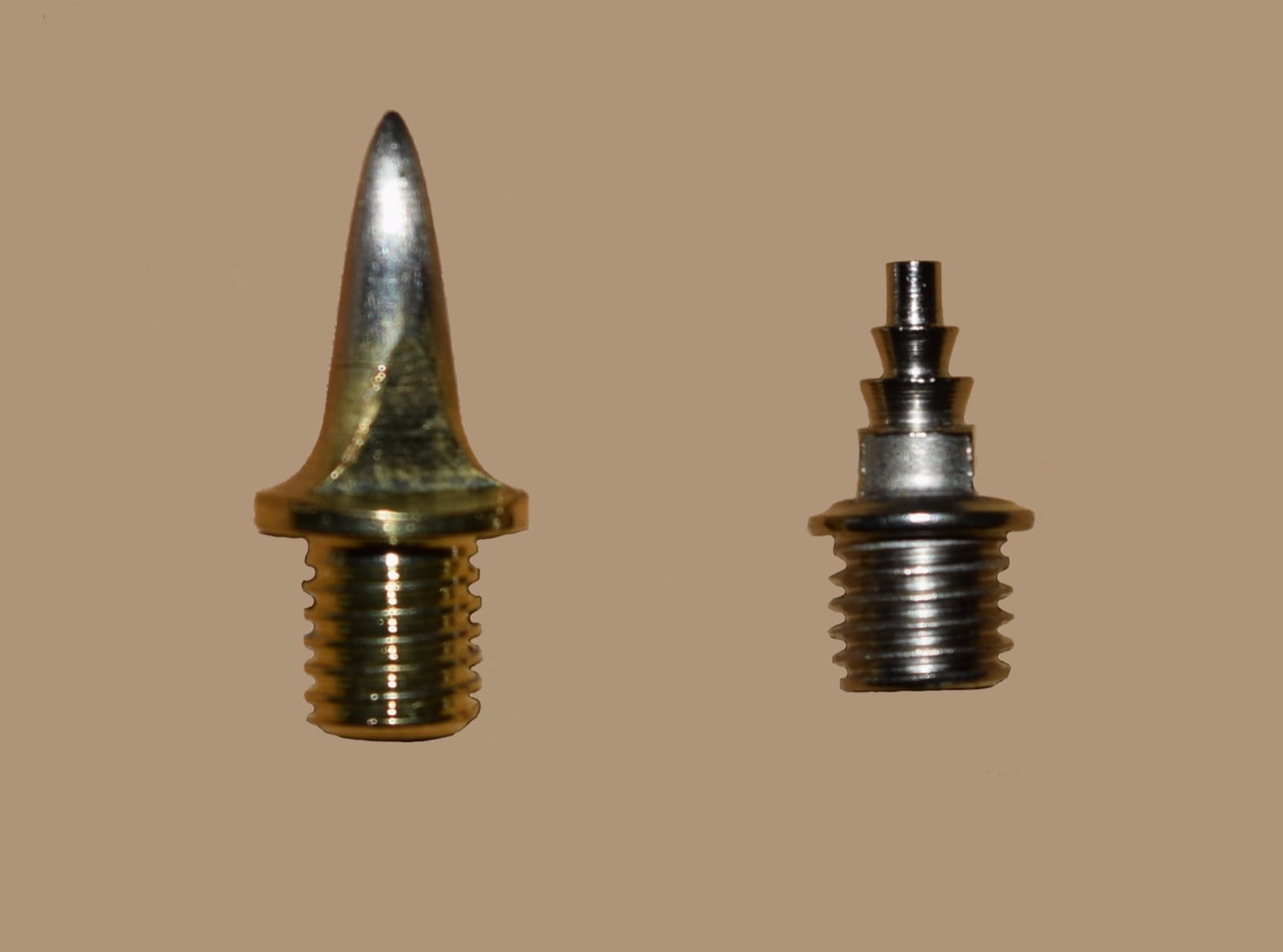
Three pin geometries dominate, and they are not interchangeable.
- Pyramid: the classic tapered cone. Safest across all surfaces and the most widely permitted — the default choice.
- Needle: maximum grip, but banned at many tracks; their main legitimate home today is cross country.
- Christmas tree (compression): tiered pins that compress the track surface rather than piercing it. Also banned at many facilities — New York’s Armory is a well-known example.
Common lengths are 6mm (¼”), 9mm (⅜”) and 12mm. Here’s the caveat that saves race days: most facilities restrict athletes to 6mm pyramid pins only, regardless of what World Athletics allows. Always check the host track’s rules before you travel — the meet information sheet usually spells it out, and track operators are entitled to impose stricter limits than the governing body.

The Current World Athletics Rules (Read This Before You Race)
If your knowledge of shoe rules dates from a few seasons ago, it’s now wrong. The old regime — 20mm maximum sole thickness for track events below 800m, 25mm for 800m and above — ended on 31 October 2024. Since 1 November 2024, the maximum sole thickness is 20mm for all track and field events, spiked or unspiked, including hurdles, steeplechase, jumps and throws. Road running and race walking shoes may go up to 40mm. For cross country, a transition applies: 20mm for spiked shoes and 40mm for non-spiked until 31 March 2026, after which any thickness is permitted from 1 April 2026. Measurements carry a 5% tolerance.
The spike-specific rules, per the World Athletics shoe regulation (C2.1A, approved 2 December 2025 and effective 1 January 2026), are:
- Maximum 11 spike positions on the sole.
- Outdoors: pin projection of no more than 9mm — except High Jump and Javelin, where up to 12mm is allowed.
- Indoors: maximum 6mm, unless the venue explicitly permits 9mm.
- Each spike must pass through a 4mm square gauge for the half of its length nearest the tip.
- Track operators may impose stricter limits than any of the above.
Practical translation: a set of 6mm pyramids keeps you legal at virtually every venue, indoor or out. Longer pins are an outdoor, event-specific and facility-permitting decision.
How long may the pin be?
The rulebook gives you three ceilings — and most host tracks quietly lower all of them to 6 mm pyramids.
Data table — legal pin projection
| Context | Maximum projection | Note |
|---|---|---|
| Indoors | 6 mm | Venue may explicitly permit 9 mm |
| Outdoors (most events) | 9 mm | World Athletics C2.1A |
| High Jump & Javelin (outdoors) | 12 mm | The only exceptions |
| Most facilities (any event) | 6 mm pyramid | Host-track rules override upward limits |
World Athletics Athletic Shoe Regulations C2.1A (effective 1 January 2026), per this guide’s sources.
Fit: Snug Is the Standard
Spikes are not trainers, and they should not fit like trainers. The target is a snug, glove-like fit — noticeably tighter than your daily running shoes. Most athletes go a half to a full size down from their trainer size. Sprint spikes should be the tightest of all, since any movement inside the shoe leaks power at push-off; distance spikes can allow slight wiggle room for comfort over longer races. Wear thin socks when you try them on — that’s how you’ll race in them.
Quick Reference: Spikes by Event
| Event | Plate | Pins | Cushioning |
|---|---|---|---|
| Sprints (100–400m) | Stiff, full-length, aggressive | ~7–10 | Zero to minimal heel |
| Middle distance (800–3,000m) | Semi-aggressive, ½–¾ length | ~6–8 | Moderate heel |
| Long distance (3,000m+) | Most flexible | ~4–6 | Most midsole cushioning |
| High jump | Stiff | Heel and forefoot | Event-specific |
| Javelin | Boot-style, ankle support | Heel and toe | Heavier, supportive build |
| Throws (shot, discus, hammer) | Smooth rotational sole | None | Stability-focused |
Spikes Are Half the Equation
The shoes handle the track; the kit handles everything else — heat, sweat and drag. A sprinter in the right spikes but a heavy cotton tee is still giving something away, which is why elite athletes match their footwear with competition-grade singlets and speedsuits. That’s our side of the start line: authentic pro elite track and field apparel, including federation kit from national teams around the world in our international teams collection.
What is the maximum sole thickness for track spikes right now?
20mm for all track and field events — a flat limit in force since 1 November 2024. The old split (20mm below 800m, 25mm for 800m and up) no longer applies. Road running and race walking shoes may be up to 40mm.
How long can my spike pins be?
Under the 2026 World Athletics regulation: up to 9mm outdoors (12mm for High Jump and Javelin) and 6mm indoors unless the venue permits 9mm. But individual facilities can be stricter — many allow only 6mm pyramid pins — so always check the host track’s rules.
How many spike positions are allowed on a shoe?
A maximum of 11 spike positions, and each pin must pass through a 4mm square gauge for the half of its length nearest the tip.
How should track spikes fit?
Snug and glove-like — most athletes size down a half to a full size from their trainers. Sprint spikes should fit tightest; distance spikes can leave slight wiggle room. Try them on with thin socks.
Do throwers wear spikes?
No. Shot put, discus and hammer use smooth-soled rotational shoes with no pins, built for spinning and gliding inside the throwing circle.
Once your spikes are dialed in, complete your race-day setup: browse our catalog of authentic pro elite singlets, speedsuits and federation kit and step onto the track dressed like the athletes you’re racing to become.