
DISTANCE
SINGLET
The lightest legal thing you can race in — and, in its Pro Elite form, the exact vest a national team wore on the start line. Here is what it is, why the athlete version is different, and how to choose one.
A distance singlet is a lightweight, sleeveless racerback vest built for one job: racing long, from the 5,000 m to the marathon. It trims a running top to the least fabric that still carries a national crest and two competition bibs — typically around 85 grams, roughly half the mass of an everyday cotton tee.
The version we archive is the race-issued one: the same federation kit an athlete pulls on in a World Championship final, not the replica hanging in a retail store. That distinction — who it was made for, and how few exist — is the whole story of this piece.
This guide is part of Kit Anatomy, our series on each garment in the Pro Elite archive. Jump straight to the distance singlets in stock, or read on for how the race piece is built.
- What it is
- A sleeveless racerback race vest for distance events, 5,000 m to marathon
- Typical mass
- About 85 g (size M) — elite race vests drop under 60 g
- Fabric
- Recycled polyester / nylon with elastane; knit weight 80–120 g/m²
- Cut
- Racerback and deep armholes for shoulder rotation and heat loss
- Governing rule
- World Athletics TR5: clean, non-objectionable, non-transparent even if wet
- Carries
- Two competition bibs (front and back); may be perforated at 10,000 m and longer
- Race-issued vs retail
- Federation-approved team kit — not the same as a store replica
- In the archive
- 38 distance singlets catalogued; Nike, adidas, Asics, Vermarc
View the data
| Garment | Typical mass (size M) | Build |
|---|---|---|
| Everyday cotton T-shirt | ~155 g | Cotton jersey, casual cut |
| Technical training top | ~120 g | Recycled polyester, everyday runs |
| Distance racing singlet | ~85 g | Featherweight knit, racerback |
| Elite ultralight race vest | ~50 g | Sub-60 g laser-cut shells |
What a distance singlet is
Strip a running shirt of its sleeves, its collar and every gram it does not need, and you get a singlet: a vest cut low at the neck, deep at the arm, and closed only across the shoulders and sides. On a distance runner it is the default racing top from the 5,000 m upward, because over 12 or 26 miles the enemy is heat, and the singlet loses more of it than anything else you are allowed to wear.
The word describes the cut, not the sport — wrestlers and rowers have singlets too. In athletics it has a narrower meaning: the sleeveless, racerback race vest, usually in a national or team colourway, worn over nothing or over a sports bra. Everything about it is subtractive. Less fabric means less weight, less water held when you sweat, and less cloth trapping warmth against the skin.
That is why the singlet, not the T-shirt, is the racing default. A cotton tee can double its weight in sweat; a race singlet is knitted to move moisture out and dry fast. The chart above puts the difference in numbers — the race piece sits at the featherweight end of the ladder on purpose.
Race-issued vs retail
The singlets in this archive are race-issued: made for and released through a national federation or its brand, in the run-up to a championship, for the athletes on the team. That is a different object from the replica you can buy in a store, even when the two share a logo. World Athletics writes the rule that makes the team version matter — Technical Rule 5 requires athletes to compete in the uniform clothing approved by their federation.
The same rule sets the constraints the garment is designed around. It must be “clean, and designed and worn so as not to be objectionable,” and “made of a material which is non-transparent even if wet.” It also has to carry the athlete's two bibs — one on the chest, one on the back — worn as issued and never cut or folded. In races of 10,000 m and longer the bibs may be perforated for airflow, a small detail that tells you these vests are built for the heat of a long race.
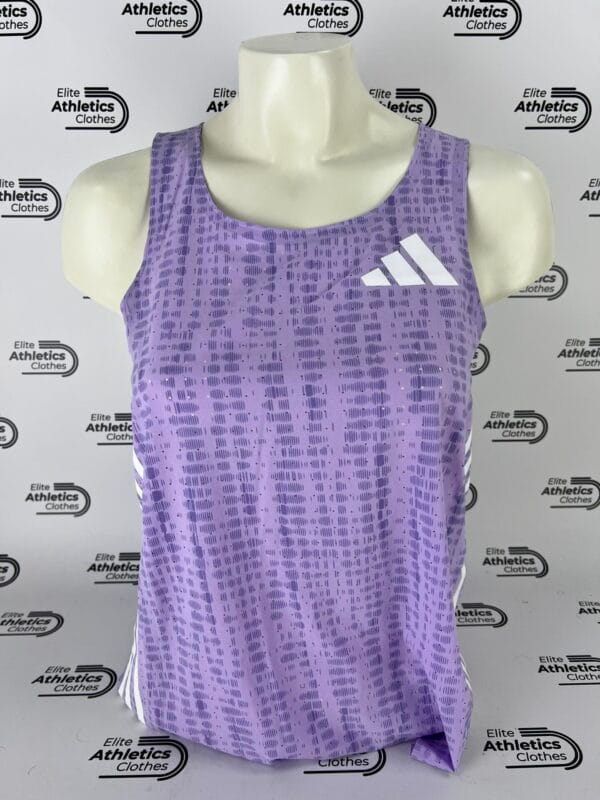 From this series · in the archiveAdidas Pro Elite Team 2025 Women Distance Singlet – Special EditionA federation team singlet in the exact make an athlete raced in — the issued piece, not a replica.140,00 €View piece →
Scarcity is the rest of the story. A retail line is printed to demand; a race-issued run is limited to what the team channel puts out for a single cycle, and once a colourway is gone it does not come back. That is the difference you are actually buying: not a badge, but a piece that was made to be worn in a final.
How the race piece is built
Look closely at a race singlet and every choice points the same way: keep the athlete cool, keep the fabric off the skin, and add nothing that flaps, chafes or holds water. Here is what those choices look like on the garment.
- The racerbackA narrow yoke between the shoulder blades frees the arms to rotate and opens the upper back to airflow — the signature cut of a racing vest.
- Deep armholesCut low toward the ribs to shed heat and let the shoulders drive, the reason a singlet never binds the way a fitted tee can.
- The knitRecycled polyester or nylon with a touch of elastane, engineered at 80–120 g/m² so it wicks sweat outward and dries before it turns into ballast.
- Bonded & flat seamsUltrasonic-bonded or flatlock joins sit flush against the skin, the difference between a comfortable marathon and two hours of chafe.
- Laser-cut hemsRaw, un-hemmed edges save grams and never roll or rub — you will see them at the arm and the hem of the lightest pieces.
- The canvasA clean chest and back panel exist for a reason: the crest, the bibs, and nothing that would “impede the view of the judges.”
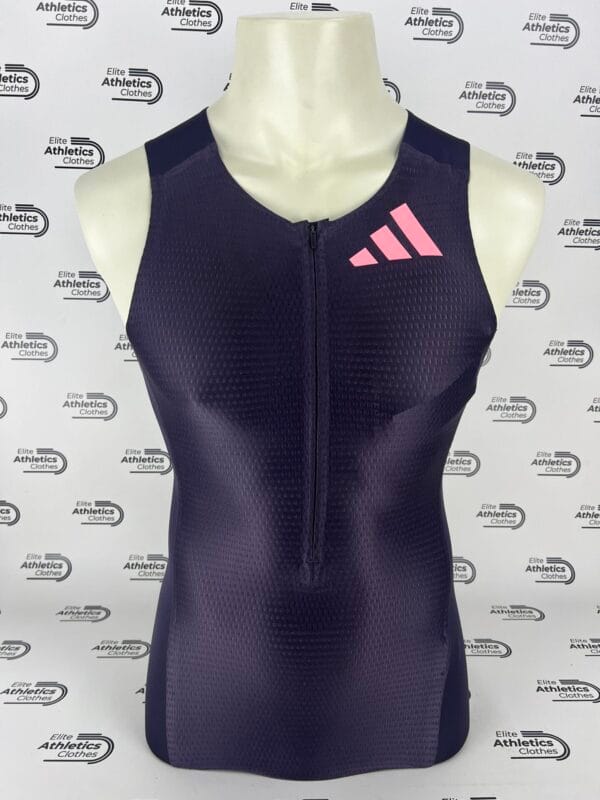 From this series · in the archiveAdidas Pro Elite Team 2024 Rheon SingletA recent team singlet showing where the tech goes now — targeted fabric, bonded construction, minimal mass.160,00 €View piece →
None of it is decorative. A distance singlet is a solved problem in cloth: the least material that still meets the rulebook, carries the bibs, and survives a hard race in the heat.
How to choose yours
Buying a race-issued singlet is not quite like buying off the rack, so a few things are worth knowing before you pick one.
- Fit close, not tightA race vest is meant to skim the body so it does not flap. Size for a snug, unrestricted fit; if you plan to layer a sports bra or base layer, account for it.
- Match the distanceMarathon and road pieces prize breathability and light weight; track and relay vests can sit a touch more fitted. Both share the same racerback logic.
- Mind the cut by genderWomen's distance singlets are cut for a different torso and often pair with or integrate a bra — check the specific piece rather than assuming unisex.
- Care keeps it lightCold wash, no fabric softener, air dry. Softener clogs the wicking knit and is the fastest way to make a featherweight vest feel heavy.
- It is archive stockRace-issued runs are small and do not restock. If a colourway and size are in front of you, that is usually the window — sold-out pieces stay listed but rarely return.
Get those right and the piece does what it was built to do: disappear. The best distance singlet is the one you stop noticing at mile 20, which is exactly what a vest made for a final is engineered to be.
Distance Singlets in the Archive
Race-issued distance singlets from national teams and their brands — the issued piece, not a retail replica. In-stock first; sold-out pieces stay listed because the runs are small and rarely return. New arrivals appear here on their own.
Adidas Pro Elite Team 2024 Rheon Singlet160,00 €View Piece →Adidas Pro Elite Team 2025 Women Distance Singlet – Special Edition140,00 €View Piece →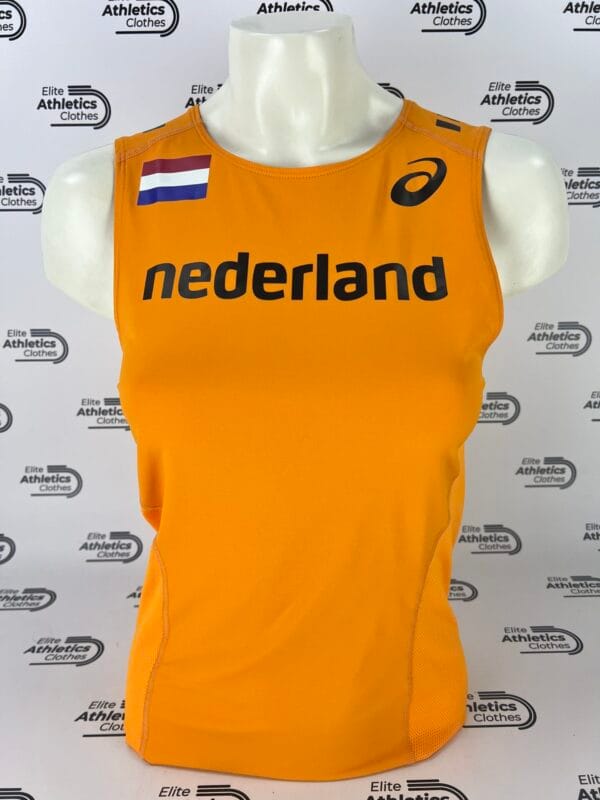 Asics Netherlands Pro Elite 2016 Women Distance Singlet120,00 €View Piece →
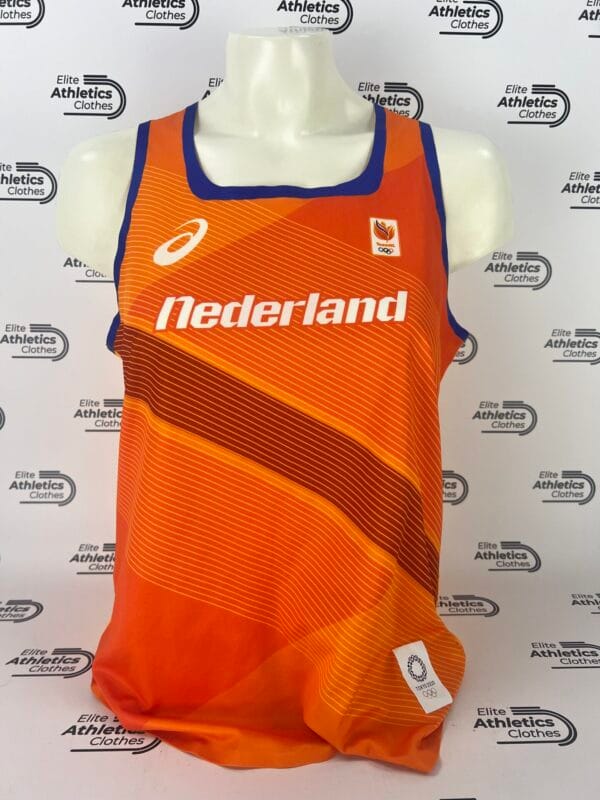 Asics Netherlands Pro Elite 2020 OLY Women Distance Singlet120,00 €View Piece →
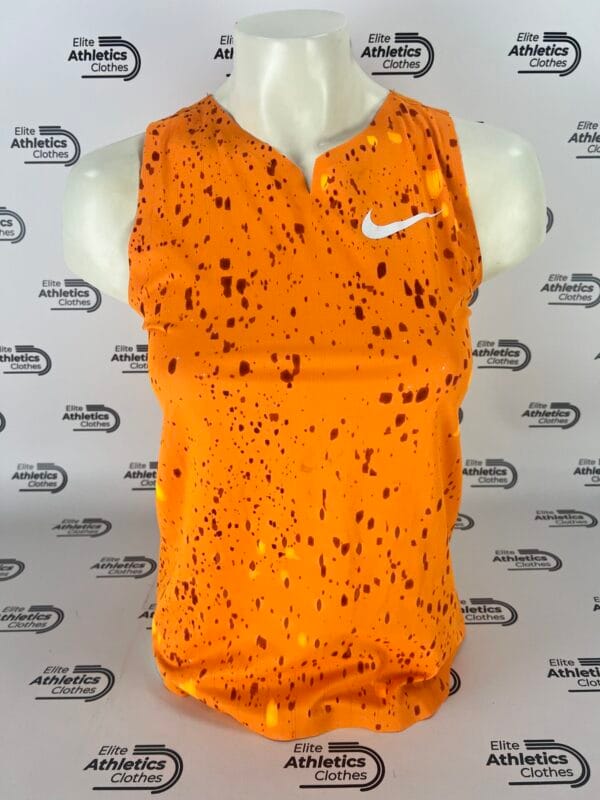 Nike Rosa & Co. Pro Elite 2024 Women Distance Singlet150,00 €View Piece →
What is a distance singlet?
A distance singlet is a lightweight, sleeveless racerback vest worn for distance running events, from the 5,000 m to the marathon. It uses the least fabric that still carries a team crest and two competition bibs — typically around 85 grams — to shed heat and move sweat away from the skin.
What is the difference between a race-issued singlet and a retail one?
A race-issued singlet is the federation-approved team kit made for the athletes on a national team for a specific championship cycle. A retail singlet is a replica sold to the public. World Athletics Technical Rule 5 requires athletes to compete in their federation's approved uniform, which is the piece we archive; the runs are small and are not restocked.
How much does a running singlet weigh?
A distance racing singlet is typically about 85 grams in a size medium, with elite ultralight race vests dropping under 60 grams. That is roughly half the weight of an everyday cotton T-shirt. The fabric itself is knitted at around 80–120 grams per square metre.
Why do runners wear singlets instead of T-shirts?
Singlets shed more heat and hold less sweat than a T-shirt. The sleeveless racerback cut opens the shoulders and upper back to airflow, the technical knit wicks moisture and dries fast, and the low mass means less cloth to carry over a long race. That is why the singlet is the racing default from 5,000 m up.
How should a race singlet fit?
A race singlet should fit close but not restrictive, skimming the body so it does not flap at speed. Size for a snug, unrestricted fit and account for any base layer or sports bra you plan to wear underneath.
Sources and References
- World Athletics — Technical Rules (extract), Rule 5: Clothing, Shoes and Athlete Bibs — official wording on competition clothing and bibs (TR5.1, TR5.7–5.9)
- European Athletics — ETC 2024 Team Manual, Competition Clothing — federation team-kit requirement in practice
- Coach — The best running singlets and vests (tested) — garment masses and racerback construction benchmarks