
HALF-ZIP
JERSEYS
Jacket-level warmth with a thermostat: the stretch knit athletes actually live in. What the half-zip jersey is, where it sits on the clo ladder, and how to choose one.
A half-zip jersey is the mid layer of an issued athletics kit: a stretch polyester knit with a high collar and a sternum-length zip, worn for cold-weather training and around the stadium. On the ASHRAE garment scale it measures 0.34 clo — two hundredths below a thin jacket.
The zip is the point: a quarter open over a warm-up, closed to the chin in a cold call room. It is the only garment in the kit with a thermostat, and the most wearable piece a team ever issues.
This is Kit Anatomy, our series on each garment in the Pro Elite archive. Jump to the half-zips in stock, or read on for the clo ladder.
- What it is
- The mid layer: stretch knit, high collar, sternum-length zip — never raced
- The warmth
- 0.34 clo — a thin jacket is 0.36; the half-zip is 0.02 behind
- The unit
- 1 clo = 0.155 m²·K/W — comfort for a resting person at 21°C
- The zip
- Sternum-length: vents open, seals closed — the kit's only thermostat
- Fabric
- Polyester + elastane — 14 of 16 in this archive declare the blend
- The reach
- This rail spans 2014 to 2026 — jerseys outlive their kits
- Race-issued vs retail
- One cycle per kit, team quantities, no restock
- In the archive
- 16 jerseys catalogued
View the data
| Garment | Insulation (clo) | Kit role |
|---|---|---|
| T-shirt | 0.08 | Training and travel |
| Short-sleeve knit shirt | 0.17 | Polo / heavier tee |
| Long-sleeve sweatshirt (half-zip class) | 0.34 | The mid layer |
| Jacket, thin | 0.36 | Outer shell, mild weather |
| Jacket, thick | 0.44 | Outer shell, cold weather |
What the half-zip is
The half-zip jersey is the middle of the issued wardrobe: warmer than a tee, lighter than a jacket, closer-cut than either. It is what athletes train in through the cold months and wear around the stadium when a jacket is too much — the layer between the layer and the skin.
Thermal engineering has a unit for what it does. Garment insulation is measured in clo — one clo keeps a resting person comfortable at 21°C — and on that scale the half-zip class sits at 0.34, two hundredths below a thin jacket's 0.36. The ladder above puts the whole issued wardrobe on one axis: the jersey does jacket-level work.
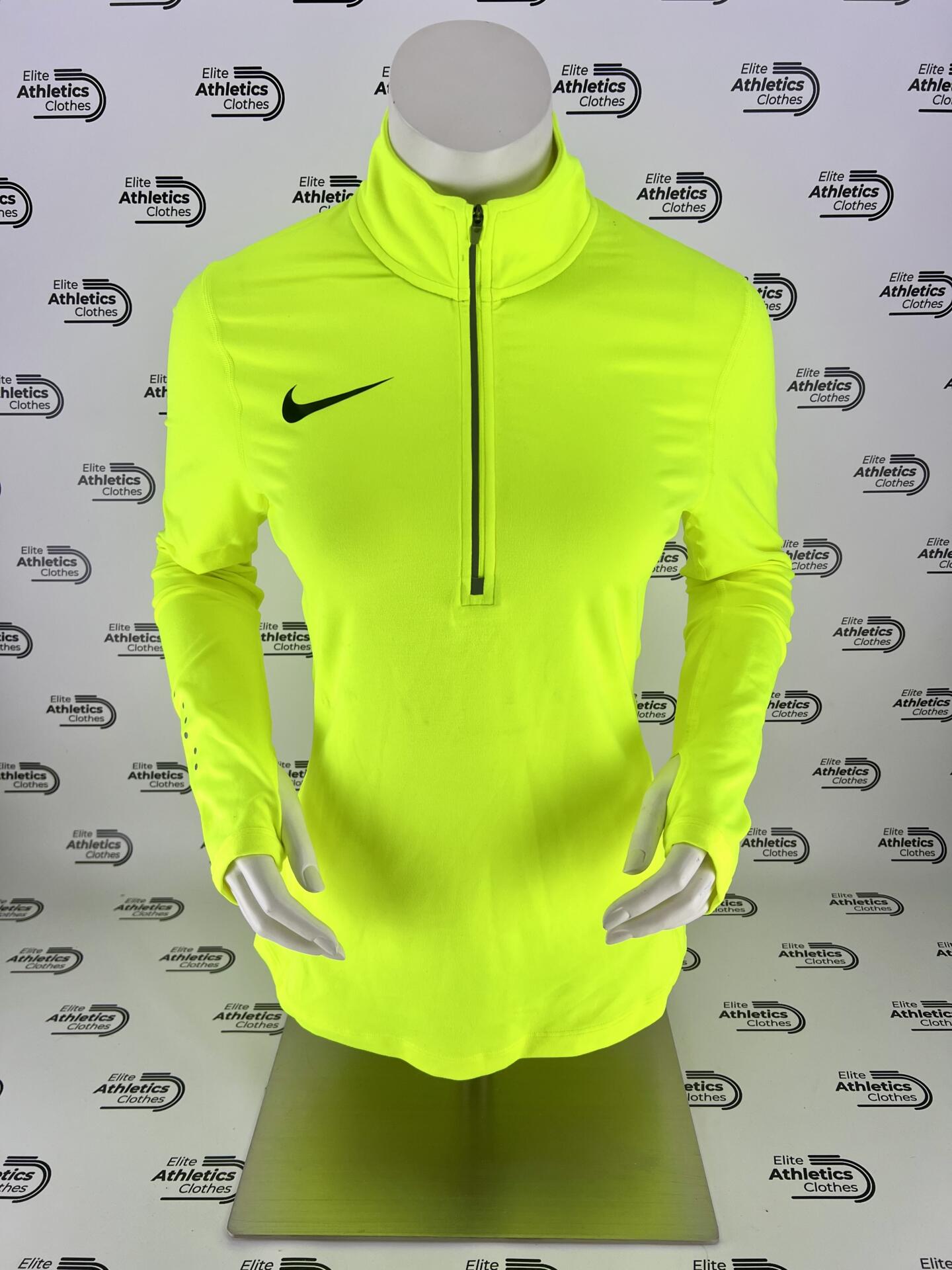 From this series · in the archiveNike Pro Elite Team 2014 Women Half Zip JerseyA 2014 team half-zip — the oldest cut in this rail, from the cycle that built the mould.90,00 €View piece →
What the jacket cannot do is the zip. A quarter of the way open over a warm-up, closed to the chin in a cold call room, half down on the bus — the half-zip is the only garment in the kit with a thermostat.
The mid layer, explained
Layering guides put every cold-weather outfit together the same way: a wicking base against the skin, an insulating mid layer over it, a shell on top when weather demands. The half-zip is the kit's answer to the middle slot — and in athletics it usually IS the outer layer, because sessions are short and shells only come out in rain.
The cut follows the job. A high collar that closes to the chin, a zip that stops at the sternum — low enough to vent, high enough that the garment pulls on over the head and stays anchored while running. Sleeves run long, often with thumb-loops in training cuts, and the body is trim so a shell fits over it without bunching.
Fourteen of the sixteen jerseys in this archive declare elastane alongside polyester — the half-zip is a stretch knit, not a woven. It moves like a base layer and insulates like a mid, which is the whole trick.
How a jersey is built
The construction brief is stable across suppliers and decades — a 2014 Nike team half-zip and a 2026 one differ in fabric finish, not in idea.
- The knitPolyester with elastane — 14 of 16 pieces in this archive declare the blend. Stretch is structural: the jersey moves with the stride.
- The zipSternum-length — the vent. Open for effort, closed for cold, and the collar stands either way.
- The collarHigh and close, the wind seal for the neck a tee cannot offer.
- The insulation0.34 clo on the ASHRAE garment scale — two hundredths below a thin jacket, with none of the bulk.
- The cuffsLong sleeves, close cuffs, thumb-loops on training cuts — the wrist is where a mid layer leaks.
- The badgeFederation or team mark on the chest, matching the race kit of its cycle — this is issued kit, not fan wear.
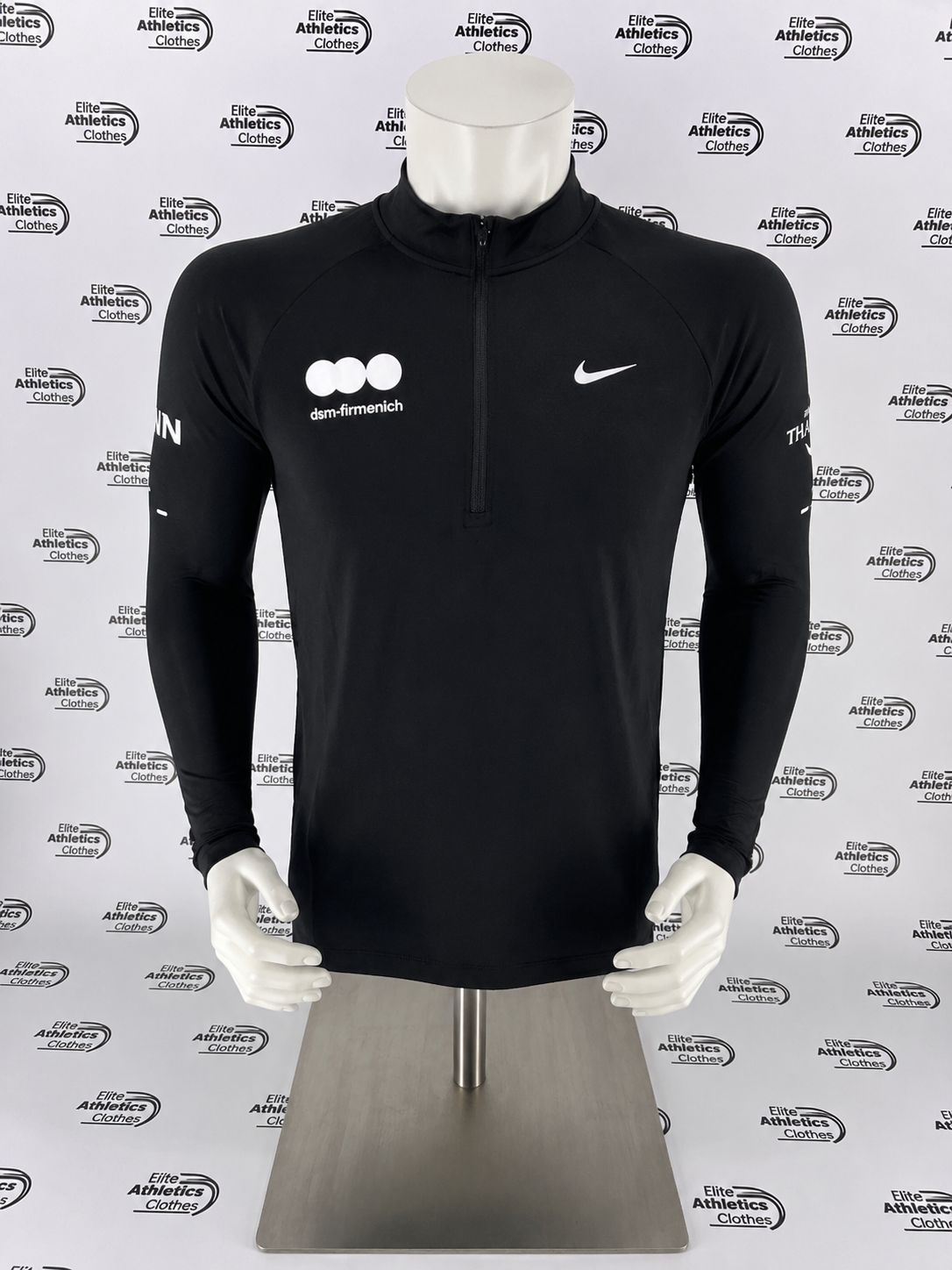 From this series · in the archiveNike DSM-Firmenich Team Pro Elite 2026 Training Half Zip JerseyThe newest cycle in the rail — a 2026 pro-team training half-zip, same idea, current knit.180,00 €View piece →
The long-sleeve training shirt is the half-zip's little sibling — same knit, no collar, no zip — and teams issue both because the two-hundredths of clo between them is sometimes exactly the difference a session needs.
How to choose yours
Choosing a half-zip is choosing the workhorse — the piece that gets worn, not displayed.
- Trim, not tightThe jersey should sit close enough to go under a shell — if it fits like a hoodie, it is a size up from its job.
- Check the zip garageA good half-zip parks the zip pull in a fabric garage at the chin — the detail that separates issued kit from cheap copies.
- Match the cycleThe jersey carries its kit's year and colours — pair it with the race pieces of the same season.
- Old rails run deepLike jackets, jerseys survive their kits — this rail reaches back to 2014, further than most singlet rails can.
- Stretch is the tellA team half-zip has elastane in the tag; an all-poly one is usually a supporter piece, not an issue.
- Wear itThe half-zip is the most wearable garment in any issued set — street-ready in a way briefs and singlets never were.
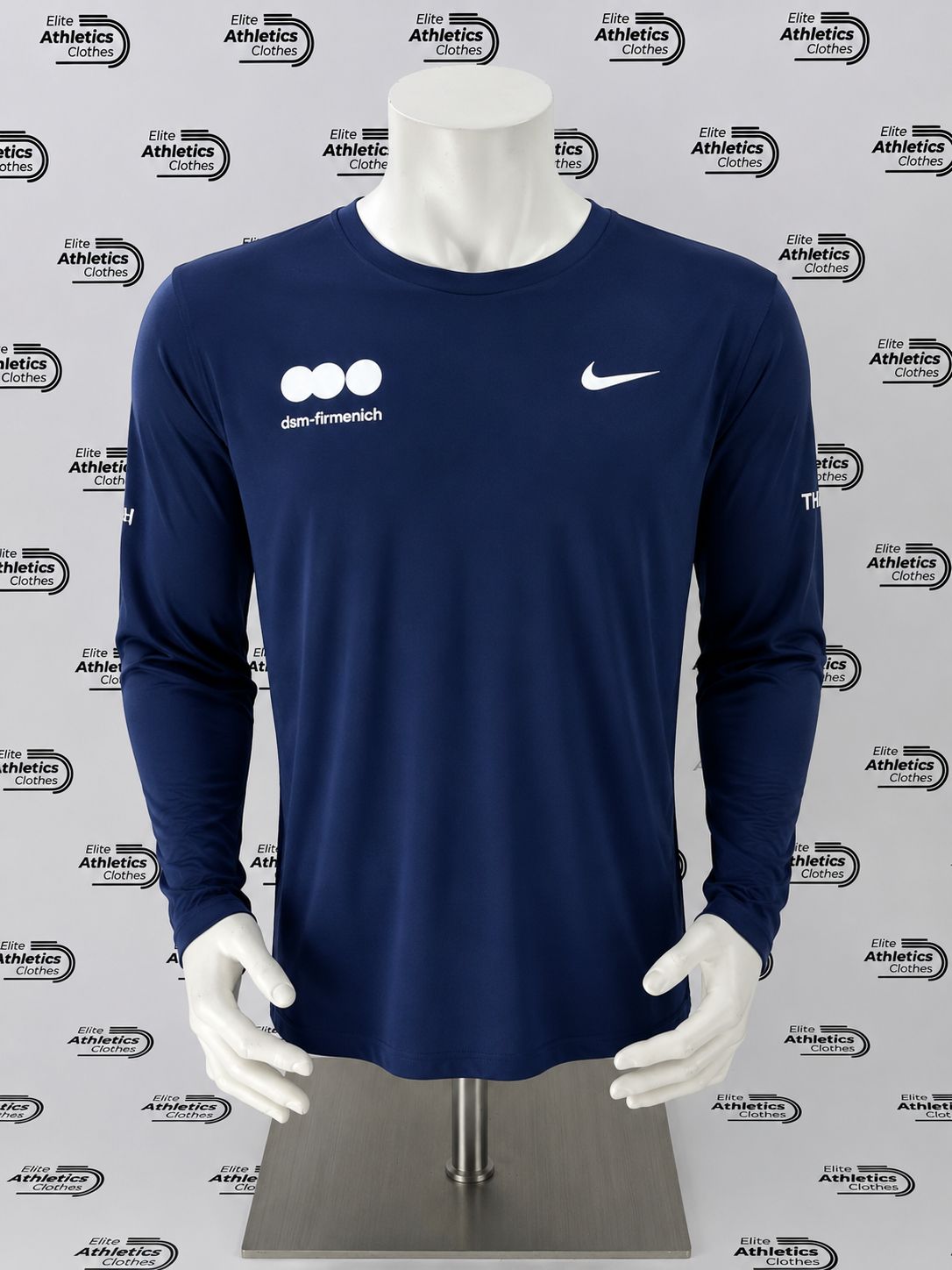 From this series · in the archiveNike DSM-Firmenich Team Pro Elite 2026 Training Long Sleeves ShirtThe little sibling — a long-sleeve training shirt, same knit without the collar and zip.180,00 €View piece →
If the singlet is the trophy and the jacket is the witness, the half-zip is the tool: the garment a professional actually wore most hours of their season.

Half-Zip Jerseys in the Archive
Federation and pro-team half-zips from 2014 to the current cycle — the mid layer of the issued kit, made for a single season and matched to the race pieces in this archive. In-stock first; sold-out pieces stay listed because the runs rarely return.
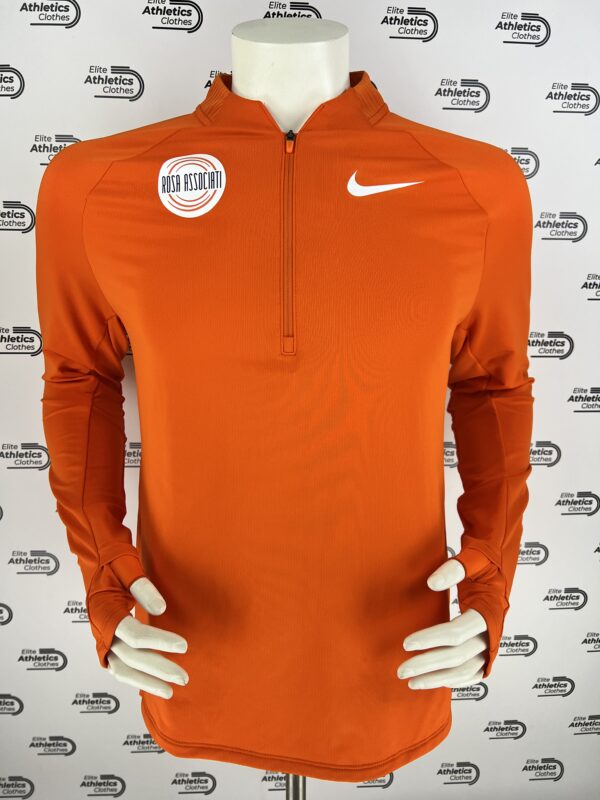 Nike Rosa & Co. Pro Elite Team 2023 Half Zip Jersey200,00 €View Piece →
 Nike Qatar International Team Pro Elite 2022 Half Zip Jersey200,00 €View Piece →
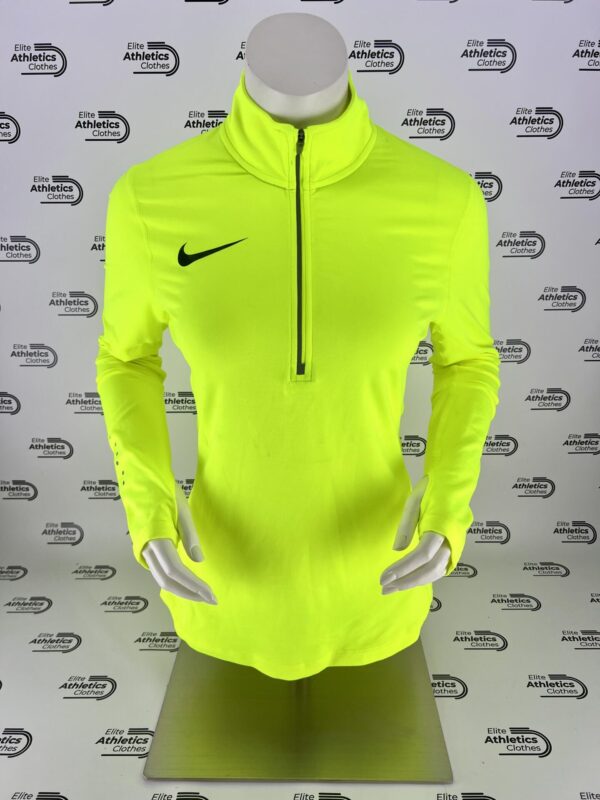 Nike Pro Elite Team 2014 Women Half Zip Jersey90,00 €View Piece →
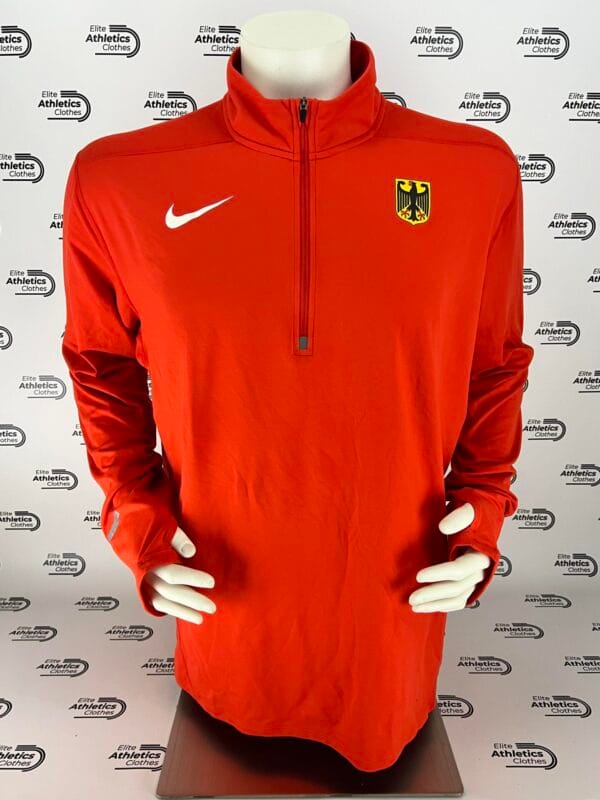 Nike Germany International Team 2019 Pro Elite Half Zip Jersey100,00 €View Piece →
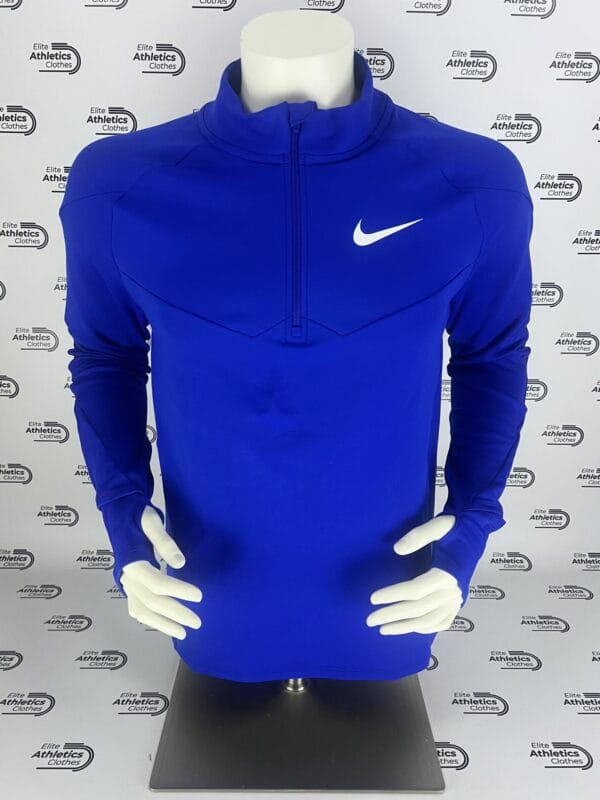 Nike Rosa & Co. Pro Elite Team 2024 Half Zip Jersey240,00 €View Piece →
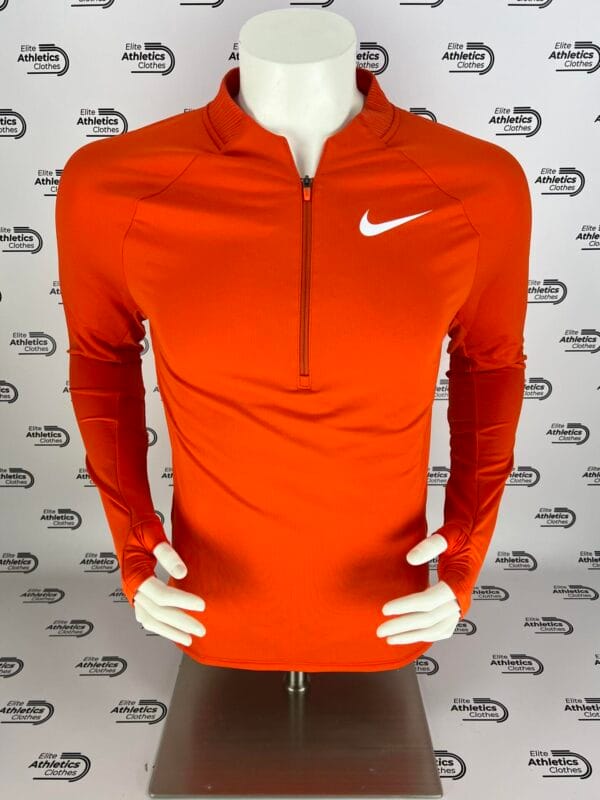 Nike Rosa & Co. Pro Elite Team 2022 Half Zip Jersey200,00 €View Piece →
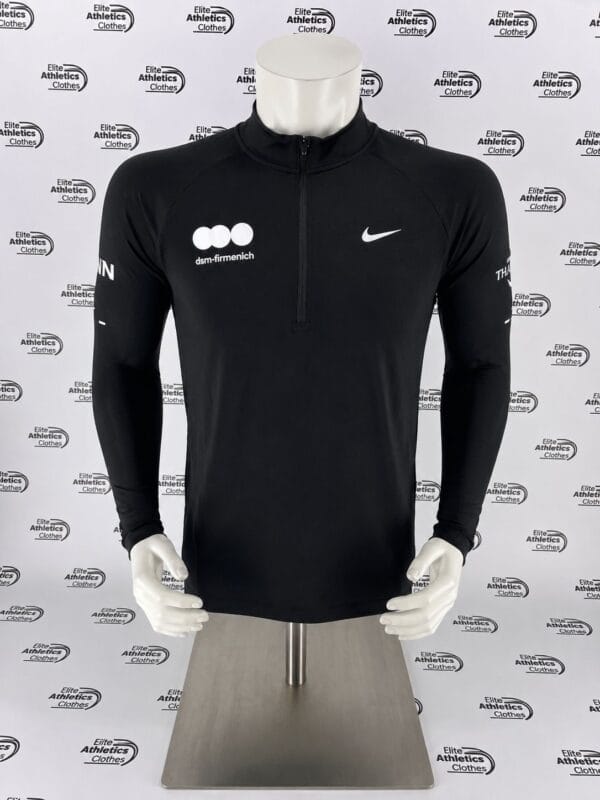 Nike DSM-Firmenich Team Pro Elite 2026 Training Half Zip Jersey180,00 €View Piece →
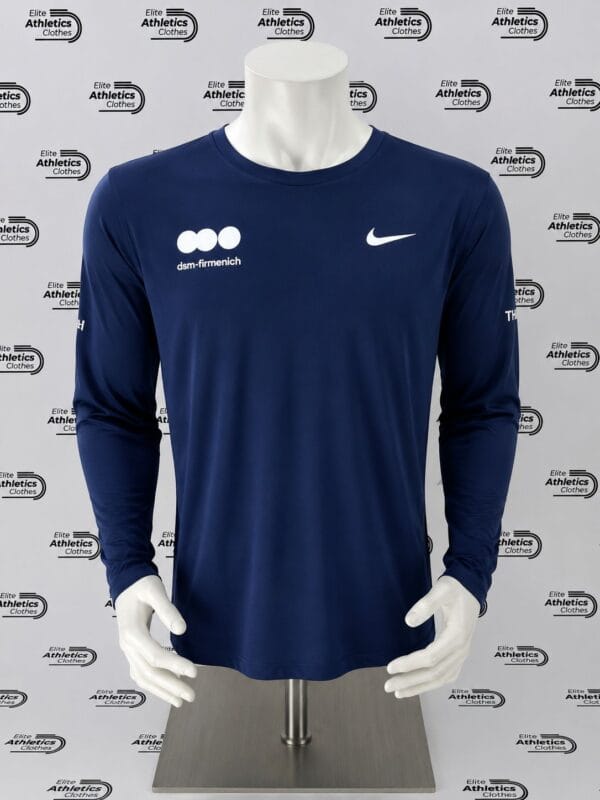 Nike DSM-Firmenich Team Pro Elite 2026 Training Long Sleeves Shirt180,00 €View Piece →
What is a half-zip jersey in athletics?
The mid layer of an issued team kit: a stretch polyester knit with a high collar and a sternum-length zip, worn for cold-weather training and around the stadium. Warmer than a tee, lighter and closer-cut than a jacket, with the team badge of its kit cycle.
How warm is a half-zip compared to a jacket?
Nearly identical. On the ASHRAE 55 garment scale the long-sleeve sweatshirt class measures 0.34 clo against 0.36 for a thin jacket — two hundredths apart. The difference is the zip: the half-zip vents, a jacket only opens.
Why do half-zips stop the zip at the chest?
So the garment pulls on over the head and stays anchored while running, with enough opening to vent heat and a collar that still closes to the chin. Full zips flap; half-zips hold.
What are team half-zips made of?
Polyester knits with elastane — 14 of the 16 jerseys in this archive declare the blend. The stretch is structural: the jersey has to move with the stride rather than sit over it.
How should a half-zip jersey fit?
Trim: close enough to layer under a shell, loose enough for a tee beneath. If it fits like a hoodie it is oversized for its job. Issued cuts run true to street sizing.
Sources and References
- ASHRAE Standard 55 — garment insulation values (clo) — 0.08 / 0.17 / 0.34 / 0.36 / 0.44 clo
- REI — layering: base, mid and shell — the three-layer system
- World Athletics — Technical Rules (TR5) — scope of the uniform rule
- Store archive fabric tags — 14 of 16 declare polyester-elastane