
Great Britain
2016
Two Games in the same stadium a fortnight apart: seven medals on the Olympic programme, thirty-three on the Paralympic — and two different kit contracts in one summer.
Great Britain's 2016 athletics season had two halves in the same Rio stadium: seven medals on the Olympic programme in August, thirty-three on the Paralympic programme in September.
Both were worn in adidas, under the contract the British Olympic and Paralympic Associations hold — while the same athletes wore Nike at every other championship of the year. The piece in our archive is from the Paralympic half.
Part of our Season Series — one year at a time. The full national story is in the history of British athletics. Jump to the 2016 kit or browse the collection.
- The season
- Rio twice: the Olympic athletics programme 12–21 August, the Paralympic 8–18 September
- Olympic haul
- 7 medals (2-1-4), sixth in the athletics table — both golds Mo Farah's
- Paralympic haul
- 33 medals (15-7-11), third in para-athletics behind China and the USA
- The first day
- Four golds on 9 September — Hermitage, Hahn, Clegg and Peacock
- Two sports, one Games
- Kadeena Cox: track cycling gold and 400 m T38 gold, four days apart
- Still standing
- Sophie Hitchon's 74.54 m hammer — British record ten years on
- The kit contracts
- adidas for the Games (BOA/BPA, since 1984) · Nike for British Athletics (since 2014)
- In our archive
- 1 piece — adidas ParalympicsGB 2016 women's long pants
Seven Medals, Two of Them Farah's
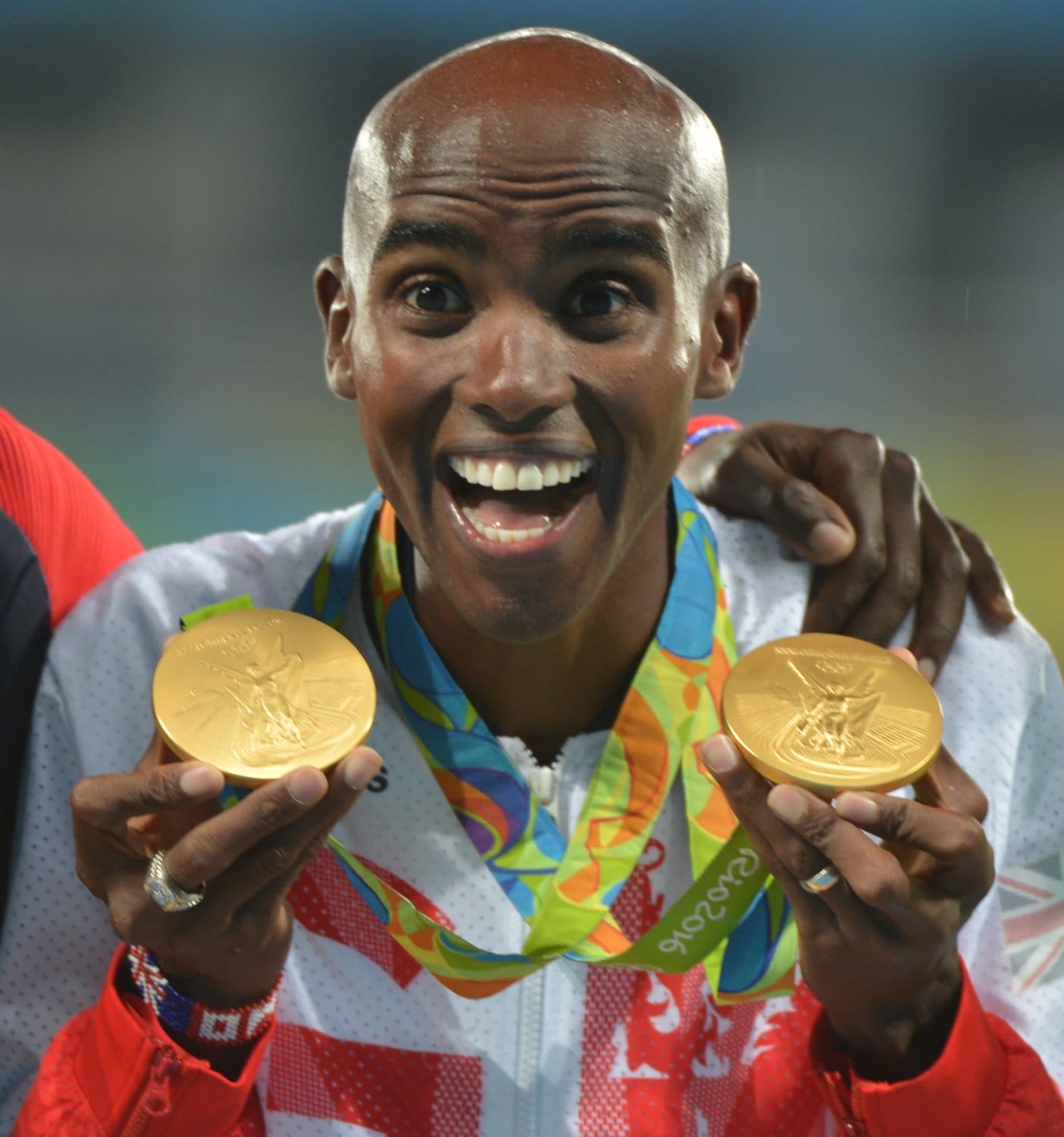
Great Britain took 80 track and field athletes to Rio, named on 13 July 2016, and came home with seven medals: two gold, one silver and four bronze, sixth in the athletics medal table. Both golds were Mo Farah's. He won the 10,000 m on 13 August in 27:05.17 after going down mid-race in a tangle with his training partner Galen Rupp, getting straight back up and winning anyway, and the 5000 m on 20 August in 13:03.30 — a second distance double at consecutive Games, something only Lasse Virén had done before him.
- GoldMo Farah — 10,000 m · 13 August27:05.17
- GoldMo Farah — 5000 m · 20 August13:03.30
- SilverJessica Ennis-Hill — Heptathlon · 12–13 August6775 pts
- BronzeGreg Rutherford — Long jump · 13 August8.29 m
- BronzeSophie Hitchon — Hammer · 15 August74.54 m · British record
- BronzePhilip, Henry, Asher-Smith, Neita — 4×100 m · 19 August41.77
- BronzeDoyle, Onuora, Diamond, Ohuruogu — 4×400 m · 20 August3:25.88
The other five tell a harder story. Jessica Ennis-Hill, defending the heptathlon title she won in London, lost it by 35 points to Nafissatou Thiam and retired eight weeks later, on 13 October. Greg Rutherford, defending the long jump, dropped to bronze with 8.29 m. Sophie Hitchon threw 74.54 m in the last round of the hammer for a British record and the first British Olympic medal ever won in the event; ten years on, in September 2026, that record is still hers, and the next best British mark alive is about four metres behind it. The two women's relays took bronze. The 41.77 of the 4×100 m has since gone: Asher-Smith, Lansiquot, Hunt and Neita ran 41.55 in London on 20 July 2024.
The rest of the season ran under a different contract, which matters for what is in the case downstairs. At the European Championships in Amsterdam in July, Britain took 16 medals and finished third; at the World Indoor Championships in Portland in March, three. Russia was absent from all of it: the IAAF Council suspended its federation in November 2015 and voted unanimously on 17 June 2016 to keep the suspension in place, and only Darya Klishina competed in Rio, cleared as a neutral two days before the long jump.
Thirty-Three Medals, Sorted by Class
The Paralympic programme opened on 8 September and ran to 18 September — 177 events, 1,100 athletes, the biggest block of the Games. ParalympicsGB finished third in para-athletics with 33 medals, 15 of them gold, behind China and the United States; across all sports the team took 147 medals and finished second, its best return since Seoul 1988. Para-athletics was its second most productive sport after swimming.
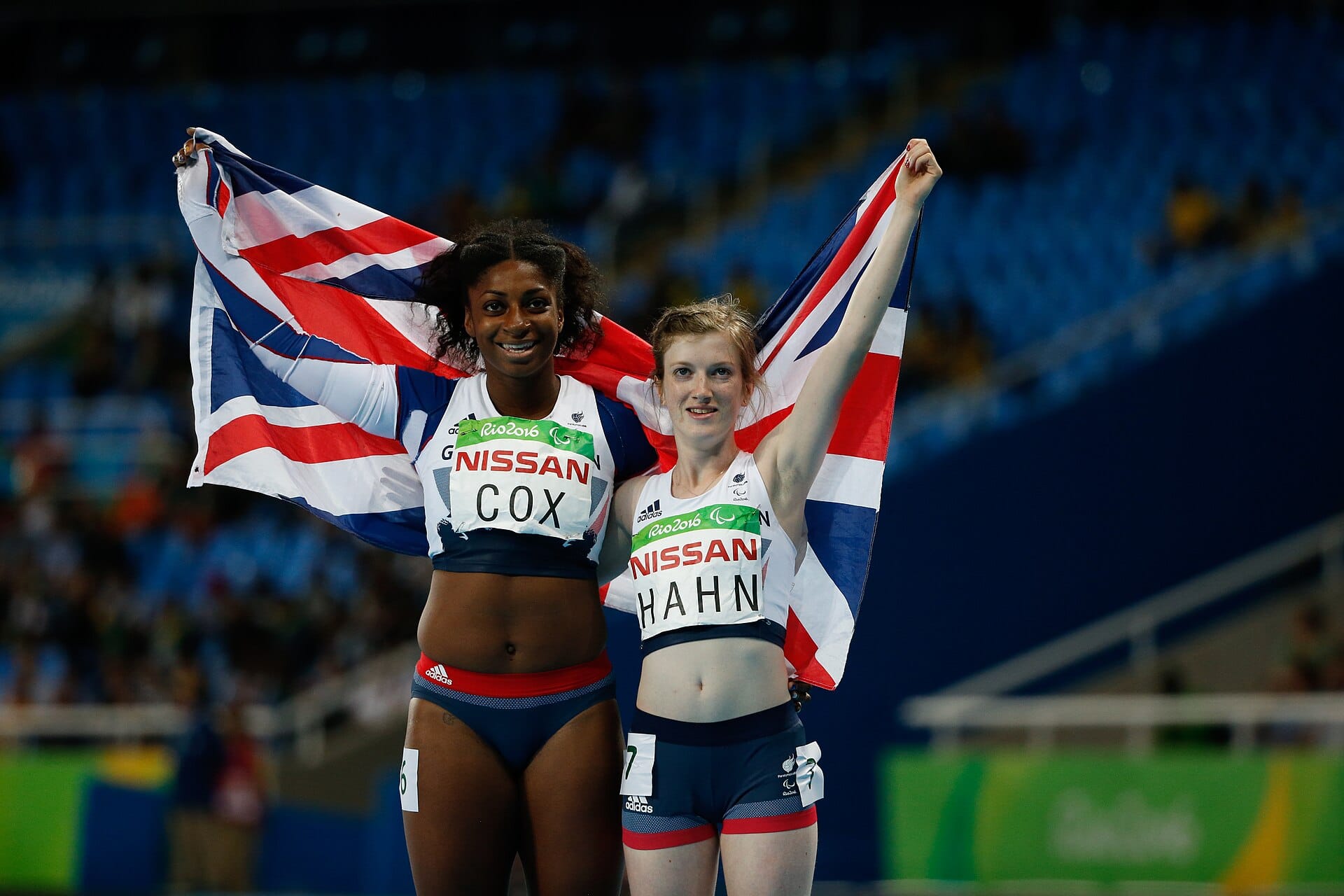
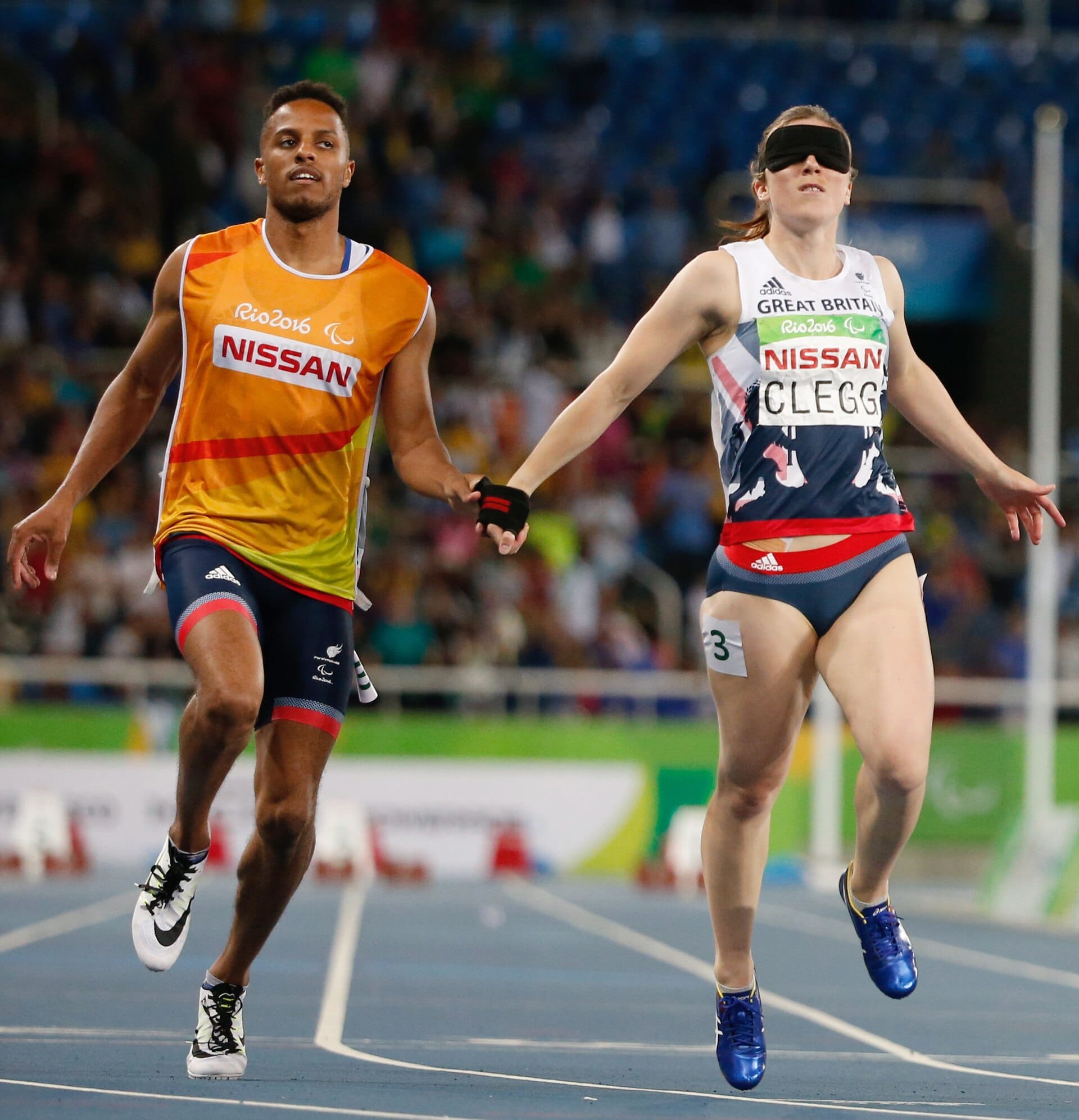
Four of those golds landed on the first day, 9 September: Georgina Hermitage in the 100 m T37 in 13.13, Sophie Hahn in the 100 m T38 in 12.62, Libby Clegg with her guide Chris Clarke in the 100 m T11 in 11.96, and Jonnie Peacock in the 100 m T44 in 10.81. Hannah Cockroft then took all three of her wheelchair races — 100 m, 400 m and 800 m T34 — with the 15-year-old Kare Adenegan second or third in every one of them. Kadeena Cox won the 400 m T38 in 1:00.71 four days after winning the 500 m time trial C4-5 on the track bike, making her the first British athlete since 1984 to win golds in two different sports at the same Games.
Every medal of the 2016 British summer (table)
| Programme | Class family | Medal | Athlete and event |
|---|---|---|---|
| Paralympic | T11 | Gold | Libby Clegg, guide Chris Clarke — 100 m T11 — 9 Sep — 11.96 |
| Paralympic | T11 | Gold | Libby Clegg, guide Chris Clarke — 200 m T11 — 13 Sep — 24.51 |
| Paralympic | T33–T34 | Gold | Hannah Cockroft — 100 m T34 — 10 Sep — 17.42, Paralympic record |
| Paralympic | T33–T34 | Gold | Hannah Cockroft — 400 m T34 — 14 Sep — 58.78, world record |
| Paralympic | T33–T34 | Gold | Hannah Cockroft — 800 m T34 — 16 Sep — 2:00.62 |
| Paralympic | T33–T34 | Silver | Kare Adenegan, 15 years old — 100 m T34 — 10 Sep — 18.29 |
| Paralympic | T33–T34 | Silver | Toby Gold — 100 m T33 — 10 Sep |
| Paralympic | T33–T34 | Bronze | Kare Adenegan — 400 m T34 — 14 Sep — 1:01.67 |
| Paralympic | T33–T34 | Bronze | Kare Adenegan — 800 m T34 — 16 Sep — 2:02.47 |
| Paralympic | T33–T34 | Bronze | Andrew Small — 100 m T33 — 10 Sep |
| Paralympic | T35–T38 | Gold | Georgina Hermitage — 100 m T37 — 9 Sep — 13.13, Paralympic record |
| Paralympic | T35–T38 | Gold | Georgina Hermitage — 400 m T37 — 13 Sep — 1:00.53 |
| Paralympic | T35–T38 | Gold | Sophie Hahn — 100 m T38 — 9 Sep — 12.62 |
| Paralympic | T35–T38 | Gold | Kadeena Cox — 400 m T38 — 14 Sep — 1:00.71, world record |
| Paralympic | T35–T38 | Gold | Paul Blake — 400 m T36 — 16 Sep |
| Paralympic | T35–T38 | Silver | Paul Blake — 800 m T36 — 17 Sep |
| Paralympic | T35–T38 | Silver | 4×100 m T35–38 — 15 Sep — 51.07, European record — Cox, Lyle, Hermitage, Hahn |
| Paralympic | T35–T38 | Bronze | Kadeena Cox — 100 m T38 — 9 Sep — 13.01 |
| Paralympic | T35–T38 | Bronze | Maria Lyle — 100 m T35 — 14 Sep |
| Paralympic | T35–T38 | Bronze | Maria Lyle — 200 m T35 — 17 Sep |
| Paralympic | T42–T44 | Gold | Richard Whitehead — 200 m T42 — 11 Sep — 23.39 |
| Paralympic | T42–T44 | Gold | Jonnie Peacock — 100 m T44 — 9 Sep — 10.81 |
| Paralympic | T42–T44 | Silver | Richard Whitehead — 100 m T42 — 15 Sep — 12.32 |
| Paralympic | T42–T44 | Silver | Jonathan Broom-Edwards — high jump T44 — 12 Sep |
| Paralympic | T42–T44 | Bronze | David Henson — 200 m T42 — 11 Sep — 24.74 |
| Paralympic | F42–F46 | Gold | Aled Davies — shot put F42 — 12 Sep — 15.97 m, Games record |
| Paralympic | F42–F46 | Gold | Hollie Arnold — javelin F46 — 13 Sep — 43.01 m, world record |
| Paralympic | F42–F46 | Silver | Stefanie Reid — long jump F44 — 9 Sep |
| Paralympic | F42–F46 | Bronze | Dan Greaves — discus F44 — 16 Sep |
| Paralympic | F32–F51 | Gold | Joanna Butterfield — club throw F51 — 11 Sep |
| Paralympic | F32–F51 | Bronze | Gemma Prescott — club throw F32 — 9 Sep |
| Paralympic | F32–F51 | Bronze | Stephen Miller — club throw F32 — 13 Sep |
| Paralympic | F20 | Bronze | Sabrina Fortune — shot put F20 — 10 Sep — 12.94 m, personal best |
| Olympic | — | Gold | Mo Farah — 10,000 m — 13 Aug — 27:05.17, after falling mid-race |
| Olympic | — | Gold | Mo Farah — 5000 m — 20 Aug — 13:03.30 |
| Olympic | — | Silver | Jessica Ennis-Hill — heptathlon — 12–13 Aug — 6775 pts, 35 behind Thiam |
| Olympic | — | Bronze | Greg Rutherford — long jump — 13 Aug — 8.29 m |
| Olympic | — | Bronze | Sophie Hitchon — hammer — 15 Aug — 74.54 m, still the British record |
| Olympic | — | Bronze | 4×100 m — 19 Aug — 41.77, national record at the time — Philip, Henry, Asher-Smith, Neita |
| Olympic | — | Bronze | 4×400 m — 20 Aug — 3:25.88 — Doyle, Onuora, Diamond, Ohuruogu |
That grid is the difference between the two halves of the summer. The Olympic programme has one open category and no classes at all; the Paralympic programme sorts the same events into families of impairment, so a single sprint distance can produce four different champions. It is also why a piece of ParalympicsGB kit is a distinct object rather than a variant: it was issued for a competition that is organised on a second axis.
Two Kits, One Summer
A British athlete in 2016 wore two different kits in the same summer, under two different contracts, and our piece belongs to the second one.
adidas dressed Team GB and ParalympicsGB in Rio under the contract held by the British Olympic Association and the British Paralympic Association — a relationship that began at Los Angeles 1984, has never been interrupted, and now runs to 2032. Nike dressed the same athletes at everything else: British Athletics signed with Nike in 2013, effective from 2014, and the deal was extended to 2030 during the London World Championships in 2017. As Athletics Weekly put it in 2024, the Olympic kit “is only used for the Olympics and Paralympics too. For other major championships… the British team wears Nike gear.”
So Portland in March and Amsterdam in July were Nike; Rio in August and September was adidas. Stella McCartney designed that adidas range, as she had for London 2012, and it covered Team GB and ParalympicsGB as one line: same crest, same identity, presented in Marylebone on 27 April 2016. The crest itself was new, drawn with the College of Arms — rose, thistle, leek and flax, a crown of medals and relay batons, the motto Ivncti in vno. The row about a shortage of red belongs to 2012, not to this kit; the complaints in 2016 were about how brief some of the women's pieces were and how large the crest sat.
The piece we hold is from the Paralympic half: women's long pants, blue and white, 75% polyester and 25% rayon, made in Indonesia, new with its original tags. Warm-up rather than competition cloth — the layer an athlete lives in around the call room, which is what our anatomy of track pants is about. The way to place a piece like this is the way our authentication guide sets out: read the crest, the year of the contract and the country of manufacture, not the badge alone.
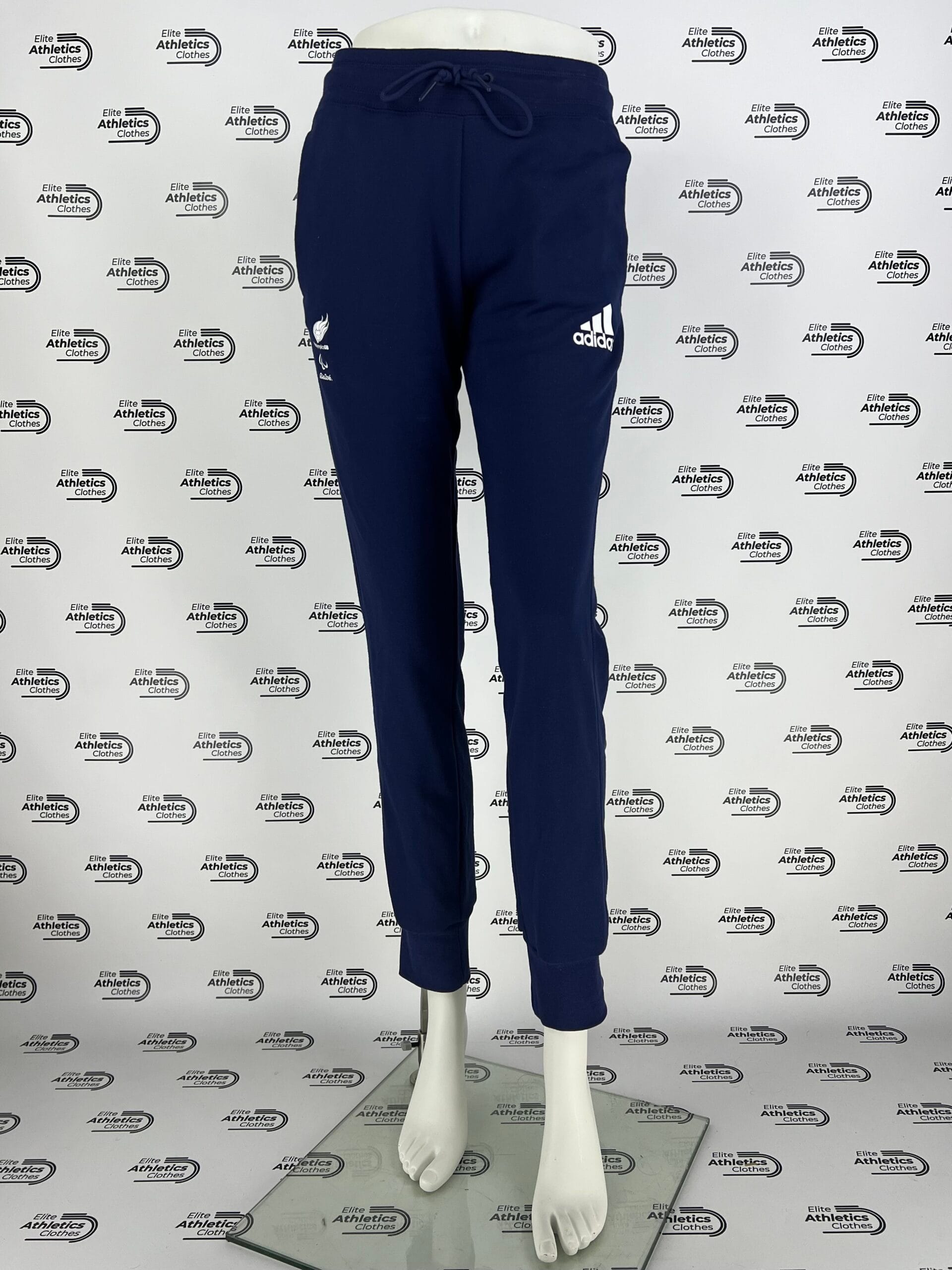 From this summer · in the archiveAdidas Great Britain Paralympics Team Pro Elite 2016 Women Long PantsParalympicsGB warm-up pants from Rio — the adidas half of the 2016 British summer, new with its original tags.50,00 €View piece →
Shop Great Britain
British race-issued kit in the archive, with the 2016 cycle first. Rio pieces are scarce for a plain reason: the Games kit is issued for two weeks of one summer and then never made again, and the Paralympic half of it was issued to a smaller team still. Browse the rest of the British rail in the collection, or read the seasons either side in Great Britain 2019, GB 2020 and Great Britain 2024.
How many medals did British athletics win in 2016?
Seven at the Olympic Games in Rio — two gold, one silver, four bronze, sixth in the athletics medal table — and 33 at the Paralympic Games in the same stadium a fortnight later: 15 gold, 7 silver, 11 bronze, third in para-athletics.
Who wore the adidas Great Britain kit in 2016?
Both teams. adidas held the contract with the British Olympic Association and the British Paralympic Association, so it dressed Team GB in August and ParalympicsGB in September, in one range designed by Stella McCartney and presented on 27 April 2016.
Is Great Britain's athletics kit made by adidas or Nike?
Both, for different competitions. adidas supplies the Olympic and Paralympic teams under the BOA and BPA contract, unbroken since Los Angeles 1984 and now running to 2032. Nike supplies British Athletics for everything else — World Championships, European Championships, indoors — signed in 2013, effective from 2014 and extended to 2030.
What did Mo Farah do in Rio 2016?
He won the 10,000 m on 13 August in 27:05.17, having fallen mid-race after clipping Galen Rupp, and the 5000 m on 20 August in 13:03.30. It was his second 5000-10,000 double at consecutive Games; only Lasse Virén had done it before. Farah retired after the Great North Run in September 2023.
What did Kadeena Cox win in Rio?
Gold in the 500 m time trial C4-5 on the track bike on 10 September and gold in the 400 m T38 on 14 September in a world record 1:00.71, plus bronze in the 100 m T38 and silver in the 4×100 m T35-38 relay. She was the first British athlete in 32 years to win golds in two sports at the same Games.
Do any British records from 2016 still stand?
Sophie Hitchon's hammer throw of 74.54 m, set in the final round in Rio on 15 August, is still the British record in September 2026. The 4×100 m relay record of 41.77 from those Games has gone: 41.55 in London on 20 July 2024.
Sources and References
- Wikipedia — Athletics at the 2016 Summer Olympics — the seven British medals and the athletics medal table
- World Athletics — British Athletics team for Rio (13 July 2016) — the 80-strong squad
- World Athletics — men’s 10,000 m report, Rio 2016 — Farah’s fall and the 27:05.17
- Wikipedia — Great Britain at the 2016 Summer Paralympics — the 33 para-athletics medals, one by one, and the 147 overall
- ParalympicsGB — Rio 2016 — 147 medals, 64 gold, second in the table
- International Paralympic Committee — Kadeena Cox, champion on two different tracks — the 1:00.71 world record and the two-sport double
- Athletics Weekly — record form in Rio (September 2016) — the four golds of 9 September
- Team GB — adidas partnership extension to 2032 (July 2024) — the partnership since Los Angeles 1984
- Athletics Weekly — the evolution of the British Olympic athletics kit (April 2024) — the Games kit is worn only at the Games; Nike everywhere else
- Athletics Weekly — British Athletics and Nike extend to 2030 (2017) — the federation deal from 2014 and its extension
- Wikipedia — List of British records in athletics — Hitchon’s 74.54 m still standing; the 4×100 m record now 41.55