
IRELAND
Four Olympic golds, all of them won between 1928 and 1956. Seven World Championship medals shared by six athletes. And a national championship that has not missed a year since 1873 — the longest unbroken series in the world.
Ireland has won seven Olympic and seven World Championship medals in athletics. All four Olympic golds came in a single 28-year window between 1928 and 1956; the most recent global medal is Kate O'Connor's heptathlon silver in Tokyo in September 2025.
That record is thin for 150 years of competition, and it is the wrong way to measure the sport here. What Ireland has that nobody else does is continuity: national championships held every single year since 1873, through emigration, partition, war and the repeated collapse of the bodies that ran them. This is the history of both — the unbroken line and the fourteen times it produced a global medal.
Race-issued Irish kit is scarce for the same reason the medal list is short: it is made in team allocations, never for retail. See what has come out of the channel in the Ireland rail.
- National championships since
- 1873 — the longest continually held national athletics championships in the world
- Governing body
- Athletics Ireland, formed 2000 from Bord Lúthchleas na hÉireann and the NACA
- Olympic athletics medals
- 7 — 4 gold, 2 silver, 1 bronze
- World Championship medals
- 7 — 4 gold, 3 silver, won by six athletes
- Olympic champions
- O'Callaghan (1928, 1932), Tisdall (1932), Delany (1956)
- Best championship
- Rome 2024 — 2 gold, 2 silver, 10th in the European medal table
- Most recent medal
- Kate O'Connor, heptathlon silver, Tokyo 2025, 6714 pts (national record)
- Oldest national record
- Catherina McKiernan, marathon 2:22:23, set in 1998
The Oldest Championships in the World
Irish athletics is older than the Irish state. The first meeting recognisable as a modern athletics competition was held at Trinity College, Dublin in 1857. In 1872 an engineer named Henry Dunlop founded the Irish Champion Athletic Club, and the following year he organised the country's first national championships. Those championships have been held every year since.
World Athletics puts it plainly: the Irish national championships, in their various forms, are the longest continually held national athletics championships in the world. They ran through famine-era emigration, through partition, through two world wars and a civil war, through the collapse and merger of every governing body that has ever administered them. The 150th edition was staged in 2022.
National championships · held every year since 1873
Olympic and World Championship medals
Medal data — table view
| Year | Athlete | Event | Medal | Championship |
|---|---|---|---|---|
| 1928 | Pat O’Callaghan | Hammer | Gold | Olympic Games, Amsterdam |
| 1932 | Bob Tisdall | 400 m hurdles | Gold | Olympic Games, Los Angeles |
| 1932 | Pat O’Callaghan | Hammer | Gold | Olympic Games, Los Angeles |
| 1956 | Ronnie Delany | 1500 m | Gold | Olympic Games, Melbourne |
| 1983 | Eamonn Coghlan | 5000 m | Gold | World Championships, Helsinki |
| 1984 | John Treacy | Marathon | Silver | Olympic Games, Los Angeles |
| 1993 | Sonia O’Sullivan | 1500 m | Silver | World Championships, Stuttgart |
| 1995 | Sonia O’Sullivan | 5000 m | Gold | World Championships, Gothenburg |
| 2000 | Sonia O’Sullivan | 5000 m | Silver | Olympic Games, Sydney |
| 2003 | Gillian O’Sullivan | 20 km walk | Silver | World Championships, Paris |
| 2009 | Olive Loughnane | 20 km walk | Gold | World Championships, Berlin |
| 2012 | Rob Heffernan | 50 km walk | Bronze | Olympic Games, London |
| 2013 | Rob Heffernan | 50 km walk | Gold | World Championships, Moscow |
| 2025 | Kate O’Connor | Heptathlon | Silver | World Championships, Tokyo |
The governing bodies themselves were far less durable than the meeting they ran. The Irish Amateur Athletic Association was founded in 1885, the same year the GAA began staging its own athletics championships — the start of a split that took most of a century to close. Ireland joined the IAAF in 1924 and sent a team to the Paris Olympics that summer. The Irish Amateur Athletic Union followed in 1937, Bord Lúthchleas na hÉireann in 1967, and the present body, Athletics Ireland, only in 2000.
Four Golds in 28 Years
Every one of Ireland's four Olympic athletics golds was won in a 28-year window between 1928 and 1956, and three of them came from two afternoons.
Pat O'Callaghan
Hammer · Amsterdam 1928 and Los Angeles 1932 · Gold, Gold
A doctor from Cork, O'Callaghan won the hammer in Amsterdam in 1928 — the first Olympic medal of any colour for an independent Ireland. Athletics Ireland records that the podium was the first time at an Olympic Games that the Irish tricolour was raised and Amhrán na bhFiann was played. Four years later in Los Angeles he retained the title with a throw of 176 feet 11 inches.
Bob Tisdall
400 m hurdles · Los Angeles 1932 · Gold
Tisdall won the 400 m hurdles on 1 August 1932, and O'Callaghan took the hammer the same day. Ireland had two Olympic champions inside an hour — a thing that has not happened since, in any sport.
Ronnie Delany
1500 m · Melbourne 1956 · Gold
Delany was 21 when he won the 1500 m in Melbourne on 1 December 1956, kicking off the final bend to beat a field that had not rated him, and breaking the Olympic record. He had gone to Villanova on a scholarship and was coached there by Jumbo Elliott; between 1956 and 1959 he won 40 consecutive indoor races. His gold bridged a 24-year gap back to Tisdall and O'Callaghan. Delany died on 11 March 2026, five days after his 91st birthday.
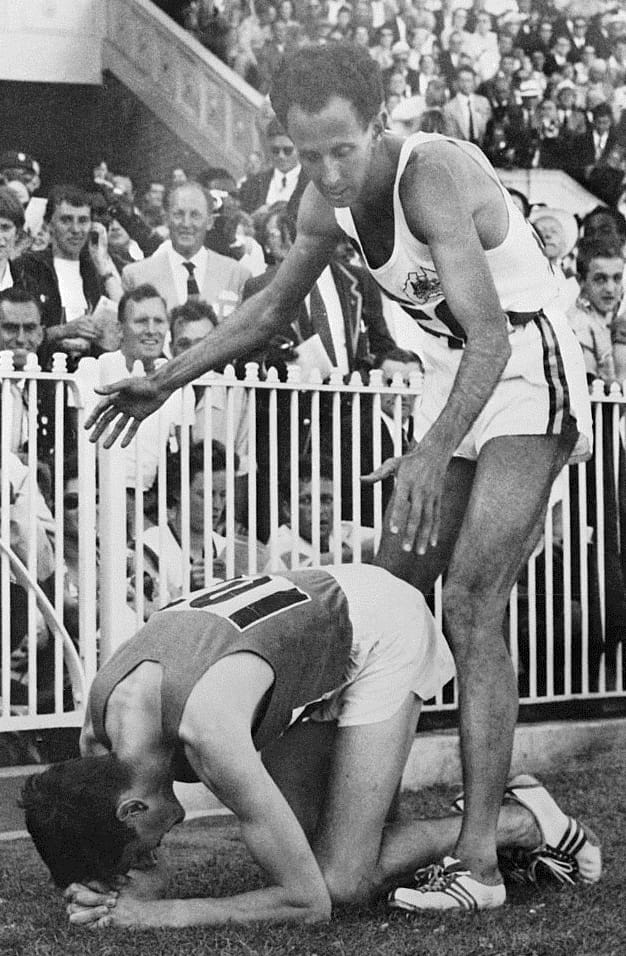
Then the golds stopped. It would be 27 years before an Irish athlete stood on top of a global podium again, and when it happened it was at a championship that had not existed in Delany's day.
Coghlan, Treacy and Sonia
The first World Championships were held in Helsinki in 1983. Eamonn Coghlan won the 5000 m at them — Ireland's first world title, at the first edition, in an event he had never won a major medal in. A year later John Treacy took Olympic marathon silver in Los Angeles, passing Britain's Charlie Spedding 150 metres from the line after finishing ninth in the 10,000 m final earlier in the same Games.
The 1990s belonged to one runner. Sonia O'Sullivan took 1500 m silver at the 1993 World Championships in Stuttgart, then the 5000 m world title in Gothenburg in 1995, then Olympic 5000 m silver in Sydney in 2000. Her time in that Sydney final, 14:41.02, is still the Irish record twenty-six years later. She has two of Ireland's seven World Championship medals; no other Irish athlete has more than one.
Eamonn Coghlan
World 5000 m champion, Helsinki 1983 — Ireland's first world title.
John Treacy
Olympic marathon silver, Los Angeles 1984, and ninth in the 10,000 m final at the same Games.
Sonia O'Sullivan
World 5000 m champion 1995, world 1500 m silver 1993, Olympic 5000 m silver 2000.
The Walking Decade
For a decade after O'Sullivan, Ireland's global medals came almost entirely from race walking — three of the four won between 2003 and 2013.
Gillian O'Sullivan took 20 km walk silver at the 2003 World Championships in Paris. Olive Loughnane walked to what was recorded as silver in Berlin in 2009 and was later promoted to the world title when Russia's Olga Kaniskina was banned. And Rob Heffernan won the 50 km at the 2013 World Championships in Moscow in 3:37:56, more than a minute clear, in a time that was the fastest in the world that year by over three minutes.
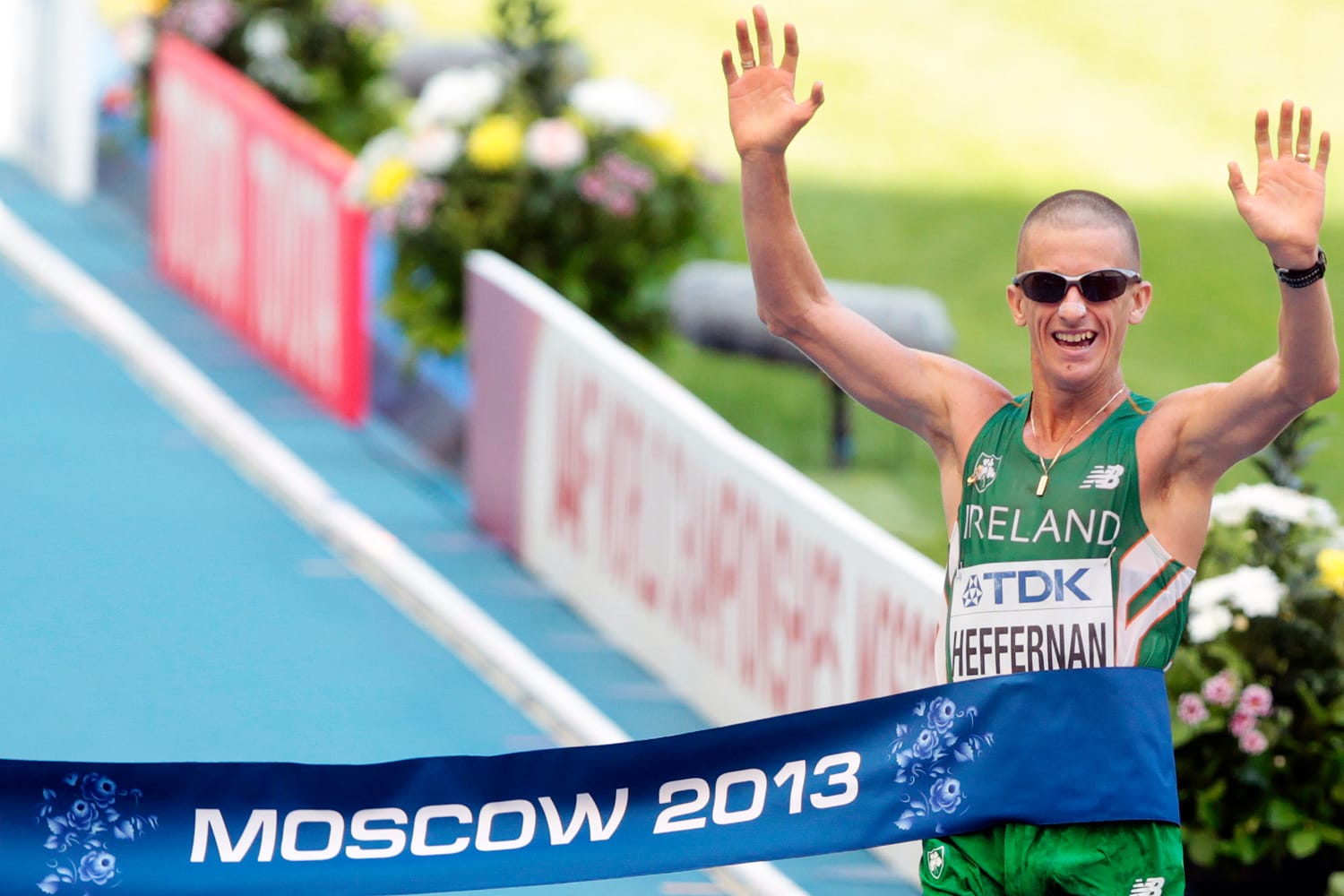
Heffernan's other medal took four years to reach him. He finished fourth in the 50 km walk at the London Olympics on 11 August 2012 in 3:37:54, an Irish record. In March 2016 the Court of Arbitration for Sport upheld appeals against six Russian athletes, and the disqualification of the winner, Sergey Kirdyapkin, moved Heffernan up to bronze. He was presented with it at Cork City Hall on 3 November 2016 — the first Irish athlete to receive an Olympic medal on home soil.
Records That Outlived Their Races
A small federation leaves long-lived records, and Ireland's oldest ones were set in the races that produced its medals. Three in particular have outlasted the careers around them.
O'Sullivan's 5000 m and Heffernan's 50 km both come from finals that put an Irish athlete on an Olympic podium. Heffernan's has an additional peculiarity: the 50 km walk has since been dropped from the championship programme, so it is a national record with nowhere left to be broken. Catherina McKiernan's marathon record has stood since 1998. At the other end, the two newest entries on the list were both set in the same week in Tokyo in September 2025.
Where Ireland Stands Now
Rome 2024 was the best championship Ireland has ever had. Two golds and two silvers, tenth in the medal table: the mixed 4×400 m relay won the event's first European final in 3:09.92, a championship record, with Christopher O'Donnell, Rhasidat Adeleke, Thomas Barr and Sharlene Mawdsley; Ciara Mageean won the 1500 m in 4:04.66; Adeleke took 400 m silver in 49.07, a national record; and the women's 4×400 m took silver in 3:22.71, another national record.
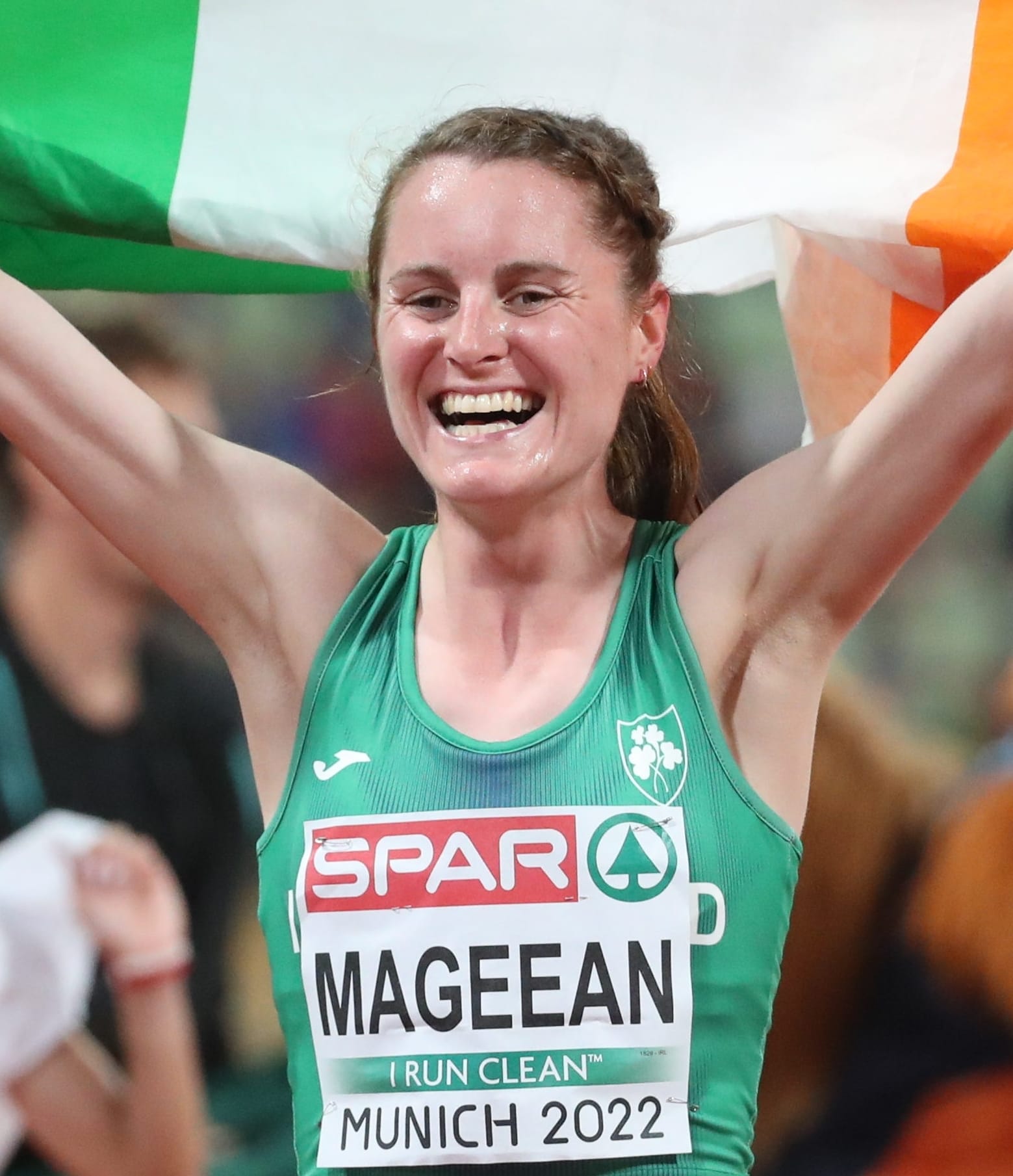
Paris followed six weeks later and produced nothing. Mageean withdrew from the Olympic 1500 m with an Achilles injury; the mixed relay ran 3:12.67 in its semi-final, fifth in the heat and tenth overall, and missed the final by two places. Ireland left the Olympic athletics programme without a medal.
Tokyo 2025 answered it. Ireland sent 30 athletes and Kate O'Connor took heptathlon silver with 6714 points, an Irish record built on personal bests in five of the seven events and a 2:09.56 in the closing 800 m. She is the sixth Irish athlete ever to reach a World Championship podium and the first to medal in a combined event. In the same stadium Cian McPhillips ran 1:42.15 for fourth in the 800 m final, also a national record. O'Connor was named Irish Times and Sport Ireland Sportswoman of the Year for 2025.
Team Ireland in the Archive
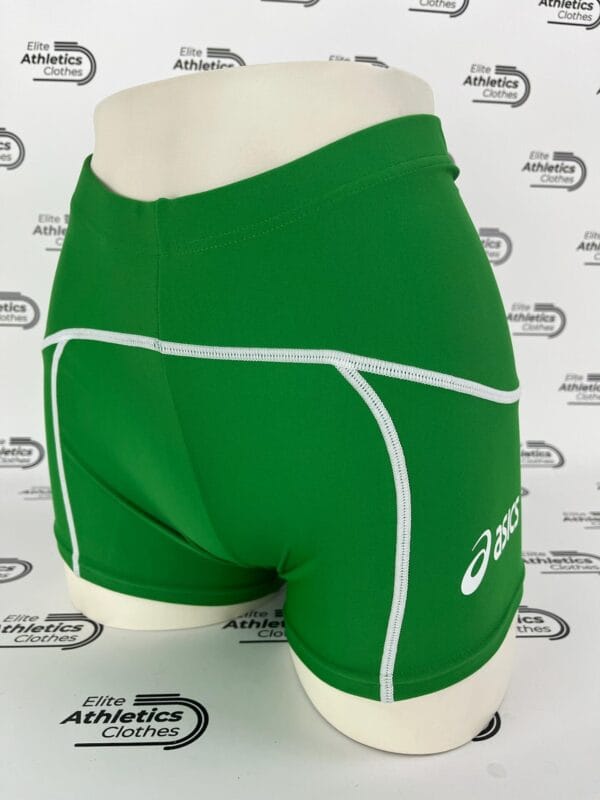
One piece. That is the whole Irish rail, and we would rather show you one real thing than pad the row out with other teams' kit. A federation that sends around twenty athletes to an Olympics issues in quantities that almost never reach resale. ASICS supplied Team Ireland's performance and team clothing for the London 2012 Games, working with the Olympic Council of Ireland and the national federations — this is from exactly that cycle.
How many Olympic medals has Ireland won in athletics?
Seven: four gold, two silver and one bronze. The golds are Pat O'Callaghan in the hammer at Amsterdam 1928 and Los Angeles 1932, Bob Tisdall in the 400 m hurdles at Los Angeles 1932, and Ronnie Delany in the 1500 m at Melbourne 1956. The silvers are John Treacy in the 1984 marathon and Sonia O'Sullivan in the 2000 5000 m, and the bronze is Rob Heffernan in the 50 km walk at London 2012.
Who was Ireland's last Olympic athletics champion?
Ronnie Delany, who won the 1500 m in Melbourne on 1 December 1956 at the age of 21. No Irish athlete has won Olympic athletics gold since. Delany died on 11 March 2026, aged 91.
Are the Irish national championships really the oldest in the world?
They are the longest continually held national athletics championships in the world, according to World Athletics. The first were organised in 1873 by Henry Dunlop of the Irish Champion Athletic Club, and they have been staged every year since; the 150th edition was held in 2022. Other countries have older single meetings, but none has an unbroken national championship series of the same length.
Who is Ireland's most decorated athlete at World Championships?
Sonia O'Sullivan, with two of Ireland's seven World Championship medals: 1500 m silver in Stuttgart in 1993 and the 5000 m title in Gothenburg in 1995. Ireland's other world champions are Eamonn Coghlan (5000 m, 1983), Olive Loughnane (20 km walk, 2009, awarded after the original winner was banned) and Rob Heffernan (50 km walk, 2013).
What was Ireland's best ever championship?
The 2024 European Championships in Rome: two golds and two silvers, and tenth place in the medal table. Ireland won the first European mixed 4×400 m relay final in a championship record of 3:09.92 and Ciara Mageean won the 1500 m, with Rhasidat Adeleke taking 400 m silver in a national record 49.07 and the women's 4×400 m adding another silver.
Is Team Ireland athletics kit sold to the public?
No. Kit issued to athletes representing Ireland is produced in allocations for the squad, not for retail, and it reaches collectors only when an athlete releases a piece. That is why the Irish rail in our archive is short: what is listed is what has actually come out of the team channel.
Sources and References
- World Athletics Heritage — Irish Championships, 150 years unbroken — championship series since 1873, governance chronology, the world's longest continuous national championships
- Athletics Ireland — Irish Athletics History at the Olympics — the seven Olympic athletics medals, the 1928 tricolour, Delany 1956
- Team Ireland — obituary, Ronnie Delany 1935-2026 — date of death, Villanova, the 40-race indoor streak
- Wikipedia — Robert Heffernan — London 2012 time and placing, the March 2016 CAS ruling, Moscow 2013
- Cork Athletics — Heffernan presented with his London 2012 bronze — Cork City Hall, 3 November 2016, first Irish athlete to receive an Olympic medal at home
- Wikipedia — Ireland at the 2024 European Athletics Championships — Rome 2024: two golds, two silvers, tenth, and every mark quoted
- Wikipedia — Ireland at the 2025 World Athletics Championships — squad size, Kate O'Connor 6714, Cian McPhillips 1:42.15
- Athletics Ireland — Kate O'Connor wins historic silver — sixth Irish athlete on a world podium, first in a combined event
- Wikipedia — List of Irish records in athletics — every national record quoted, checked 4 August 2026
- Olympic Council of Ireland — ASICS Olympic clothing — ASICS supplied Team Ireland performance and team clothing for the London 2012 Games