
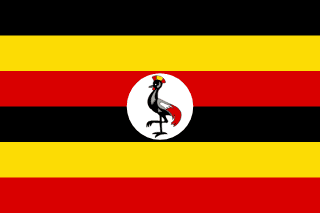
Uganda
From Lake Victoria to the high-altitude roads of Kapchorwa, Uganda has built a deep running tradition — world-record holders, Olympic champions, and some of the most exciting middle- and long-distance runners of the modern era.
Uganda has risen from John Akii-Bua’s world-record 400m hurdles gold at Munich 1972 to become a genuine distance-running nation. Joshua Cheptegei holds the 5,000m and 10,000m world records and won Olympic 5,000m gold at Tokyo 2020, where Peruth Chemutai became the first Ugandan woman to win Olympic athletics gold, in the 3,000m steeplechase.
Its story runs from the colonial schoolyards where running first took hold, through John Akii-Bua’s 1972 Munich gold, to a modern golden era led by Joshua Cheptegei, Peruth Chemutai and Jacob Kiplimo. Built on natural high-altitude talent, a strong running culture and good coaching, Uganda’s rise on the global stage has been steady — a nation that now stands among the best in world athletics.
At Elite Athletics Clothes we celebrate the heritage and ambition of every athletics nation, including Uganda’s running culture. Explore our full range of African athletics apparel and find competition-grade gear worn by the elite athletes who inspire millions.
- Federation
- Uganda Athletics Federation, member of World Athletics
- Olympic athletics medals
- 9: 5 gold · 2 silver · 2 bronze — all in the hurdles, distance track and the marathon
- The unique claim
- Ugandan men hold the 5000m, 10,000m and half-marathon world records at the same time (Cheptegei ×2, Kiplimo)
- Silence, then eruption
- 40 years between Olympic golds — Akii-Bua (1972) to Kiprotich (2012); then a flood of distance medals
- The double world-record man
- Joshua Cheptegei: 5000m 12:35.36 and 10,000m 26:11.00 (both 2020); Olympic gold at 5000m (2020) and 10,000m (2024)
- The first gold
- John Akii-Bua won the 400m hurdles at Munich 1972 in a world-record 47.82 — the first man under 48 seconds, from lane 1
- The first woman
- Peruth Chemutai, 3000m steeplechase gold (Tokyo 2020) — the first Ugandan woman to win any Olympic medal; silver Paris 2024
- The marathon man
- Stephen Kiprotich held the Olympic (2012) and world (2013) marathon titles at the same time
The Origins of Track and Field in Uganda
The roots of competitive athletics in Uganda trace back to the colonial period, when British administrators and missionaries introduced organised sport to the region as part of schooling and military life. Running, jumping and field events were incorporated into missionary school curricula from the early twentieth century, giving young Ugandans their first structured exposure to track and field competition.
Unlike football or cricket, athletics required minimal equipment and could be practised on any open terrain — a crucial advantage in a country where infrastructure was limited. This accessibility made running the great equaliser, drawing in talented youth from rural communities who might otherwise never have had access to competitive sport.
The high-altitude environment of the country’s eastern and western highlands, between 1,200 and 2,300 metres above sea level, would later prove a real physiological advantage for distance runners — the base on which Uganda’s global success was built.
Colonial Roots to a Post-Independence Running Nation
Uganda’s first participation in international athletics came under the banner of British East Africa during the colonial era. Local competitions were held across the protectorate, and the most gifted athletes were occasionally selected to represent the region at inter-colonial meetings. The Uganda Athletics Federation was formally established in the years surrounding independence, tasked with building a structured system of development, selection and international representation.
Uganda gained independence from Britain on 9 October 1962, and with it came a strong drive to compete internationally. Athletics was one of the most accessible and prestigious routes to recognition, and the country had already made its Olympic debut at the 1956 Melbourne Games.
The 1960s were a formative decade. Government investment in sport, combined with the expansion of secondary-school athletics programmes, began to produce a pipeline of competitive athletes. Participation in East African regional championships — contested against Kenya, Tanzania and Ethiopia — provided crucial experience and helped identify the athletes capable of performing at world level.
Uganda’s Greatest Athletes
Ugandan athletics history runs through a small group of outstanding performers who carried the crested crane higher than almost anyone expected — from a boycott-era Olympic great to a modern generation rewriting the record books. These are the athletes who have defined it.
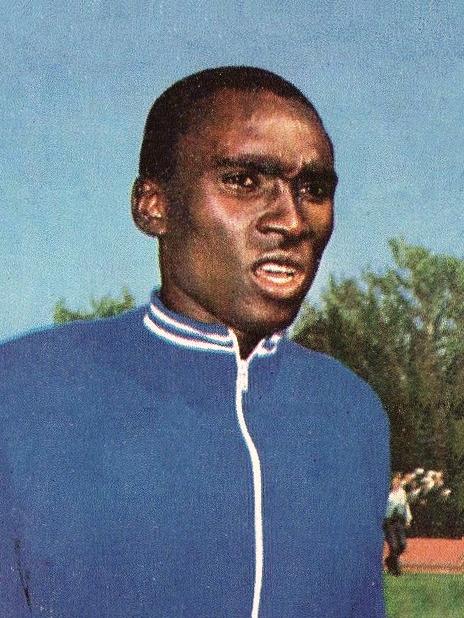
John Akii-Bua
Born 1949 in Lira and coached by Malcolm Arnold, he won Uganda’s first Olympic athletics gold at Munich 1972 in a world-record 47.82, then completed an unforgettable lap of honour, flag in hand.
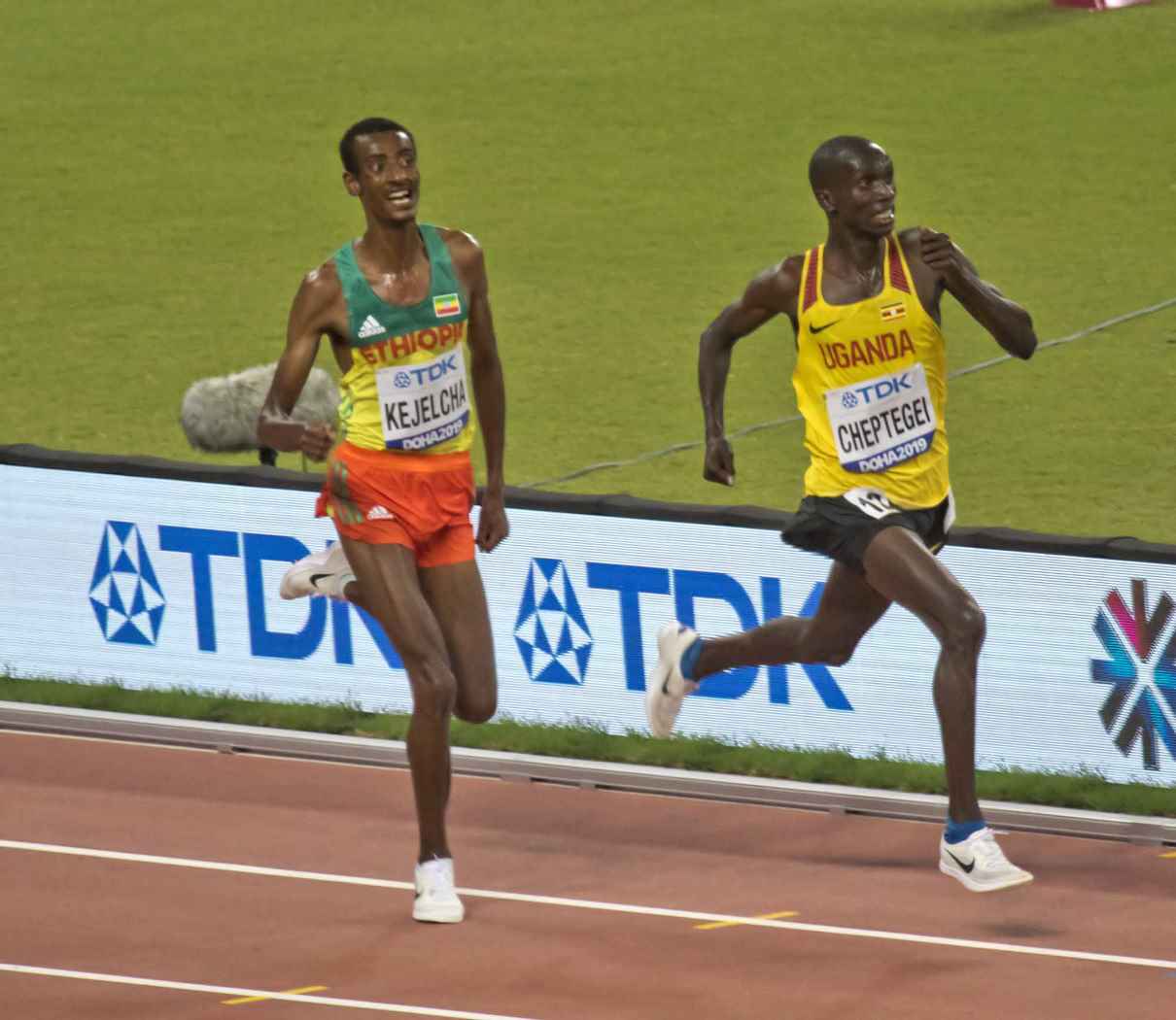
Joshua Cheptegei
Born 1996 in Tegeres, Kapchorwa, he holds world records in the 5,000m (12:35.36) and 10,000m (26:11.00), won Tokyo 2020 5,000m gold and 10,000m silver, and the 2019 Doha 10,000m world title — arguably Uganda’s greatest ever.
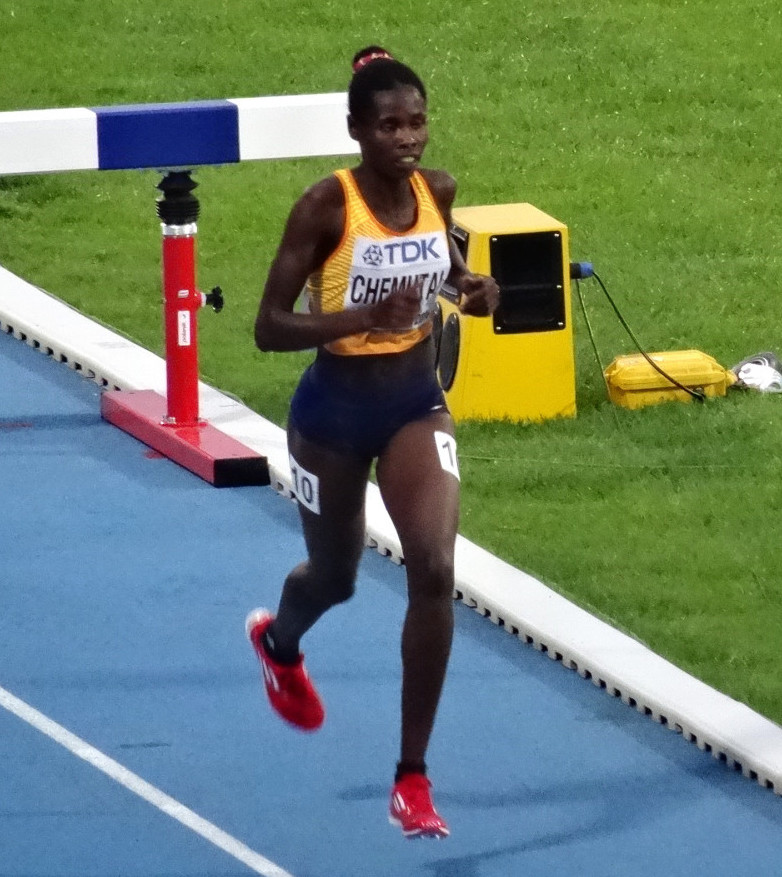
Peruth Chemutai
Born 1999 in Bukwo District, she made history at Tokyo 2020 as the first Ugandan woman to win an Olympic athletics gold, taking the 3,000m steeplechase after winning World U20 silver in 2018.
Jacob Kiplimo
Born 2000 in Kween, he set a half-marathon world record of 57:31 in Lisbon in 2021 at just 20, won 10,000m bronze at Tokyo 2020, and owns two World Cross Country titles. In 2025 he ran 56:42 in Barcelona — 48 seconds under the world record, unratified because of a lead-car assist — then won the Chicago Marathon in 2:02:23 in only his second race over the distance.
Stephen Kiprotich
He won Olympic marathon gold at London 2012 in 2:08:01 and followed it with World Championship marathon gold in Moscow in 2013 — a rare Olympic-and-world double across the classic distance.
Dorcus Inzikuru
She became the first Ugandan woman to win a global athletics title, claiming steeplechase gold in 9:18.24 at the 2005 Helsinki World Championships and paving the way for the generations that followed.
Olympic Achievements
Uganda’s Olympic athletics history turns on moments of individual brilliance. The country has never been a medal factory on the scale of Kenya or Ethiopia, but its best performers have produced some of the Games’ most memorable moments — culminating in a Tokyo 2020 haul that confirmed its arrival as a genuine power.
Silence, then eruption
Every Ugandan global athletics gold. One in 1972, then a 40-year near-silence, then a flood of distance-running titles from 2012 on.
Every Ugandan Olympic and outdoor World Championship gold. The lone 1972 gold is John Akii-Bua’s; the modern cluster is almost entirely 5000m, 10,000m, steeplechase and marathon. Sources: World Athletics; Wikipedia; Olympics.com.
View the data
| Year | Athlete | Event | Title |
|---|---|---|---|
| 1972 | John Akii-Bua | 400m hurdles | Olympic |
| 2012 | Stephen Kiprotich | Marathon | Olympic |
| 2020 | Joshua Cheptegei | 5000m | Olympic |
| 2020 | Peruth Chemutai | 3000m steeplechase | Olympic |
| 2024 | Joshua Cheptegei | 10,000m | Olympic |
| 2005 | Dorcus Inzikuru | 3000m steeplechase | World Champs |
| 2013 | Stephen Kiprotich | Marathon | World Champs |
| 2019 | Halimah Nakaayi | 800m | World Champs |
| 2019 | Joshua Cheptegei | 10,000m | World Champs |
| 2022 | Joshua Cheptegei | 10,000m | World Champs |
| 2023 | Joshua Cheptegei | 10,000m | World Champs |
| 2023 | Victor Kiplangat | Marathon | World Champs |
Uganda makes its Olympic debut, sending a small delegation of three male track-and-field athletes onto the world stage.
John Akii-Bua wins Uganda’s first Olympic athletics gold in the 400m hurdles with a world record of 47.82 seconds.
Uganda boycotts the Games in protest at New Zealand’s rugby tour of South Africa, denying Akii-Bua the chance to defend his title.
Uganda again boycotts, this time in solidarity with the United States, as the ageing Akii-Bua’s championship window closes.
Stephen Kiprotich wins Olympic marathon gold in 2:08:01, adding a major chapter to Uganda’s running story.
Uganda’s finest Games: Cheptegei 5,000m gold and 10,000m silver, Chemutai steeplechase gold, Kiplimo 10,000m bronze.
World Championship Achievements
Uganda’s performances at the World Athletics Championships have grown in stature with each passing decade. Athletes began regularly reaching finals from the 1990s onward, but the era of consistent success truly began in the 2010s and accelerated dramatically into the 2020s. Joshua Cheptegei is Uganda’s most decorated World Championships athlete, winning the 10,000 metres title at the 2019 World Championships in Doha in one of the most decisive victories ever seen in the event, before adding further medals in subsequent cycles.
Jacob Kiplimo has added to it, with medals in the 10,000 metres and the depth he brings to Ugandan distance running. Dorcus Inzikuru had blazed the trail years earlier, becoming the first Ugandan woman to win a global athletics title with steeplechase gold at the 2005 Helsinki World Championships. Uganda has also produced strong cross-country runners, regularly placing near the top of the World Cross Country Championships.
The Crested Crane on the World Stage
Uganda’s national team competes under the distinctive colours of black, yellow and red, inspired by the national flag. The crested crane emblem is worn with immense pride, and the sight of a Ugandan vest crossing a finish line first has become a familiar and celebrated image at the world’s great athletics events.
Athletes and fans alike connect deeply with the colours and the history they represent. From Akii-Bua’s flag-in-hand lap of honour in Munich to Cheptegei’s world-record runs, the national kit has become inseparable from Uganda’s moments of sporting immortality.
Uganda’s athletes race in black, yellow and red — the colours of the national flag — with the crested crane worn with immense national pride.
Running Culture and the Kapchorwa Heartland
Running is woven into daily life in Uganda, especially in the highland communities of the east and west. In many rural areas children run several kilometres to school each day — an informal but very effective form of altitude training that has quietly produced top runners for decades. The parallels with Kenya’s Rift Valley are striking, and not coincidental: both share similar geography, altitude and attitudes toward running.
If one place encapsulates Uganda’s athletics story, it is Kapchorwa, the small highland town on the slopes of Mount Elgon in Eastern Uganda, sitting at approximately 1,800 to 2,400 metres above sea level. The thin mountain air stimulates the body to produce more red blood cells, increasing oxygen-carrying capacity and endurance — a well-documented, entirely legal advantage central to the success of both Kenyan and Ugandan runners.
The Cheptegei Athletics Club, founded in Kapchorwa, has become one of Africa’s most respected training bases, drawing international athletes to the altitude and the running culture. The local Sebei community, from which many of Uganda’s greatest runners have come, has a long tradition of athletics across generations.
The Current State of Uganda Athletics
Uganda’s athletics programme has never been stronger or better resourced. Uganda Athletics, the national federation, works in close partnership with World Athletics and the International Olympic Committee to deliver structured development programmes at grassroots, youth and elite levels, supported by a well-established national championships calendar and regular international competition for its top athletes.
The federation’s focus on the highland districts — Kapchorwa, Bukwo and Kween — has built a concentrated zone of distance running that rivals any region on earth. Altitude training camps, access to competitions in Europe and Asia, and mentorship from stars like Joshua Cheptegei have created a strong ecosystem. The guard is now changing on the roads: Cheptegei skipped the Tokyo 2025 World Championships to move to the marathon full-time, while Kiplimo turned his half-marathon speed into a Chicago Marathon victory the same autumn.
Future Stars and Emerging Talents
The pipeline of Ugandan talent shows no sign of slowing. A generation trained in the Kapchorwa highlands and mentored by the country’s established stars is approaching its prime, and several are already posting times that point to strong senior careers. With the 2028 Los Angeles Olympics ahead, Uganda is quietly building toward what could be its best-ever Games.
Oscar Chelimo
The younger brother of Jacob Kiplimo has shown enormous promise in the distance events and is widely regarded as a future world champion emerging from the Kapchorwa highlands.
Uganda Records & Historic Milestones
Shop Uganda Athletics Apparel
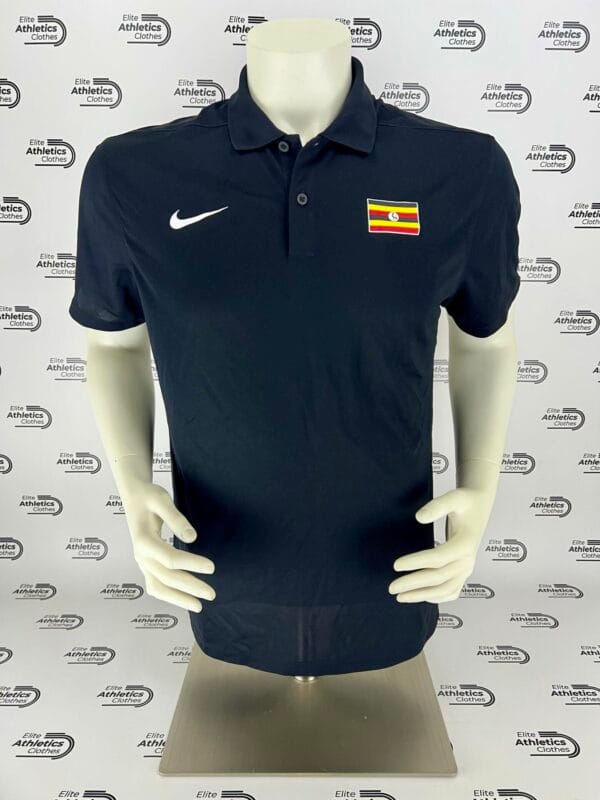
The Uganda rail is a single piece right now — the Nike Uganda Olympic Team polo below, athlete-issued and verified. Ugandan kit surfaces rarely; when a new piece arrives, this is where it lands.
Who is Uganda’s greatest ever athlete?
Uganda’s greatest ever athlete is widely considered to be Joshua Cheptegei, the world record holder in the 5,000m and 10,000m and an Olympic champion. However, John Akii-Bua — winner of Olympic gold and the 400m hurdles world record at Munich 1972 — holds an equally legendary status in Ugandan athletics history.
Has Uganda ever won an Olympic gold medal in athletics?
Yes. Uganda has won three Olympic gold medals in athletics: John Akii-Bua in the 400m hurdles at Munich 1972, Joshua Cheptegei in the 5,000m at Tokyo 2020, and Peruth Chemutai in the 3,000m steeplechase at Tokyo 2020.
Where do Uganda’s best runners come from?
The majority of Uganda’s elite distance runners come from the highland districts of eastern Uganda — particularly Kapchorwa, Bukwo and Kween — on the slopes of Mount Elgon. This high-altitude region, sitting between 1,800 and 2,400 metres above sea level, is Uganda’s running heartland.
Does Uganda have any world records in athletics?
Yes. Joshua Cheptegei holds world records in the 5,000m (12:35.36, Monaco 2020) and the 10,000m (26:11.00, Valencia 2020). Jacob Kiplimo set the world half-marathon record of 57:31 in Lisbon in 2021, a mark since surpassed.
Who was the first Ugandan woman to win an Olympic athletics gold medal?
Peruth Chemutai became the first Ugandan woman to win an Olympic athletics gold medal when she won the 3,000m steeplechase at Tokyo 2020. Her historic victory opened a new chapter in Uganda’s athletics story and inspired a new generation of young Ugandan female athletes.
Where can I buy Uganda athletics apparel?
You can browse Uganda-inspired and East African athletics apparel at Elite Athletics Clothes. Our store specialises in authentic Pro Elite competition-grade gear from the world’s greatest athletics nations — visit our African athletics apparel category for the full range of available products.
Who makes Uganda’s athletics kit?
Nike has supplied the Uganda Athletics Federation since July 2016, when it replaced Erreà ahead of the Rio Olympics, and dressed Uganda again at Paris 2024. Authenticated athlete-issued Uganda pieces surface at Elite Athletics Clothes when available.
Sources and References
- John Akii-Bua – Wikipedia — born 3 December 1949 in Lira; 1972 Munich 400m hurdles gold in world-record 47.82; family of 43 children; coached by Malcolm Arnold; died 20 June 1997.
- Joshua Cheptegei – Wikipedia — 5000m world record 12:35.36 (Monaco 2020) and 10000m world record 26:11.00 (Valencia 2020), both breaking Kenenisa Bekele’s marks; Tokyo 2020 5000m gold and 10000m silver; 2019 Doha 10000m world title.
- Peruth Chemutai – Wikipedia — born 10 July 1999 in Bukwo District; Tokyo 2020 3000m steeplechase gold (first Ugandan woman to win Olympic gold); 2018 World U20 steeplechase silver.
- Jacob Kiplimo – Wikipedia — born 14 November 2000 in Kween; half-marathon 57:31 (Lisbon, 21 Nov 2021, since surpassed); Tokyo 2020 10000m bronze; World Cross Country titles.
- Stephen Kiprotich – Wikipedia — 2012 London Olympic marathon gold (2:08:01) and 2013 Moscow World Championship marathon gold.
- Dorcus Inzikuru – Wikipedia — first Ugandan woman to win a global athletics title; 3000m steeplechase gold (9:18.24) at the 2005 Helsinki World Championships.
- Uganda at the 1956 Summer Olympics – Wikipedia — Uganda’s Olympic debut at Melbourne 1956 with three male track-and-field athletes.
- Uganda – Wikipedia — independence from Britain on 9 October 1962; national background.