
JUMPS
SPIKES
One label, four different machines: the long jumper's sprint shoe, the triple jumper's armour, the high jumper's heel spikes, the vaulter's runway racer. How they differ, and how to pick the right one.
Jumps spikes are the take-off shoes of the four jumping events — long jump, triple jump, high jump and pole vault — and they are four genuinely different designs: sprint-like and rigid for the long jump, heavily heel-cushioned for the triple, heel-spiked with a 12 mm pin allowance for the high jump, and speed-tuned for the vault.
They also carry a rule of their own: in every jumping event the forefoot of the sole may not sit higher than the heel, a clause written to keep the take-off board honest in the super-shoe era.
This is Spike Series No. 04 inside Kit Anatomy. The other families: sprint · middle distance · distance · throws. Or jump to the spikes in the archive.
- Events
- Long jump, triple jump, high jump, pole vault — four distinct shoe designs
- The unique one
- High jump — the only event shoe with heel spikes, for the curved approach
- Pin limits
- 12 mm in the high jump; 9 mm in the other jumps; 6 mm indoors
- Geometry rule
- Forefoot may not sit higher than the heel — specific to the jumping events
- Sole limit
- 20 mm max, spike receptacles included
- Most cushioned
- Triple jump — repeated heel strikes under multiples of body weight
- Max positions
- Up to 11 spike receptacles; Nike's High Jump Elite uses all of them
- Era benchmark
- Duplantis' pole vault world record: 6.31 m, March 2026 — his fifteenth
| Event | Plate | Heel spikes | Heel cushioning | Max pin |
|---|---|---|---|---|
| Long jump | Rigid, sprint-like (full carbon in the LJ Elite) | No | Moderate — enough to absorb the board | 9 mm |
| Triple jump | Flatter, rolls the whole foot | No | The most heel cushioning of any jump shoe | 9 mm |
| High jump | Rigid Pebax, built for the curve | Yes — the only running event shoe with them | Firm, stability first | 12 mm |
| Pole vault | Close to triple, tuned for runway speed | No | Thinner than triple | 9 mm |
Chart data as a table
| Event | Plate | Heel spikes | Heel cushioning | Max pin |
|---|---|---|---|---|
| Long jump | Rigid, sprint-like | No | Moderate | 9 mm |
| Triple jump | Flatter, full-foot roll | No | Greatest of the four | 9 mm |
| High jump | Rigid Pebax | Yes | Firm | 12 mm |
| Pole vault | Near-triple, speed-tuned | No | Thinner than triple | 9 mm |
Four events, four shoes
“Jumps spikes” is really four shoes wearing one label. The long jump wants a sprinter's shoe that can survive a violent plant. The triple jump wants armour for a heel that will strike the runway three times under multiples of body weight. The high jump wants grip through a curve no other event runs. And the pole vault wants pure runway speed with a safe landing thrown in.
That is why this chapter is a matrix rather than a single spec sheet. The grid above puts the four events against the four traits that separate them — and the gold cells mark the answers only one event gives: heel spikes and a 12 mm pin for the high jumper, maximum heel protection for the triple jumper.
The running families have their own chapters — sprint, middle distance and distance — and the circle events get theirs in throw shoes.
The rules only jumpers have
Jumps shoes live under the same 2026 rulebook as the rest of the track — a 20 mm maximum sole measured with the spike receptacles included, up to 11 pin positions — plus two clauses of their own.
First, the geometry clause: in all four jumping events, the sole under the centre of the forefoot may not sit higher than the sole under the centre of the heel. In plain terms, no wedge builds and no reversed ramps — a rule written to stop stack-height creep at the take-off board.
Second, the pin exception: high jumpers may run pins of up to 12 mm, against 9 mm for every other jump — a concession to the curved, often wet approach and a take-off that happens on one planted heel. The only other athletes with the same allowance are javelin throwers, whose spiked boots are cousins of the high jump shoe. Indoors, everyone drops to 6 mm unless the venue allows more.
How each shoe is built
Model by model, this is how the four answers look in 2026.
- Long jumpThe Nike Air Zoom LJ Elite is the template: full-length carbon plate, six forefoot pins, sprint-spike DNA with a firmer landing platform — because the last stride arrives at close to top speed.
- Triple jumpFlatter sole so the foot can roll through hop, step and jump; strong heel hold and the thickest cushioning of the group. The plate is there to spread load as much as to return it.
- High jumpThe specialist's specialist: a rigid Pebax plate shaped for the J-curve, lateral stability, a midfoot strap — and spike receptacles in the heel. Nike's High Jump Elite offers 11 per shoe, the legal maximum.
- Pole vaultNearly a triple jump shoe, trimmed for speed: thinner cushioning, the same secure hold. Vaulters are sprinters until the plant.
- The multi-event entryBudget lines like the Zoom Rival Jump cover several jumps in one shoe — the honest first buy for a young athlete who has not specialised yet.
- The era's benchmarkThe most-watched jumper alive competes in none of the above: Mondo Duplantis — who took the pole vault world record to 6.31 m in March 2026, his fifteenth — vaults for Puma, whose spike line covers the runway too.
What the four share is the fit philosophy: a jumps shoe is sized to hold a foot that arrives at speed and stops, hard. Straps over the midfoot, heels that do not slide, and no dead space in the toe box.
How to choose yours
Choosing comes down to one question: which take-off are you protecting?
- Specialise when it mattersJumping one event seriously? Buy that event's shoe — the differences in the matrix are real, and the triple jump in a long jump shoe is a bruised heel waiting to happen.
- Multi-eventers go multiCombined-event athletes and beginners are exactly who the multi-jump models exist for. Specialise later.
- High jumpers: use the heelThe heel receptacles and the 12 mm allowance exist because the curve rewards them — take pins you are entitled to.
- Check the venue and the listIndoor boards cap pins at 6 mm unless told otherwise, and World Rankings competition requires a model from the World Athletics approved-shoe list.
- Strap it downIf a jumps shoe has a midfoot strap, it is not decoration — a loose shoe at plant is where centimetres go to die.
For the all-events overview, start with our complete track spikes guide; the running families are linked above.


Spikes in the Archive
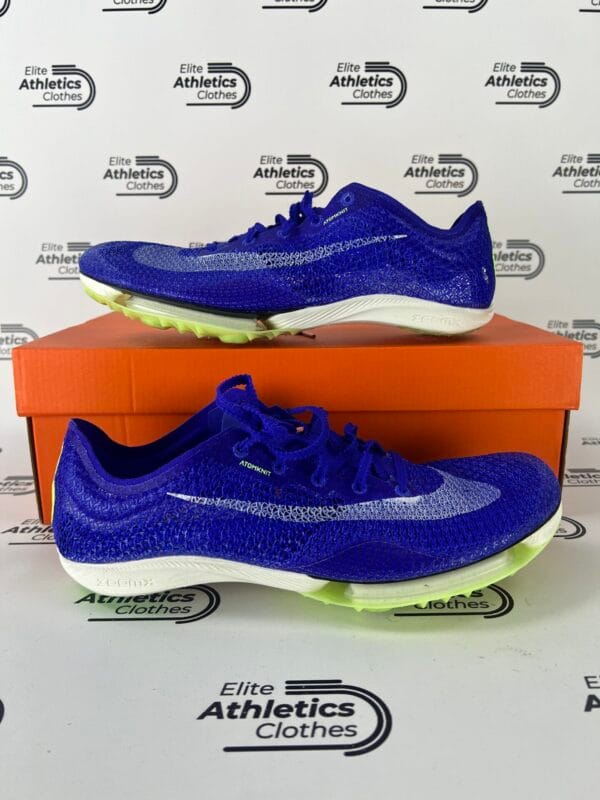
Footwear is the newest wing of this archive, and it is honest about its size: one race spike so far, listed exactly as it surfaced. The grid updates itself as new pairs come in — the clothing side of the Pro Elite archive is where the depth lives today.
What are jumps spikes?
Jumps spikes are the take-off shoes for the four jumping events. Each is different: long jump shoes are rigid and sprint-like, triple jump shoes carry the most heel cushioning, high jump shoes are the only ones with heel spikes, and pole vault shoes are tuned for runway speed.
Why do high jump shoes have spikes in the heel?
Because the high jump approach is a curve, often taken on a wet track, and take-off happens over one planted heel. The rules recognise it: high jumpers may use pins up to 12 mm long, against 9 mm for the other jumps — an allowance shared only with javelin throwers.
Can you long jump in sprint spikes?
Many young athletes do, and the designs are close — but a dedicated long jump shoe adds a firmer landing platform and more support for a plant that arrives at near top speed. For the triple jump the answer is a firm no: it needs heel protection sprint spikes simply do not have.
What is the sole thickness rule for jumping events?
20 mm maximum, like all track and field events since November 2024 — plus a clause specific to the jumps: the sole under the forefoot may not be higher than under the heel, which rules out wedge-shaped builds at the take-off board.
Do multi-event jump shoes exist?
Yes — entry-level models cover several jumps in one shoe and are the sensible first buy for combined-event athletes and beginners. Specialist shoes start to pay once one event becomes the focus.
Sources and References
- World Athletics — C2.1A Athletic Shoe Regulations (in force 1 Jan 2026) — jump-specific geometry clause, 12 mm high jump pins, sole limits
- Running Warehouse — best jump shoes guide (2026) — event-by-event anatomy of the four designs
- Running Warehouse — Nike Zoom High Jump Elite — 11 spike receptacles and Pebax plate
- Road Runner Sports — Nike Air Zoom LJ Elite — full-length carbon plate in the long jump reference
- ESPN — Duplantis raises the world record to 6.31 m — the fifteenth record, March 2026