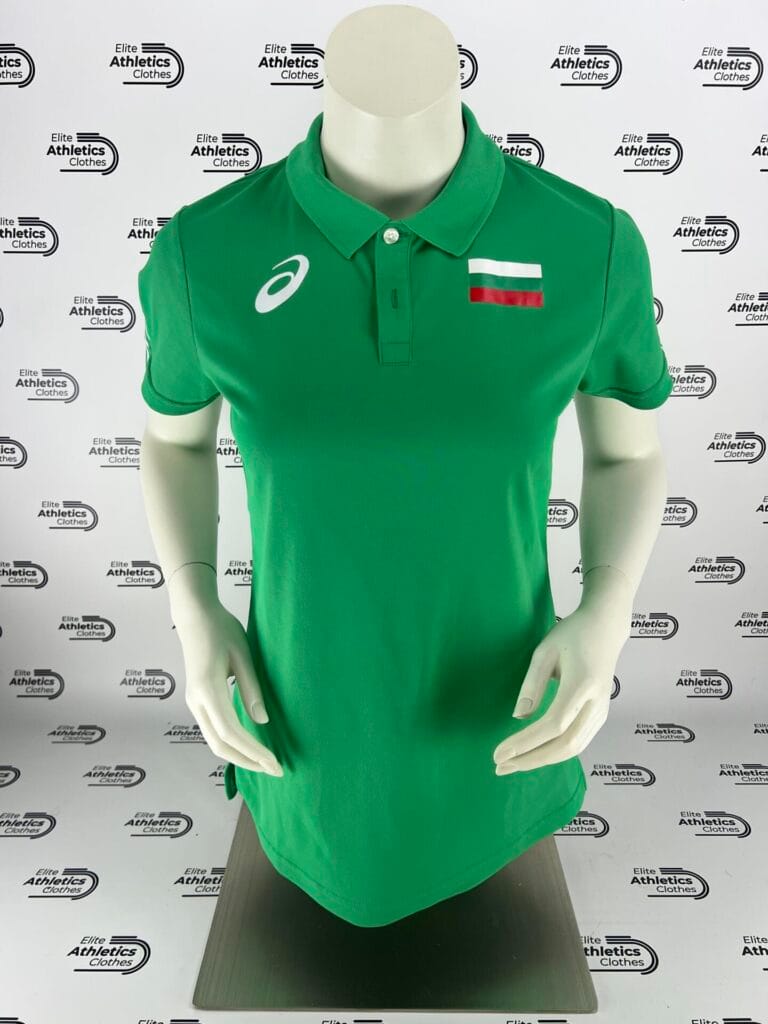
Asics Bulgaria International Team Pro Elite 2018 Women Polo Shirt worn by Bulgaria International Team pro athletes during 2018 season.
Tap a crossed size and we write you the day one lands in it
Asics Bulgaria International Team Pro Elite 2018 Women Polo Shirt worn by Bulgaria International Team pro athletes during 2018 season. 100% Authentic Color: Green/White/Red 100% Polyester Made in China Excellent condition Worn by a pro athlete
Ships from Switzerland, tracked · processed in 1–3 business days · free over €150
| Size | Chest | Waist | Hip |
|---|---|---|---|
| XS | 79–84 | 61–66 | 86–91 |
| S | 84–89 | 66–71 | 91–97 |
| M | 89–94 | 71–76 | 97–102 |
| L | 94–100 | 76–83 | 102–107 |
| XL | 100–108 | 83–90 | 107–114 |
Listed size: S · body measurements in cm, as published by Asics
Use the brand body chart as a starting point. Ask us for flat measurements of this exact piece to compare with a garment you already wear.
Bulgaria sent 14 athletes — seven men, seven women — to the European Championships in Berlin in August 2018, and the medal that came back was decided at 2.00 metres on the evening of 10 August. Mirela Demireva cleared it, equalling the best jump of her life. So did Mariya Lasitskene, competing as an Authorised Neutral Athlete rather than for Russia. The countback went to Lasitskene, who had missed less on the way up, and Demireva took silver — her second consecutive European silver after Amsterdam 2016. Marie-Laurence Jungfleisch of Germany was third at 1.96.
The silver did not stand alone. Three more Bulgarian women finished inside the top six in Berlin: Gabriela Petrova was sixth in the triple jump at 14.26, Radoslava Mavrodieva sixth in the shot put at 18.03, and Ivet Lalova-Collio — at 34, in her fourteenth season as an international sprinter — fifth in the 200 metres final in 22.82.
A team t-shirt is the training and travel piece of an issued athletics kit — worn in the hotel, the bus and the warm-up area, never in the race. It carries the same federation badge as the competition kit, in street sizing and heavier knits.
The modern issue is polyester — 50 of the 56 tees in this archive declare it — because cotton holds twenty times the moisture. Cotton survives at the travel end of the set, where nobody sweats and softness wins.