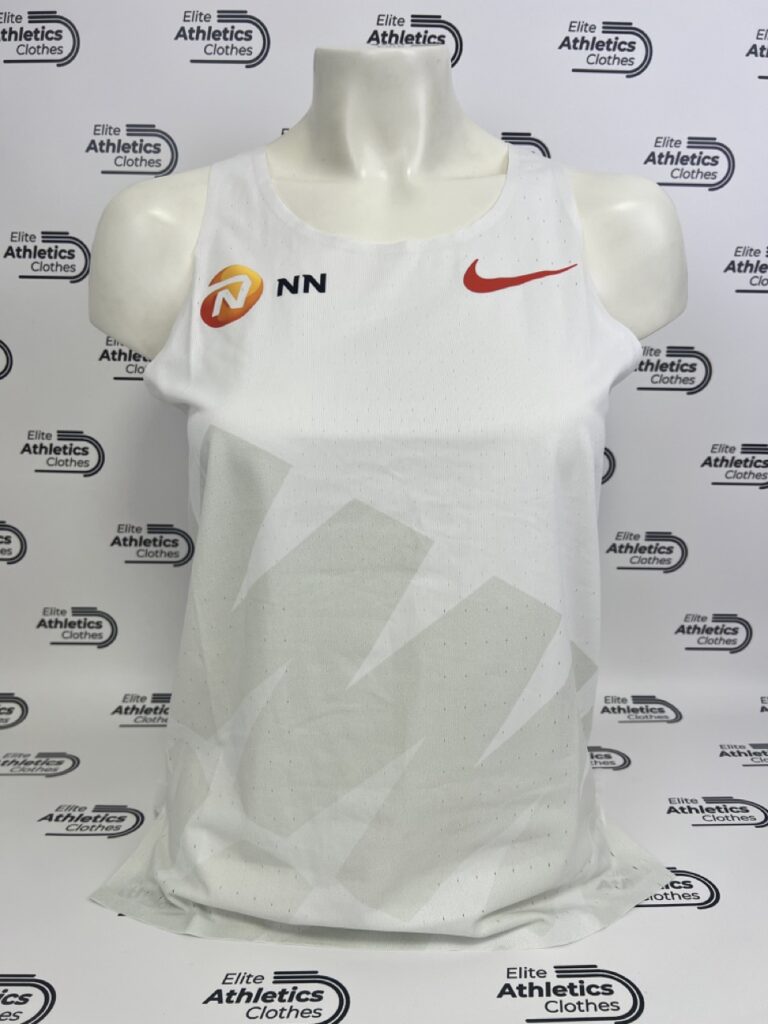
Nike NN Running Team Pro Elite 2020/2021 Women Distance Singlet worn by NN Running Team pro athletes during 2020 and 2021 seasons.
Tap a crossed size and we write you the day one lands in it
Nike NN Running Team Pro Elite 2020/2021 Women Distance Singlet worn by NN Running Team pro athletes during 2020 and 2021 seasons. 100% Authentic Color: White/Grey/Black/Orange 100% Polyester Excellent Condition Made in USA
Ships from Switzerland, tracked · processed in 1–3 business days · free over €150
| Size | Chest | Waist | Hip |
|---|---|---|---|
| XXS | 70–76 | 54–60 | 78–84 |
| XS | 76–83 | 60–67 | 84–91 |
| S | 83–90 | 67–74 | 91–98 |
| M | 90–97 | 74–81 | 98–105 |
| L | 97–104 | 81–88 | 105–112 |
| XL | 104–114 | 88–98 | 112–120 |
| XXL | 114–124 | 98–108 | 120–128 |
Listed size: S · body measurements in cm, as published by Nike
Use the brand body chart as a starting point. Ask us for flat measurements of this exact piece to compare with a garment you already wear.
When the calendar emptied in 2020, the team replaced races with clocks. Across twenty months its two track leaders broke six world records between them, most of them in near-empty stadiums — and kit from this cycle carries the double stamp 2020/2021 because the season it was built for moved a year.
The cycle's signature evening came on 7 October 2020 in Valencia: Cheptegei took the 10,000 m record (26:11.00) and Gidey the women's 5,000 m (14:06.62) on the same night, on the same track. Cheptegei's two track records still stand in September 2026; Gidey's half marathon mark from a year later — 1:02:52, again Valencia — is still the only sub-63 ever run by a woman. In June 2021 she had also taken the 10,000 m record in Hengelo, 29:01.03, two days after Sifan Hassan had set it on the same track.
Construction is team issue through and through — our authentication guide covers the tells.
A distance singlet is a lightweight, sleeveless racerback vest built for one job: racing long, from the 5,000 m to the marathon. It trims a running top to the least fabric that still carries a national crest and two competition bibs — typically around 85 grams, roughly half the mass of an everyday cotton tee.
The version we archive is the race-issued one: the same federation kit an athlete pulls on in a World Championship final, not the replica hanging in a retail store.
Strip a running shirt of its sleeves, its collar and every gram it does not need, and you get a singlet: a vest cut low at the neck, deep at the arm, and closed only across the shoulders and sides. On a distance runner it is the default racing top from the 5,000 m upward, because over 12 or 26 miles the enemy is heat, and the singlet loses more of it than anything else you are allowed to wear.