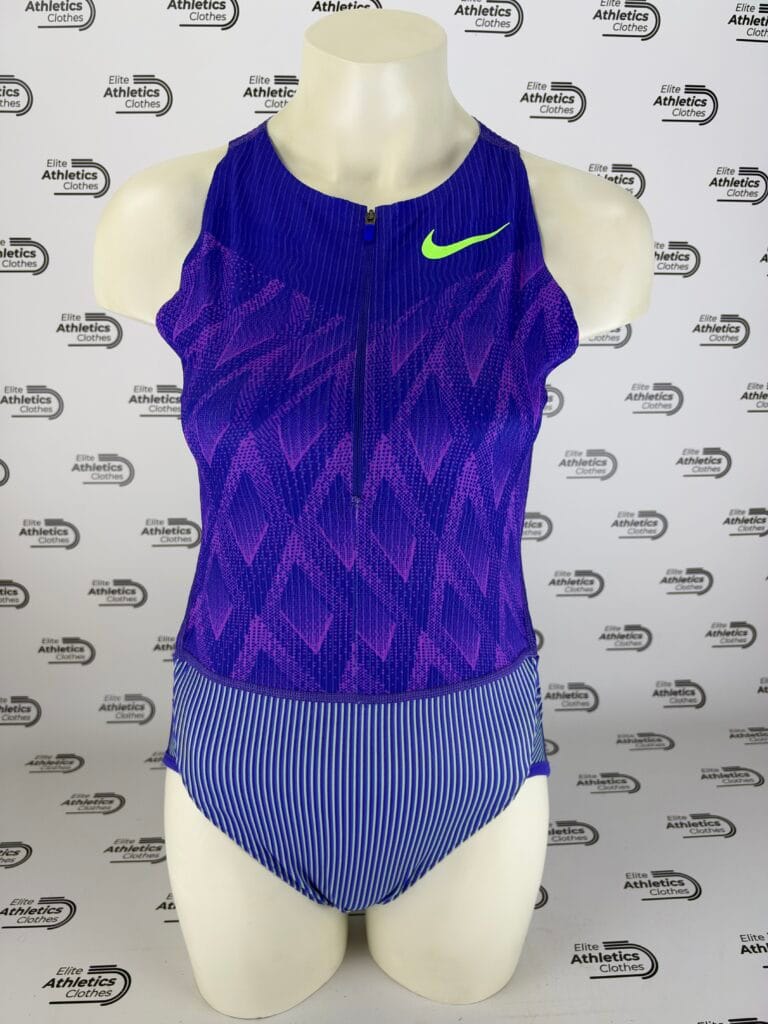
An exclusive Nike Pro Elite Women Speedsuit from the 2026 Novuna London Athletics Meet collection, specially designed for Nike-sponsored athletes competing at the 2026 Wanda Diamond League meeting in London.
Tap a crossed size and we write you the day one lands in it
An exclusive Nike Pro Elite Women Speedsuit from the 2026 Novuna London Athletics Meet collection, specially designed for Nike-sponsored athletes competing at the 2026 Wanda Diamond League meeting in London. • 100% Authentic • Color: Violet Mist / Gym Blue / Electric Green • Body: 83% Polyester - 17% Elastane / Panels lining: 88% Polyester - 12% Elastane • Advanced Brethability with Nike Dri-FIT ADV Technology • Texturized swoosh • Quarter-zip front closure • Made in USA New condition
Ships from Switzerland, tracked · processed in 1–3 business days · free over €150
| Size | Chest | Waist | Hip |
|---|---|---|---|
| XXS | 70–76 | 54–60 | 78–84 |
| XS | 76–83 | 60–67 | 84–91 |
| S | 83–90 | 67–74 | 91–98 |
| M | 90–97 | 74–81 | 98–105 |
| L | 97–104 | 81–88 | 105–112 |
| XL | 104–114 | 88–98 | 112–120 |
| XXL | 114–124 | 98–108 | 120–128 |
Listed size: M · body measurements in cm, as published by Nike
Use the brand body chart as a starting point. Ask us for flat measurements of this exact piece to compare with a garment you already wear.
Nike Pro Elite is the kit Nike makes for the athletes and federations it sponsors, rather than for its retail range.
A speedsuit is a fitted one-piece track racing garment — singlet and shorts fused into a single skin-tight surface — worn by sprinters, hurdlers and relay squads to eliminate loose fabric entirely.
It is also athletics apparel's laboratory: Flo-Jo's 1988 one-leggers, Cathy Freeman's wind-tunnel-zoned Swift Suit at Sydney 2000, London 2012's dimpled TurboSpeed and the Paris 2024 unitards are all chapters of the same experiment. And in a race-issued archive, the one-piece is the scarcest garment of all.
The speedsuit is the kit reduced to one decision: a fitted one-piece that replaces singlet and shorts with a single garment. Sprinters, hurdlers and relay squads wear them for the obvious reason — zero loose fabric, zero interfaces, a uniform that moves as one surface from shoulder to thigh.
A speedsuit is built less like clothing and more like a surface treatment for a moving body.