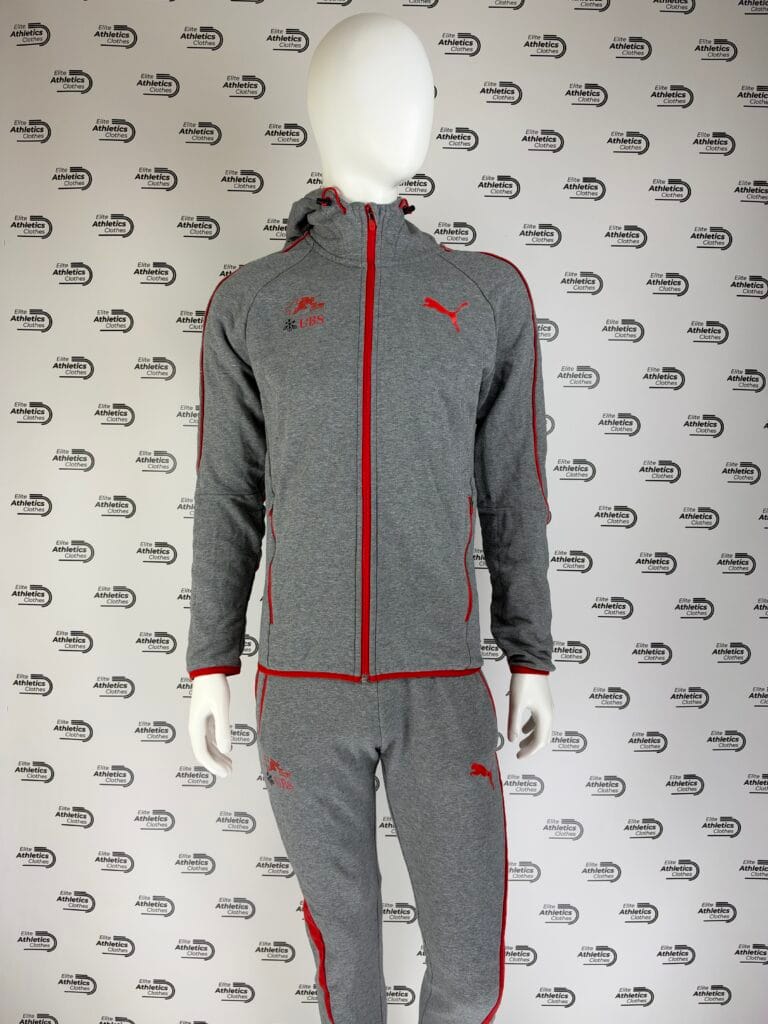
Puma Switzerland International Team 2016 Pro Elite Tracksuit worn by Switzerland international athletes during 2016 season.
Tap a crossed size and we write you the day one lands in it
Puma Switzerland International Team 2016 Pro Elite Tracksuit worn by Switzerland international athletes during 2016 season. 100% Authentic Color: Grey/Red/White Swiss Athletics logo UBS logo Worn by a pro athlete but excellent condition
Ships from Switzerland, tracked · processed in 1–3 business days · free over €150
Check the jacket and trousers separately: chest and sleeve length for the top, waist and inseam for the bottoms.
We do not have a body size chart for this brand and cut. Ask us for flat measurements of this exact piece before choosing a size.
Switzerland sent 47 athletes to the European Championships in Amsterdam, 6–10 July 2016, forty of them as individual starters. By the federation's own count they came home with five medals and thirteen places in the top eight.
The two golds came in the same race and belonged to the same man. Tadesse Abraham, born in Eritrea, won the half marathon in 1:02:03, and his time led the Swiss six to the team title by two seconds over Spain. The bronzes were all on the track: Mujinga Kambundji in the 100 m, Kariem Hussein in the 400 m hurdles two years after winning the event in Zürich, and Léa Sprunger in the women's 400 m hurdles, in 55.41.
Behind the medals sat a deep row of near misses. Selina Büchel and Clélia Rard-Reuse were both fourth, in the 800 m and the 100 m hurdles; Fabienne Schlumpf was fifth in the steeplechase; Angelica Moser, aged eighteen, was seventh in the pole vault.
A team tracksuit is the matching jacket-and-pants unit of an issued athletics kit — worn travelling, warming up, on the bench and on the podium, and the piece least likely to have been raced in. It is the formal uniform of a team's public minutes.
The form is the oldest in sportswear: Le Coq Sportif's 1939 Sunday Suit, industrialised by adidas from 1966 and named after athletes from Beckenbauer to Munich champion Heide Rosendahl. On a championship team it is still equipment.
The tracksuit is the garment the public associates with a national team: the matching jacket and pants worn travelling, warming up, on the bench and on the podium. Within an issued kit it is the one entry that is two garments sold as a unit — and the least likely piece of any set to have been raced in.
The dates on the thread are worth spelling out, because the tracksuit's history runs through athletics twice.