
MIDDLE DISTANCE
SPIKES
The one spike family that overlaps both of its neighbours: enough plate for the straights, enough heel for the laps. What it is, how the Air Zoom Victory generation is built, and when it is the right buy.
A middle distance spike is the track shoe for the 800, 1500 and 3000: 6 to 8 pins, a semi-stiff plate, and — the family's defining line — real cushioning under the heel, because middle distance runners actually use theirs. Its reference model, the Nike Air Zoom Victory, is declared for everything from 800 to 5000 m.
That spread is the point. Sprint spikes stop at 400; distance spikes begin around 3000; this family bridges the gap, which makes it the default first spike for anyone who races across events — and the one family our archive currently holds in footwear.
This is Spike Series No. 02 inside Kit Anatomy. The other families: sprint · distance · jumps · throws. Or go straight to the Air Zoom Victory in the archive.
- Events
- 800, 1500 and 3000 m at the core — the Victory is maker-declared for 800–5000 m
- Pins
- 6–8, forefoot-biased; the Victory runs 6 replaceable steel pins
- Plate
- Semi-stiff; full-length carbon Flyplate in the Victory, tuned softer than a sprint plate
- The defining line
- Always some heel cushioning — the feature no sprint spike has
- Weight
- Nike Air Zoom Victory: about 130 g in a size 9
- Sole limit
- 20 mm max, spike receptacles included — unified across track and field since 1 Nov 2024
- Pin limit
- 9 mm outdoors, 6 mm indoors unless the venue allows more
- In the archive
- One pair: the Air Zoom Victory in Racer Blue — first-generation, Tokyo-era
Chart data as a table
| Family / model | Range | Pins | Plate |
|---|---|---|---|
| Sprint spikes | 60–400 m + hurdles | 7–10 | Rigid, full carbon |
| Middle distance spikes | 800–3000 m core | 6–8 | Semi-stiff |
| Nike Air Zoom Victory | 800–5000 m (maker-declared) | 6 | Full-length carbon Flyplate |
| Distance spikes | 3000–10,000 m | 4–6 | Partial / flexible |
What a middle distance spike is
Between the sprinter's ramp and the distance runner's slipper sits the shoe that has to be a little of both. A middle distance spike races everything from the 800 to the 3000 — two laps run near-sprint speed, or seven and a half run on rhythm — and its design is a negotiation: enough plate to return energy on the straights, enough give and heel foam to survive the pace changes and the laps.
That is why the chart above matters. Sprint spikes stop at 400. Distance spikes start making sense around the 3000. The middle distance family overlaps both, and its reference model — the Nike Air Zoom Victory — is declared by its own maker for everything from 800 to 5000 m. No other spike on the track covers that spread.
The neighbours have their own chapters: the sprint spike below it, the distance spike above it, and the specialist jumps and throws shoes beside them.
How the race shoe is built
A middle distance spike reads like a sprint spike with the sharp edges filed down — or a distance spike with its spine stiffened, depending on which side you approach it from.
- The plateSemi-stiff — a step softer than a sprint plate. The Victory carries a full-length carbon Flyplate, but tuned for laps, not for a ten-second effort.
- The pins6–8, forefoot-biased. The Victory races on 6 replaceable steel pins.
- The heelThis is the line the family will not cross: unlike a sprint spike, there is always some cushioning under the heel, because an 800 or 1500 runner will touch it.
- The propulsion layerIn the Victory: ZoomX foam plus a dual-chamber Air Zoom unit under the forefoot — the same ingredients as the marathon super shoes, cut down to spike weight.
- The weightAround 130 g for the Victory in a size 9 — lighter than the sprint models, within grams of the distance ones.
- The upperRace-thin knits: the Victory's Atomknit was the lightest upper Nike had put on a track shoe at its debut.
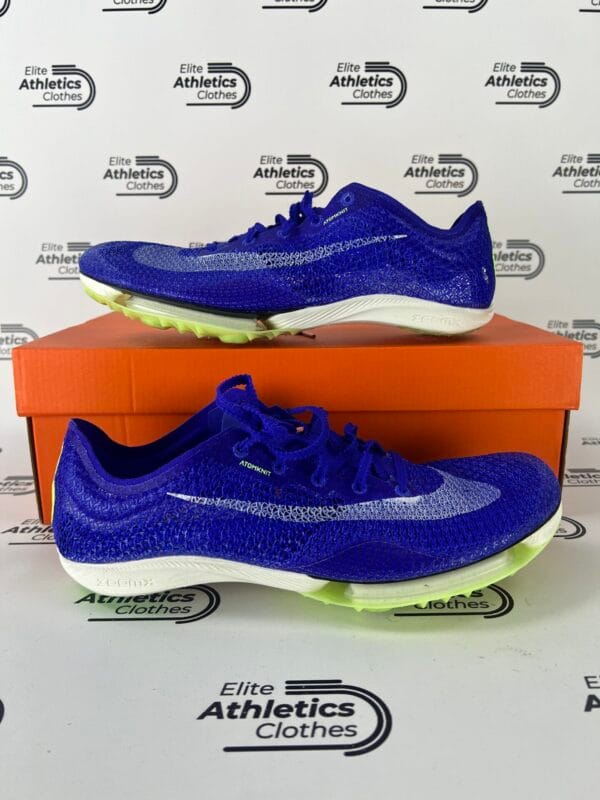 From this family · in the archiveNike Air Zoom Victory Racer BlueThe reference middle distance spike of the first super-spike generation — ZoomX, dual Air Zoom chambers and a carbon Flyplate at about 130 g, in the Racer Blue colourway.120,00 €View piece →
The rules frame the family the same way they frame every track shoe in 2026: at most 20 mm of sole measured with the spike receptacles included, at most 11 pin positions, pins of 9 mm outdoors and 6 mm indoors, and one rigid plate beside the spike plate. The Victory generation was built to those numbers — and to race a World Rankings meeting, a model has to sit on the World Athletics approved-shoe list.
The super-spike era, mid-track
The middle distance is where the super-spike era is easiest to see, because the era arrived mid-generation. Air-and-foam prototypes reached the track in 2020; the Victory went on general sale for the Tokyo Olympic season; and peer-reviewed work now finds that advanced-footwear spikes moved performances measurably in every event from the 800 to the 10,000 from late 2019 on.
The records tell the same story with dates. Faith Kipyegon — still racing, still the benchmark — lowered her own 1500 m world record to 3:48.68 at the 2025 Prefontaine Classic, her second rewrite of a mark that had stood untouched for years before the new generation of shoes and tracks. Which spike she wore that day is not on the record, and this series does not guess; what is certain is that the era she leads is raced on plates and pressurised air.
For the shoe itself, the generations are easy to follow: the original Victory carried the flag from 2021, and its successor took over in April 2024 — which is what makes a first-generation pair an era piece rather than just last season's stock.
How to choose yours
If you only buy one pair of spikes, this is the family the guides point to — and the reasoning is on the chart.
- Buy the bridgeRacing across events — an 800 one weekend, a 3000 the next? A middle distance spike is the one pair that covers the season.
- Coming down from distanceIf your base is 5000 m and you drop to the 1500 occasionally, the stiffer plate will feel fast; give your calves a few sessions to adapt.
- Coming up from sprintsIf you live at 400 and stretch to the 800, the heel foam is the feature you are buying — do not race the 800 on a bare-heel sprint plate.
- Pins and venuesSame rulebook as every family: 9 mm pins outdoors, 6 mm indoors unless the venue says otherwise. Carry both.
- FitSnug but lap-proof: closer than a trainer, a shade more room than a sprint spike — your foot swells over 3000 m of racing.
The wider map is in our complete track spikes guide; the deep dives on the neighbouring families are linked above.
Spikes in the Archive
Footwear is the newest wing of this archive, and it is honest about its size: one race spike so far, listed exactly as it surfaced. The grid updates itself as new pairs come in — the clothing side of the Pro Elite archive is where the depth lives today.
What are middle distance spikes?
Middle distance spikes are track racing shoes for the 800, 1500 and 3000 m. They carry 6 to 8 forefoot-biased pins over a semi-stiff plate and — unlike sprint spikes — always include some heel cushioning, because middle distance runners land on their heels through pace changes and laps.
What events can you run in the Nike Air Zoom Victory?
Nike declares the Air Zoom Victory for events from 800 to 5000 m. It combines ZoomX foam, a dual-chamber Air Zoom unit under the forefoot and a full-length carbon Flyplate at about 130 grams — the reference middle distance spike of the first super-spike generation.
What is the difference between middle distance and sprint spikes?
Stiffness and the heel. A sprint spike carries 7 to 10 pins over the most rigid plate in athletics and little or no heel cushioning; a middle distance spike softens the plate, drops to 6 to 8 pins and keeps real foam under the heel. Sprint spikes stop making sense past 400 m.
Are middle distance spikes a good first pair?
For most club athletes, yes. The family bridges sprint and distance ranges — its reference model is declared for 800 to 5000 m — so one pair covers a whole season of racing across events.
What are the 2026 rules for middle distance spikes?
The same as every track shoe: a 20 mm maximum sole measured with the spike receptacles included, up to 11 pin positions, pins of at most 9 mm outdoors and 6 mm indoors, and the model must appear on the World Athletics approved-shoe list for World Rankings competition.
Sources and References
- World Athletics — C2.1A Athletic Shoe Regulations (in force 1 Jan 2026) — sole, pin and plate rules; approved-shoe list
- Running Warehouse — Nike Air Zoom Victory — maker-declared 800–5000 m range and construction
- Running Magazine (Canada) — Air Zoom Victory review — 130 g weight and 2021 availability
- bioRxiv — advanced footwear technology in track events (2024 preprint) — measured performance shifts, 800 m to 10,000 m, from late 2019
- World Athletics — Kipyegon 3:48.68 at the 2025 Prefontaine Classic — the current 1500 m world record
- Runners Need — running spikes buying guide — family ranges and pin counts