
SPEEDSUIT
One garment, four decades of wind-tunnel experiments, and the rarest piece in any race-issued archive. What the one-piece speedsuit is, where it came from, and what to know before owning one.
A speedsuit is a fitted one-piece track racing garment — singlet and shorts fused into a single skin-tight surface — worn by sprinters, hurdlers and relay squads to eliminate loose fabric entirely.
It is also athletics apparel's laboratory: Flo-Jo's 1988 one-leggers, Cathy Freeman's wind-tunnel-zoned Swift Suit at Sydney 2000, London 2012's dimpled TurboSpeed and the Paris 2024 unitards are all chapters of the same experiment. And in a race-issued archive, the one-piece is the scarcest garment of all.
This is Kit Anatomy, our series on each garment in the Pro Elite archive. Jump to the speedsuits in the archive, or read on for the whole aero story.
- What it is
- A fitted one-piece replacing singlet + shorts; sprint, hurdles and relay kit
- First famous one
- Flo-Jo's self-designed “one-legger” suits, 1988
- The engineered one
- Nike Swift Suit, Sydney 2000 — zoned wind-tunnel fabrics, hooded
- Boldest claim
- TurboSpeed 2012: up to 0.023 s / 100 m (Nike's own figure)
- Construction
- Zoned fabrics, surface textures, compression fit, quarter-zip on some models
- The norm today
- Sleeveless one-pieces; Freeman's hood was worn at one Games only
- Rarity
- Pro-athlete-only issue; the scarcest type in the race-issued archive
- In the archive
- 8 speedsuits catalogued
View the data
| Year | Suit | What it introduced |
|---|---|---|
| 1988 | Flo-Jo's one-leggers | Self-designed asymmetric one-piece suits, worn with briefs over the top |
| 2000 | Nike Swift Suit (Cathy Freeman, Sydney 400 m gold) | Nearly 3 years of development; fabrics wind-tunnel-tested per body zone; hooded |
| 2012 | Nike Pro TurboSpeed (London) | Golf-ball-style dimples; Nike claimed up to 0.023 s over 100 m vs its prior kit |
| 2016 | Rio-era suits | Vortex generators embossed on tape patches (per Nike aerodynamicist Len Brownlie) |
| 2024 | Paris AeroSwift unitards | Dri-FIT ADV; first finals-only uniform with motion-capture graphic |
What a speedsuit is
The speedsuit is the kit reduced to one decision: a fitted one-piece that replaces singlet and shorts with a single garment. Sprinters, hurdlers and relay squads wear them for the obvious reason — zero loose fabric, zero interfaces, a uniform that moves as one surface from shoulder to thigh.
It is also the rarest piece in any race-issued archive. One-piece suits are made in small numbers for the athletes who race in them — Nike lists its Pro Elite speedsuits as pro-athlete-only issue — and most never reach any shop in any form. When one surfaces, it is usually the only one of its kind in the room.
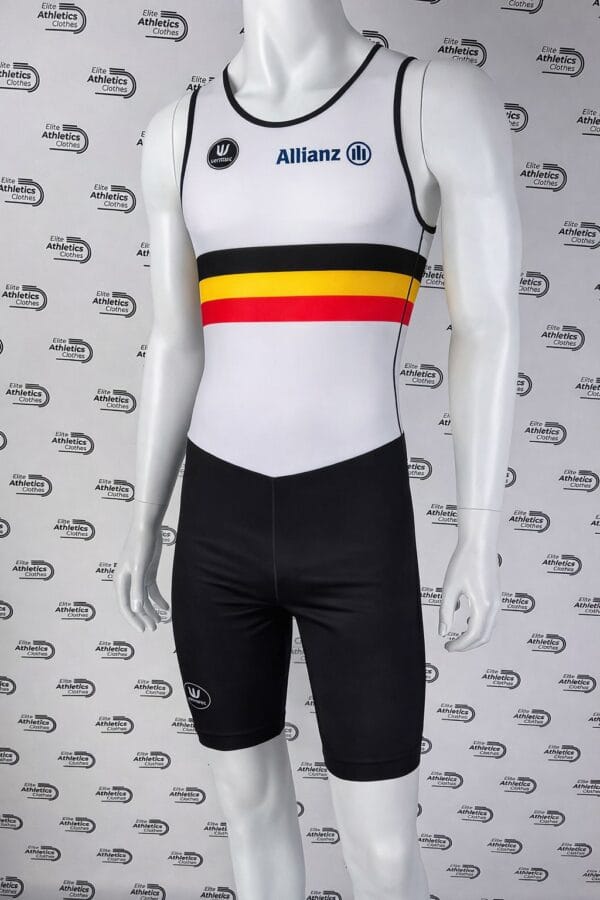 From this series · in the archiveVermarc Belgium Pro Elite 2024 SpeedsuitA race-issued one-piece in the archive — the single-garment logic in federation colours.150,00 €View piece →
The speedsuit is where athletics apparel does its open experimentation: every aerodynamic idea the sport has tried in the last four decades arrived wearing one.
Four decades of the one-piece
The modern lineage starts with Florence Griffith-Joyner, who from April 1988 raced in asymmetric one-piece suits of her own design — one leg to the ankle, the other cut away, a style she named the “one-legger” and said began as an accident with scissors and a mirror. At that July's US trials, in a purple one-legger, she ran the 100 m world record that still stands.
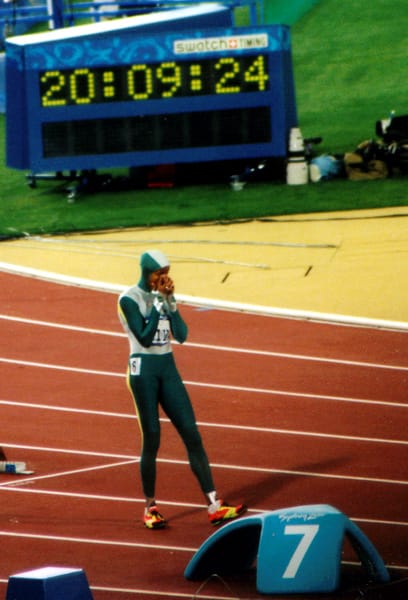
The scientific era arrived at Sydney 2000. Cathy Freeman won 400 m gold in the hooded Nike Swift Suit — nearly three years in development under designer Edward Harber, with aerodynamicists Len Brownlie and Chester Kyle wind-tunnel-testing fabrics on body-part-sized cylinders to choose a texture for each zone of the body. Harber's defence of the hood was simple: no speed skater would race without one. Freeman remains the only athlete to have worn it at an Olympics — the suit was revolutionary, and the hood never returned.
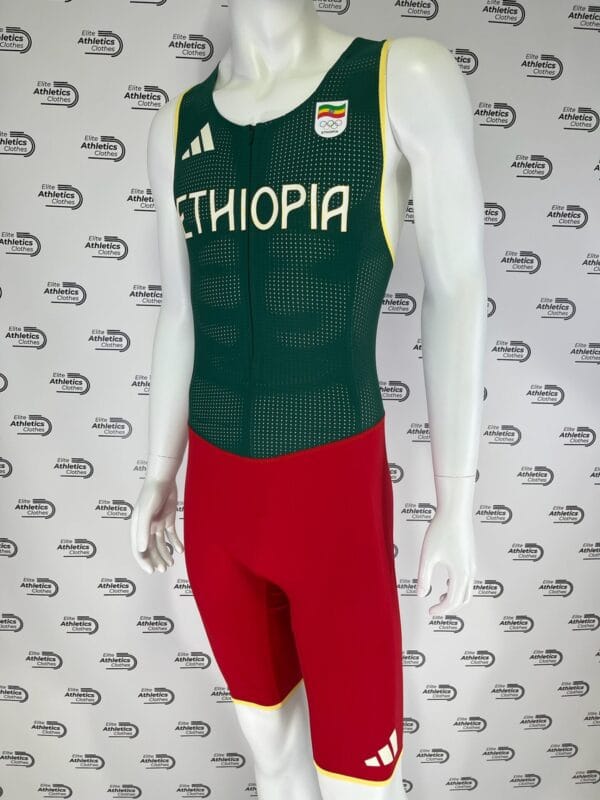 From this series · in the archiveAdidas Ethiopia Pro Elite 2024 OLY Sleeveless SpeedsuitAn Olympic-cycle sleeveless one-piece — the Swift Suit's descendant, minus the hood.Sold out · check back soonView piece →
Since then the experiments have kept coming in waves: London 2012's TurboSpeed borrowed golf-ball dimples, with Nike claiming up to 0.023 seconds saved over 100 m from more than a thousand hours of wind-tunnel work; Rio-era suits carried vortex generators embossed on tape patches; and Paris 2024 brought AeroSwift unitards with a finals-only motion-capture graphic. The claims always belong to the maker — but the suits keep getting made, and the sprinters keep choosing them.
How a speedsuit is built
A speedsuit is built less like clothing and more like a surface treatment for a moving body.
- One pieceSinglet and bottoms fused: no waistband interface, no hem meeting a hem, one continuous line from shoulder to mid-thigh.
- Zoned fabricsThe Swift program's signature — different fabrics and textures per body zone, each chosen in the wind tunnel for that segment's speed through the air.
- Surface textureDimples (TurboSpeed) and embossed vortex-generator patches (Rio era) — textures that manage airflow the way a golf ball's skin does.
- Compression fitCut skin-tight; the garment works only under tension, moulded to the individual athlete.
- The closureFitted entry with a short zip on some pro models — a quarter-zip appears on verified race-issued examples.
- Sleeveless normAthletics settled on the sleeveless cut; Freeman's full sleeves and hood remain a one-race chapter.
Nothing else in the archive concentrates as much documented engineering per gram of fabric.
Owning one
Owning a speedsuit is collecting at the sharp end; racing in one is a commitment.
- Fit is everythingA speedsuit works under tension: it should fit like a swimsuit two sizes into the future. If it hangs anywhere, it is too big.
- Race-day garmentOne-pieces are for the gun, not the warm-up — athletes cover them until the last minute and peel the layers at the blocks.
- Mind the rarityRuns are tiny and pro-issue only; a surfaced suit is usually the only size available, so buy the piece, not the plan.
- Check the cycleA suit belongs to one team cycle — crest, sponsor and cut date it precisely, which is exactly its value in an archive.
- Archive realityMost speedsuits here sell and never restock; sold-out pieces stay listed because the next one may take years to surface.
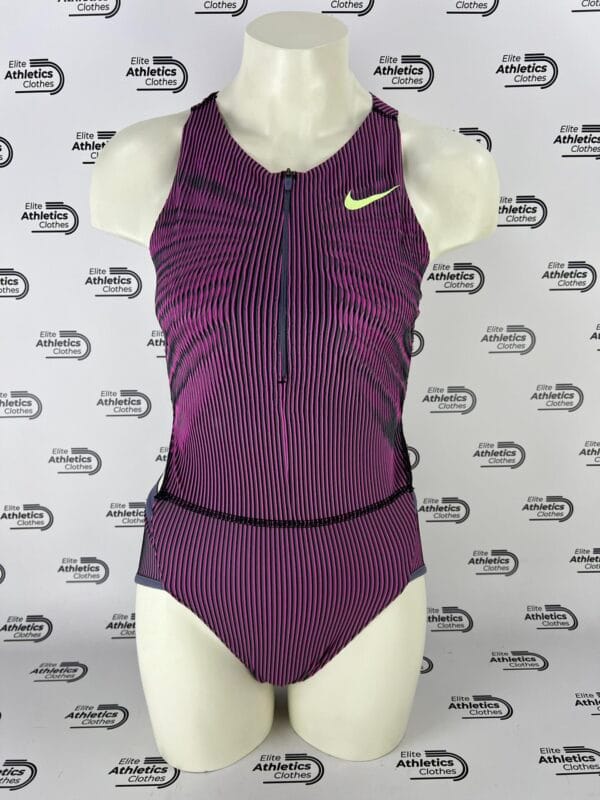 From this series · in the archiveNike Pro Elite 2024 Women SpeedsuitA women's one-piece from the archive — small runs, single sizes, rarely seen twice.Sold out · check back soonView piece →
If the singlet is the sport's standard-bearer, the speedsuit is its concept car — and occasionally, as in Sydney, the concept wins gold.
Speedsuits in the Archive
The rarest garment type we handle: race-issued one-piece suits from national squads and their brands, made in tiny pro-only runs. Most pieces here have sold and may never restock — they stay listed as the archive's record, and anything in stock is the exception.
Vermarc Belgium Pro Elite 2024 Speedsuit150,00 €View Piece →Adidas Ethiopia Pro Elite 2024 OLY Sleeveless SpeedsuitSold out · check back soonView Piece →Nike Pro Elite 2024 Women SpeedsuitSold out · check back soonView Piece → Adidas Pro Elite 2023 Women SpeedsuitSold out · check back soonView Piece →
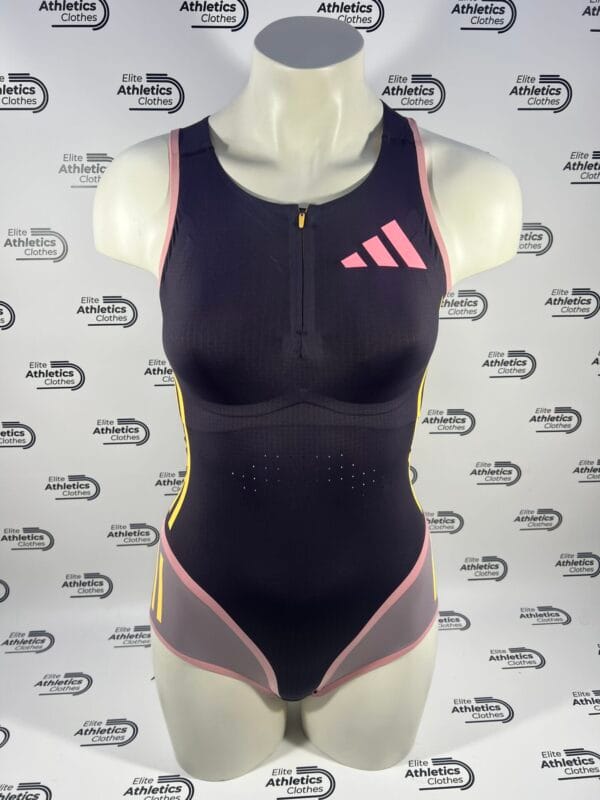 Adidas Pro Elite 2024 Women Sleeveless SpeedsuitSold out · check back soonView Piece →
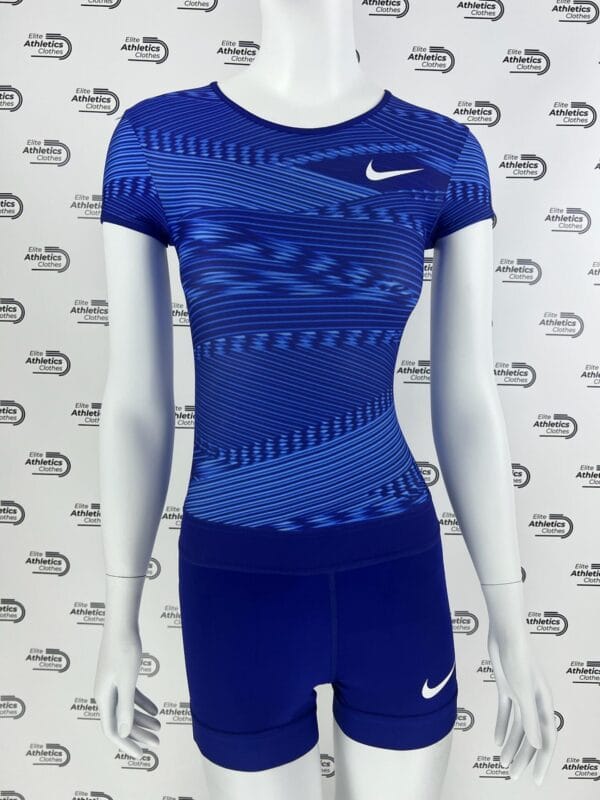 Nike 2019 Pro Elite Women Sleeves SpeedsuitSold out · check back soonView Piece →
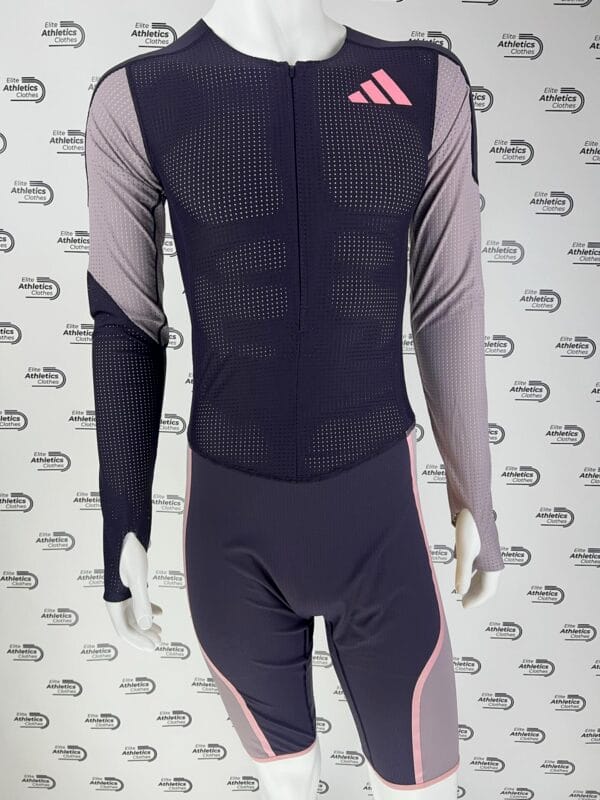 Adidas Pro Elite 2024 Long Sleeves SpeedsuitSold out · check back soonView Piece →
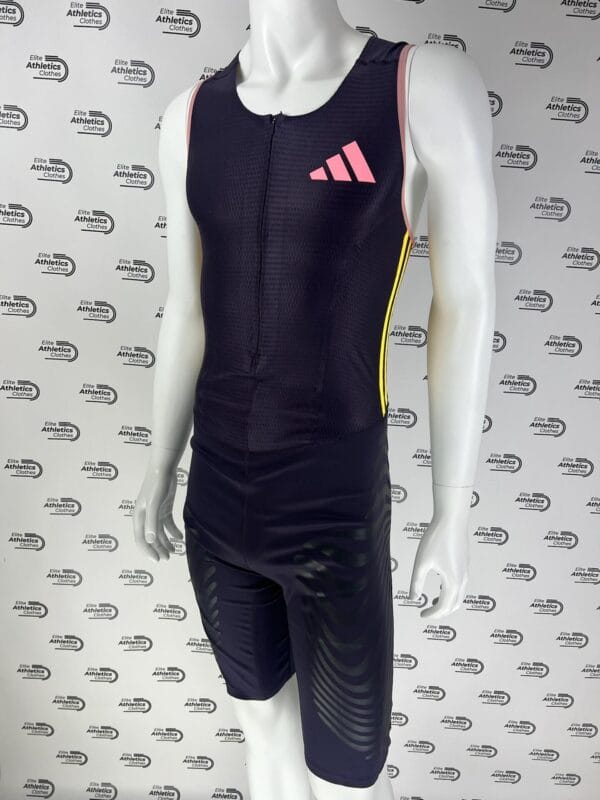 Adidas Pro Elite 2024 Rheon Sleeveless SpeedsuitSold out · check back soonView Piece →
What is a speedsuit in track and field?
A speedsuit is a fitted one-piece racing garment that replaces the singlet and shorts, worn mainly by sprinters, hurdlers and relay runners. It eliminates loose fabric and garment interfaces, and has been the test bed for most aerodynamic experiments in athletics apparel since the late 1980s.
Who wore the first famous speedsuit?
Florence Griffith-Joyner made the one-piece famous in 1988 with her self-designed “one-legger” suits. The first fully engineered speedsuit was the hooded Nike Swift Suit that Cathy Freeman wore to 400 m gold at Sydney 2000, developed over nearly three years with wind-tunnel-tested fabrics per body zone.
Do speedsuits actually make you faster?
The claims belong to the manufacturers: Nike said its 2012 TurboSpeed dimpled suit saved up to 0.023 seconds over 100 m in wind-tunnel testing versus its prior kit. Independent verification is scarce — what is certain is the fit benefit of a single garment with zero loose fabric.
Why are race-issued speedsuits so rare?
They are made in tiny runs for the athletes who race in them — Nike lists Pro Elite speedsuits as pro-athlete-only issue — and most never reach retail in any form. In a race-issued archive the one-piece is typically the scarcest garment type of all.
How should a speedsuit fit?
Skin-tight everywhere: the garment only works under tension. It should feel like a swimsuit a size or two smaller than instinct suggests, worn for the race itself rather than the warm-up.
Sources and References
- Olympics.com — Cathy Freeman's Sydney 2000 suit — the Swift Suit at the 400 m final
- myKhel — the story behind the Sydney Swift Suit — Harber, Brownlie, Kyle, zoned wind-tunnel fabrics
- WWD — Florence Griffith-Joyner's race outfits — the 1988 one-leggers
- New Atlas — Nike Pro TurboSpeed (2012) — dimples, 0.023 s claim, Project Swift